WORLD> Global General

|
WORLD> Global General
|
|
Related
Explorer sure of climate change after historic trek
By C. J. Holtzman (China Daily)
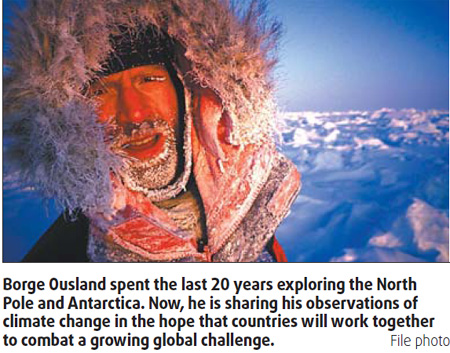
Updated: 2009-07-06 09:16 Over the past 20 years, Borge Ousland has traveled to the far reaches of the earth, crossing both the Arctic and Antarctica on solo explorations, driven by what the Norwegian calls the "old Viking spirit to see what is beyond the horizon".
He has also witnessed the widespread impacts of global warming first hand. "I'm not a politician. I'm not a scientist. I'm a polar explorer," said Ousland. "So when it comes to the global warming issue, I'm a rough diamond. But I've of course seen the changes and would like to express my concerns about global warming because these beautiful areas are disappearing, and it affects the whole world." Ousland made the first unsupported ski trek across 800 km from the Arctic coast to the North Pole in 1990 with two companions. In 1994, he completed a solo trek to the North Pole. He then decided to begin exploring professionally. In 1996, Ousland became the first person to cross Antarctica alone and without outside support. He then became the first person to cross the Arctic alone from Siberia to Canada over the North Pole in 2001. In 2006 he undertook one of his most difficult expeditions with fellow adventurer Mike Horn when both crossed from Cape Arktichesky to the North Pole in winter. In 2007, Ousland and Thomas Ulrich followed the path of explorers Fridtjof Nansen and Hjalmar Johansens from the North Pole through Franz Josef Land to Cape Flora while living off the land for three weeks. During the time Ousland has been visiting the Arctic, he has seen a 30 percent reduction in the thickness of the ice. "When I was there (in the Arctic) in 1990, the ice was thick. It was old ice. It's been there for years," said Ousland. "Now the young ice is all one or two winters old, so it is flatter, and it is more sharp and broken. It is a totally different type of ice. The thickness is only 1 or 2 m."
In sudden transformations, animal life is unable to adapt quickly enough to the changing environment, he said. "Animals that thrive in the water will benefit, but other animals, like the ring seal that is dependent on drifting ice to give birth to its cubs will be losers, and the polar bear will be a loser," said Ousland. During his expeditions Ousland noticed a change in polar bear behavior as it loses habitat. He says in areas where bears have enough food, they stay away or come toward him only because they are curious. Although they are dangerous anywhere, in areas with less food they are much more aggressive because many of them are living on only birds and seaweed. "It is very sad that this beautiful animal has become a symbol of global warming because when the ice melts, they don't have anywhere to go," said Ousland. "I don't think the summer ice on the North Pole will be there in 40 or 50 years. But I think we can stop it, or we can reduce the rate of global warming, but we have to do it now," he said. Ousland believes that the issue of global warming needs to be addressed with both politics and technology. Political agreements in upcoming world meetings will put pressure on countries to meet expectations, but technological advancements will also be needed to tackle environmental issues related to ongoing economic development. "I am surprised to come to China and see how modern it is and how much this country has been able to achieve in such a short period of time," said Ousland, who was on his first visit to China. "I think that China just needs one thing and that is to decide for themselves, and when they do this, I think they can turn this around very quickly. So I have great expectations for China, and I hope that they will take it seriously," he said. Working with countries including Norway, China has been striving to improve environmental technologies in anticipation of the Climate Conference in Copenhagen this December, when negotiators from 170 countries will discuss issues impacting global warming. "The world is standing together and that is the message I think people are hoping for," said Ousland. Although Norway and other smaller countries are doing what they can to combat growing environmental issues, Ousland knows it will be the larger countries like the United States and China that will make the biggest impact on reducing emissions. He said that the new president in the United States and China's increased focus on environmental issues could enable the giants to greatly help in the crisis, one he has observed personally. "There is absolutely no doubt the polar ocean is melting," said Ouland. "But it seems to me that people don't do anything until they see it themselves. That's a problem with the global warming issue. It's a sneaky disease." |