WORLD> America

|
WORLD> America
|
|
Vast expanses of Arctic ice melt in summer heat
(Agencies)
Updated: 2009-08-10 11:58
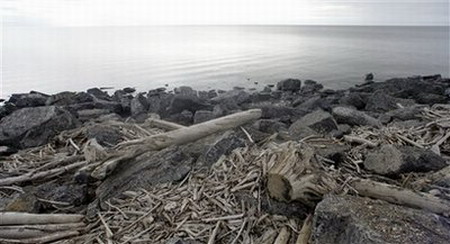
TUKTOYAKTUK, Northwest Territories: The Arctic Ocean has given up tens of thousands more square miles (square kilometers) of ice on Sunday in a relentless summer of melt, with scientists watching through satellite eyes for a possible record low polar ice cap. From the barren Arctic shore of this village in Canada's far northwest, 1,500 miles (2,414 kilometers) north of Seattle, veteran observer Eddie Gruben has seen the summer ice retreating more each decade as the world has warmed. By this weekend the ice edge lay some 80 miles (128 kilometers) at sea. "Forty years ago, it was 40 miles (64 kilometers) out," said Gruben, 89, patriarch of a local contracting business. Global average temperatures rose 1 degree Fahrenheit (0.6 degree Celsius) in the past century, but Arctic temperatures rose twice as much or even faster, almost certainly in good part because of manmade greenhouse gases, researchers say. In late July the mercury soared to almost 86 degrees Fahrenheit (30 degrees Celsius) in this settlement of 900 Inuvialuit, the name for western Arctic Eskimos.
As of Thursday, the US National Snow and Ice Data Center reported, the polar ice cap extended over 2.61 million square miles (6.75 million square kilometers) after having shrunk an average 41,000 square miles (106,000 square kilometers) a day in July -- equivalent to one Indiana or three Belgiums daily. The rate of melt was similar to that of July 2007, the year when the ice cap dwindled to a record low minimum extent of 1.7 million square miles (4.3 million square kilometers) in September. In its latest analysis, the Colorado-based NSIDC said Arctic atmospheric conditions this summer have been similar to those of the summer of 2007, including a high-pressure ridge that produced clear skies and strong melt in the Beaufort Sea, the arm of the Arctic Ocean off northern Alaska and northwestern Canada. In July, "we saw acceleration in loss of ice," the US center's Walt Meier told The Associated Press. In recent days the pace has slowed, making a record-breaking final minimum "less likely but still possible," he said. Scientists say the makeup of the frozen polar sea has shifted significantly the past few years, as thick multiyear ice has given way as the Arctic's dominant form to thin ice that comes and goes with each winter and summer. The past few years have "signaled a fundamental change in the character of the ice and the Arctic climate," Meier said. Ironically, the summer melts since 2007 appear to have allowed disintegrating but still thick multiyear ice to drift this year into the relatively narrow channels of the Northwest Passage, the east-west water route through Canada's Arctic islands. Usually impassable channels had been relatively ice-free the past two summers. "We need some warm temperatures with easterly or southeasterly winds to break up and move this ice to the north," Mark Schrader, skipper of the sailboat "Ocean Watch," e-mailed The Associated Press from the west entrance to the passage. The steel-hulled sailboat, with scientists joining it at stops along the way, is on a 25,000-mile (40,232-kilometer), foundation-financed circumnavigation of the Americas, to view and demonstrate the impact of climate change on the continents' environments. Environmentalists worry, for example, that the ice-dependent polar bear will struggle to survive as the Arctic cap melts. Schrader reported seeing only one bear, an animal chased from the Arctic shore of Barrow, Alaska, that "swam close to Ocean Watch on its way out to sea." Observation satellites' remote sensors will tell researchers in September whether the polar cap diminished this summer to its smallest size on record. Then the sun will begin to slip below the horizon for several months, and temperatures plunging in the polar darkness will freeze the surface of the sea again, leaving this and other Arctic coastlines in the grip of ice. Most of the sea ice will be new, thinner and weaker annual formations, however. At a global conference last March in Copenhagen, scientists declared that climate change is occurring faster than had been anticipated, citing the fast-dying Arctic cap as one example. A month later, the US National Oceanic and Atmospheric Administration predicted Arctic summers could be almost ice-free within 30 years, not at the century's end as earlier predicted. |