WORLD> Asia-Pacific

|
WORLD> Asia-Pacific
|
|
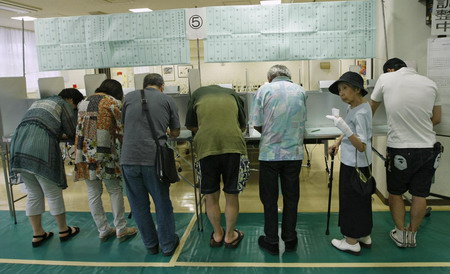
Japanese express mixed feelings on election day
(Xinhua)
Updated: 2009-08-30 15:42 TOKYO: On an overcast and sticky summer day in the Japanese capital, voters headed to the polls in what will likely turn out to be an election that changes the political landscape of the nation for years to come.
As citizens headed to polling stations, however, while most fully expected the Democratic Party of Japan (DPJ) and its leader Yukio Hatoyama to win in a landslide few were willing to give him more than a frosty reception. "The task of changing this country is a huge and complex one," said Kaori Suzuki, a 40-year-old housewife. "While I think there is need for change, particularly in the way the nation is governed, what the DPJ is going to try and do seems risky. I do hope they can manage it though, because I think a lot of the changes they make will be for the better." Others were not as kind. "Unfortunately, I think the DPJ will definitely win," said a woman who refused to give her name. "While I am not a supporter of the Liberal Democratic Party (LDP) by any means, I don't think that Hatoyama has the skills needed to be prime minister. He has already started to cause problems in international relations with the things he has said about changing Japan's relationship with America. I am very worried."
"Prime Minister Taro Aso has not been given enough time to put his plan into place. He has only served for one year. If we give him more time, I think his plans may work. Since Koizumi left office, there has been too much change in Japan. What we need is continuity, so that a leader can implement their policies in full, not another new prime minister," said Tetsuya Okamoto, who is in his forties. Meanwhile, Junichiro Saito, a man in his sixties, said that he knew Hatoyama was likely to win the election but he didn't care. "All I want - whoever wins -is for them to fix the mess we are in. Young people don't stand a chance if things stay as they are." Many young people were, however, excited at the prospect of seeing the DPJ elected because of its policies concerning social welfare, and in particular, planned benefits to be given for young mothers. The party has promised to pay a child-rearing allowance for all children until they finish junior high school and to make high school tuition effectively free and universities more inclusive. "If they manage to implement these policies, I will be much more comfortable having children," said Kaori Yoshida, a woman in her twenties. For some, however, neither the DPJ nor the LDP offer any hope. "I will be lodging a protest vote with one of the smaller parties," said Ai Matsuoka, 36. "Both the LDP and DPJ get their politicians from the upper classes. While I am not poor, I am certainly not as wealthy as the people in these parties. I feel no connection with them whatsoever and never intend to lend my support to them." The lower-house election is the first since 2005, when the LDP, under the leadership of Junichiro Koizumi, won in a landslide as the public voiced its support for a number of proposed reforms - notably, the privatization of Japan's postal service. Since then, however, the public has become disillusioned with the ruling party as a series of scandals and gaffes by politicians have led to anger and a desire for change. In 2007, the DPJ gained control of the upper house, and it now hopes to take full control as pundits, media surveys and the public all predict a strong victory for the party and a crushing defeat for the LDP. |