WORLD> Asia-Pacific

|
WORLD> Asia-Pacific
|
|
Passports linked to 9/11 found along Afghan border
(Agencies)
Updated: 2009-10-30 15:39 SHERWANGAI, Pakistan: Pakistani soldiers battling their way into a Taliban stronghold along the Afghan border have seized passports that may be linked to 9/11 suspects, as they confront an enemy skilled in operating in a mountainous terrain with endless ways to wage a guerrilla war.
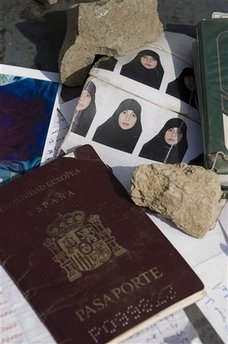
Soldiers displayed passports seized in the operation, among them a German document belonging to a man named Said Bahaji. That matches the name of a man thought to have been a member of the Hamburg cell that conceived the 9/11 attacks. Bahaji is believed to have fled Germany shortly before the attacks in New York and Washington. The passport included a tourist visa for Pakistan and a stamp indicating he'd arrived in the southern city of Karachi on Sept. 4, 2001. Another passport, from Spain, bears the name of Raquel Burgos Garcia. Spanish media have reported that a woman with the same name is married to Amer Azizi, an alleged al-Qaida member from Morocco suspected in both the 9/11 attacks and the Madrid train bombings in 2004. Her family in Madrid has had no news of her since 2001, according to Spanish media. Her passport included visas to India and Iran, and the army displayed a Moroccan document with Burgos Garcia's photo and other information. It was impossible to determine whether the passports are genuine, and German and Spanish officials did not immediately respond to requests for comment. Maj. Gen. Athar Abbas, the army's chief spokesman, said he had not realized the passports matched any prominent names, and declined further comment other than to say European militants were sprinkled throughout the area.
US Secretary of State Hillary Rodham Clinton, visiting this country on Thursday, said Pakistan squandered opportunities over the years to kill or capture al-Qaida leaders responsible for the Sept. 11 attacks. "I find it hard to believe that nobody in your government knows where they are and couldn't get them if they really wanted to," Clinton said in an interview with Pakistani journalists in Lahore. "Maybe that's the case. Maybe they're not gettable. I don't know." Although the military spent months using airstrikes to soften up targets in South Waziristan, nearly two weeks into the ground offensive it has captured only a few areas, none with significant strategic value. The army has seized weapons but is still trying to secure the main roads and regularly comes under rocket fire. "It's a long-drawn haul," Abbas said. "They are offering resistance, and we are also striking them hard." Pakistan's tribal belt, a semiautonomous stretch of land where the government has long had little influence, is usually off-limits to foreigners. In recent years, as the militants' influence has spread, even many Pakistanis dare not venture here. The tribal regions are some of the poorest, most underdeveloped areas in the world and have long been guided by traditional codes and councils. The Taliban have slaughtered hundreds of tribal elders in their rise to power. In Sherwangai, a sparsely populated district along one of the offensive's three major fronts, army commanders said they had killed 82 insurgents and lost six soldiers in their attempt to secure the area, where the hills are covered in brush, rocks and dust and strong winds whip high ridges. Many battle-hardened Uzbek militants are believed to have taken shelter here. The military is slowly capturing isolated hamlets as it encircles the small town of Kaniguram, its next target in the push forward. But even where the army has taken control, much of the area remains dangerous, filled with land mines and roadside bombs. After an initial surge of resistance, many militants have been fleeing. Because the army has sealed off the main passes, "they will not be able to go out in a major way," said Maj. Gen. Khalid Rabbani, a top battlefield commander. Yet, he added, "If somebody chooses even to cross Mount Everest, he will be able to do it. So there are going to be a few, changing their disguise — taking care of their beards and long hair — they will be able to get out." In addition to the passports, the military displayed papers and dozens of weapons and large amounts of ammunition it said it had recovered from Sherwangai. Civilians were nowhere to be seen during Thursday's trip — some 155,000 have left the region in the past few months. South Waziristan normally has about 500,000 people. At one military outpost, in a large mud compound in Sherwangai, smoke could be seen rising in the distance from villages under army fire. Officials assured reporters the civilians had left those areas. The military previously estimated that the South Waziristan offensive would take at least two to three months, and officials were hesitant Thursday to give a deadline. They also declined to give a time frame for how long troops would have to stay to prevent militants from returning. It also is unclear whether Islamabad has any plans for how to govern the territory effectively and prevent the insurgency from again taking root. The army has deployed three divisions — about 30,000 troops — to take on some 5,000 to 8,000 militants, Abbas said, lowering a previous estimate of 10,000 militants. His estimate included up to 1,500 foreign fighters, most of them Uzbeks. Afghan fighters are also reportedly filtering in from across the border. This is the fourth major offensive the Pakistani army has launched in South Waziristan since 2004, and this time the military has promised a fight to the finish. The previous operations ended in setbacks or peace deals that left the militant groups even stronger. |
||||||||