Africans boycott meetings at UN climate talks


|
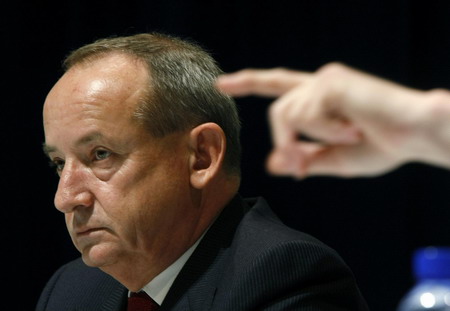 Head of the U.N. Climate Change Secretariat Yvo de Boer attends a news conference during the Barcelona Climate Change Talks, November 2, 2009. [Agencies] |
BARCELONA, Spain: African countries boycotted meetings at U.N. climate talks Tuesday, saying that industrial countries had set carbon-cutting targets too low for reducing global greenhouse gas emissions.
The action forced several technical meetings to be canceled at this week's U.N. climate talks in Barcelona. Delegates warned that, unless the African protest was settled, it could set back the timetable for concluding a new climate change pact at a major U.N. conference next month in Copenhagen.
The 50 or so African countries said they would only discuss pledges submitted by wealthy countries, and that talks on other issues including carbon offsets and action by developing countries should not move forward until there is full commitment by industrial countries.


It was the first time the Africans have taken such concerted action at the U.N. climate talks, but they have been coordinating their position over the past year to ensure unity in the final lead-up to the Copenhagen conference, said Antonio Hill, of Oxfam International.
Scientists say industrial countries should reduce emissions by 25 to 40 percent from 1990 levels by 2020, but targets announced so far amount to far less than the minimum.
The African walkout stymied only part of the talks, which operate in two parallel bodies. Negotiations on the overall shape of a deal and on financing for poor countries continued uninterrupted.
European delegates met leaders of the African group for two hours, but failed to persuade them to return to the committee rooms. A broader meeting was called to try to break the impasse.
Anders Turresson, the chief delegate from Sweden which holds the EU presidency, said that while EU leaders shared the Africans' concern about the low level of pledges, their tactic of limiting the discussion to emission targets was unproductive.
"I wouldn't call this situation a full deadlock," he said.
The larger group of more than 130 developing countries backed the African group's action, meant "to focus the mind" of the developed countries on the most important issue, said Sudanese Ambassador Lumumba De-Aping. He also indicated that walking out was a tactic often used in the negotiating process, and did not necessarily spell doom for the talks.
Climate Network Africa, a Kenya-based nongovernmental group, accused industrialized countries of not negotiating in good faith while Africans suffer from drought and floods.
Africa is seeking higher commitments "because we are under pressure, but the response (from developed countries) is that it is politically and economically difficult for them to put numbers on the table," said the group's director, Grace Akumu. "For us it is a question of life and death."
A landmark 2007 U.N. report based on the work of about 2,000 scientists predicted Africa would suffer the most from drought, agricultural damage, rising sea levels threatening coastal areas and the spread of tropical pests and diseases.
A new study published Tuesday says the glaciers on Africa's highest mountain, Kilimanjaro, have lost 85 percent of the ice they had in 1912, with more than a quarter present in 2000 gone by 2007.
The study, in the Proceedings of the National Academy of Sciences, cited Earth's rising temperatures as at least a partial cause. It said similar changes have occurred at Mount Kenya and the Rwenzori Mountains in Africa, as well as at glaciers in South America and the Himalayas.