China
China develops herbal medication to treat A/H1N1 flu
(Xinhua)
Updated: 2009-12-17 19:47
 |
Large Medium Small |
BEIJING: Chinese medical specialists announced Thursday they had developed a Chinese herbal medication to treat the A/H1N1 flu.
Seven months of scientific and clinical studies showed the remedy, called "Jin Hua Qing Gan Fang," was effective in treating A/H1N1 flu patients, said Wang Chen, president of Beijing's Chaoyang Hospital.
"It can shorten patients' fever period and improve their respiratory systems. Doctors have found no negative effects on patients who were treated in this way," he said.
"It is also very cheap, only about a quarter of the cost of Tamiflu," he said at a press conference held by the Beijing Municipal Government.
|
 |
|
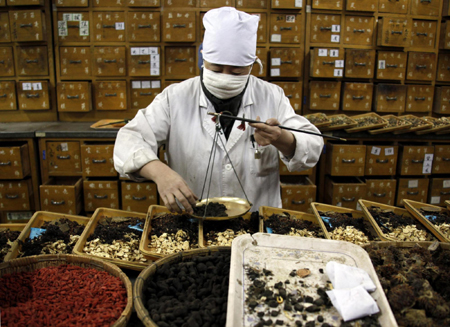
A worker in the herbal medicine department of the Beijing University Hospital of Chinese Medicine, weighs and then mixes herbs for packaging December 17, 2009.[Agencies]? |
Tamiflu, a product of Swiss drugmaker Roche Holding, was recommended by the World Health Organization (WHO) for the treatment of the A/H1N1 flu.
"The municipal government has gathered the most outstanding medical experts in the Chinese capital to develop the new medication," Zhao Jing, director of the Beijing Municipal Administration of Traditional Chinese Medicine, said at the press conference.
Over the past seven months, more than 120 medical specialists, led by academicians Wang Yongyan and Li Lianda from the Chinese Academy of Engineering, had participated in the research, she said.
The municipal government earmarked 10 million yuan (US$1.47 million) for the project, she said.
"Medical experts proved the effectiveness of Jin Hua in treating A/H1N1 flu from both the basic scientific studies and clinical studies," she said.
|


"In vivo and in vitro, experiments on mice and rabbits show Jin Hua can bring down a fever and resist the A/H1N1 flu virus," said Huang Luqi, vice president of the China Academy of Chinese Medical Sciences.
Thursday's Beijing Daily hailed the new herbal medication as the "world's first traditional Chinese medicine to treat the A/H1N1 flu".
Citing medical officials, the paper said "Jin Hua" was picked from among more than 100 classic anti-flu prescriptions based on traditional Chinese herbal medicine.
"Science workers proved its effectiveness through medical experiments on more than 4,000 mice and clinical studies on 410 patients with slight A/H1N1 flu syndrome," it said.
The "Jin Hua" prescription had been adopted in many local traditional Chinese medicine hospitals, it said.
Zhao Jing said 11 hospitals nationwide, including Chaoyang Hospital and Ditan Hospital in Beijing, had conducted clinical studies on "Jin Hua" and gave positive assessments.
"We are applying for patents for 'Jin Hua' both at home and abroad," she said.
"We are further developing the medicine and trying to present it to the whole country and world as soon as possible, thus offering an alternative to treat the A/H1N1 flu," she said.
The Chinese mainland has reported almost 108,000 A/H1N1 flu cases, including 442 deaths, according to the Ministry of Health.
 |
|
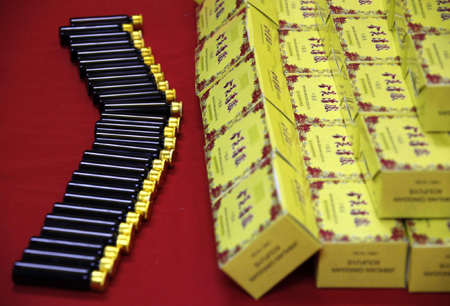
Packets and vials of a Chinese herbal medicine claiming to alleviate the symptoms of H1N1 influenza, also known as swine flu, can be seen on display at the official launch in Beijing December 17, 2009.[Agencies] |
Dr. Cris Tunon, senior program management officer at the WHO Representative Office in China, said Thursday the "WHO welcomes the clinical results," as the traditional Chinese medicine offered a low-cost treatment of A/H1N1 flu.