Asia-Pacific
Japan seeks to come clean from secret nuke deal
(Agencies)
Updated: 2010-01-11 11:02
 |
Large Medium Small |
|
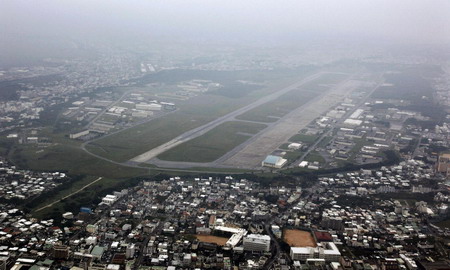 An aerial view shows US Marine's Futenma air station between the urban area in Ginowan, southern Japanese island of Okinawa, October 13, 2009. [Agencies] |
TOKYO: To the government's critics, it was a long and shocking act of official stonewalling: Agreements long hidden in Foreign Ministry files allowed nuclear-armed US warships to enter Japanese ports, violating a hallowed principle of postwar Japan. Yet their very existence was officially denied.
Now, in a clear break from the past, a new prime minister has gone where none of his predecessors dared go: He has ordered a panel of ministry officials and academics to investigate the secret agreements.


They also could intensify public debate about the future of Japan's long-standing security alliance with the US, which has bases here. Hatoyama, a liberal who took office in September, has called for making the relationship more balanced, starting with efforts to evict an unpopular US base from the island of Okinawa.
That Japan agreed to let nuclear-armed ships enter its ports and waters ceased to be a secret some years ago with the declassification of American documents. Such ships had routinely docked in various Japanese ports since the 1960s, sometimes setting off protests.
But in a nation where memories of Hiroshima and Nagasaki drive a fierce aversion to nuclear weapons, a formal admission of the secret agreements would be a stunning reversal, and confirm that previous governments systematically lied to the public.
"The Foreign Ministry repeatedly denied their existence, even in statements before Parliament," lawmaker Muneo Suzuki said in an interview with The Associated Press.
Suzuki held top political posts at the Foreign Ministry, yet although he had heard about the secret documents, he said that even he could not pry them out of his officials.
"The Foreign Ministry should be held deeply accountable," said Suzuki, who has switched sides and is now a member of Hatoyama's coalition.
Historical accounts show that Prime Minister Masayoshi Ohira, who died in office in 1980, considered going public on the secret pacts, but was advised against it by his aides as politically too dangerous.
Only a few Foreign Ministry bureaucrats have spoken out in recent years.
One, Kazuhiko Togo, said he and other high-ranking officials kept quiet for fear that disclosure of the agreements would trigger riots and perhaps topple the prime minister.
"The political costs were too great," Togo told the AP.
Even after American officials acknowledged the pacts in the 1990s, leaders of the long-ruling Liberal Democratic Party persistently denied them, right up to Taro Aso, the last LDP prime minister before Hatoyama's Democrats took over.
"They did not exist," Aso said in a nationally televised response to a reporter's question last July.
"It all goes to show how far behind Japan is in administrative transparency," said Koichi Nakano, professor of political science at Sophia University in Tokyo.
Even the name of revered Eisaku Sato, the prime minister viewed as the architect of Japan's postwar pacifism and resistance to nuclear weapons, has been thrust into the debate.
Three weeks ago, Sato's son revealed a document he found in Sato's desk after his death in 1975 and which he kept hidden.
The 1969 document, signed by Sato and President Richard Nixon, showed they agreed that US-occupied Okinawa would be returned to Japan, but the US would retain the right to have nuclear weapons on the island if the necessity arose. The agreements on Okinawa were a key part of the secret pacts that also covered US warships entering ports throughout Japan.
Back then, it was the height of the Cold War, and the US felt it needed a free hand to confront nuclear-armed Soviet Union.
|
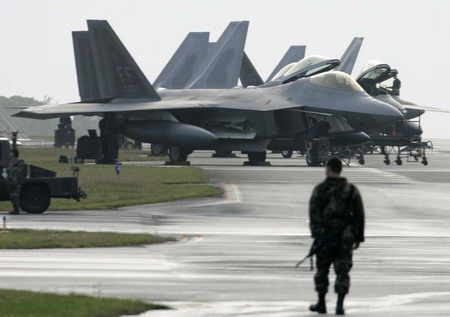 In this undated file photo, more than a dozen US military bases are dotted over Okinawa. [Agencies] |