Asia-Pacific
Obama hits Wall Street, pushes for bank limits
(China Daily)
Updated: 2010-01-22 10:02
 |
Large Medium Small |
WASHINGTON: Embracing Depression-era policy and populist politics, a combative President Barack Obama chastised big Wall Street banks Thursday and urgently called for limits on their size and investments to stave off a new economic meltdown.
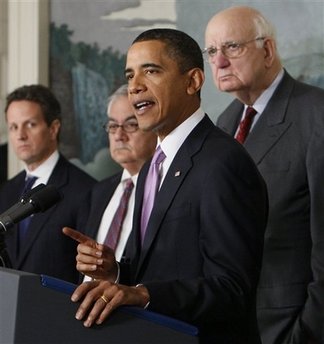 US President Barack Obama speaks about tougher regulations on banks that would limit the size and complexity of large financial institutions, Thursday, January 21, 2010, at the White House in Washington. [Agencies] |
Investors responded by dumping bank stock.
Obama's rhetoric covered the whole financial industry, but the key changes will affect only a few high-profile players, including JPMorgan Chase & Co., while sparing investment banks like Goldman Sachs Group Inc. The move could undercut Treasury Secretary Timothy Geithner's strategy of maintaining close ties with the financial industry as part of the administration's overhaul efforts.
"We have to get this done," Obama said at the White House. "If these folks want a fight, it's a fight I'm ready to have."
"We've come through a terrible crisis," the president said, pivoting the White House focus from health care to an economy that has been slow to recover during his first year in office. "The American people have paid a very high price. ... That's why we're going to rein in the excess and abuse that nearly brought down our financial system."


Obama's announcement included changes that have been advocated for over a year by former Federal Reserve Chairman Paul Volcker — who appeared with the president at the White House — particularly by endorsing Volcker's proposal to ban banks that take deposits from also trading stocks for their own profit. The change would separate commercial banks from investment banks, a line that was blurred a decade ago by the repeal of the Depression-era Glass-Steagall Act.
That won't help, suggested Rob Nichols, president of the Financial Services Forum, an industry group representing 18 of the largest financial companies.
"Proposals to preemptively break up large, well-managed and well-capitalized banking companies — or to reimpose Glass-Steagall restrictions — are based on a misdiagnosis of the causes of the financial crisis," he said.
Neither the president's proposal, which would need congressional approval to take effect, nor his aggressive tone is likely to help the administration's case in working with Wall Street and finding support from banks that will need to boost lending to support an economic recovery.
Geithner has worked closely with bankers since coming into office, especially when designing proposals to overhaul financial regulation. Many banks have responded by supporting administration plans publicly and offering their assistance behind the scenes.
Thursday changed that.
Bank representatives usually give input on such issues and are briefed on decisions. But that apparently wasn't the case this week, though officials said the administration still values bankers' opinions.
Said White House press secretary Robert Gibbs: "I'll let them decide where they come down on this proposal. I'll let them decide where they come down on whether taxpayers should be paid back for what they lend."
The administration also would change an existing cap that limits a bank from holding more than 10 percent of the deposits insured by the Federal Deposit Insurance Corp. It was unclear how many banks the change would affect, but they would include Bank of America Corp., JPMorgan Chase & Co. and Citigroup Inc.
But not big banks. Investment banks Goldman Sachs Group Inc. and Morgan Stanley don't take consumer deposits. They became banking companies during the financial crisis, to gain access to discount loans from the Federal Reserve.
Now that the financial system has stabilized, there is nothing keeping them from becoming non-banks without changing their businesses.
Financial industry officials are especially frustrated by a proposed change they see as political and punitive without doing anything to prevent future crises. They say the changes would not have prevented the largest bank failures of the crisis.
American International Group Inc. was an insurance conglomerate, and did not have consumer deposits. Washington Mutual and Wachovia failed because of unsound lending, not speculation and for-profit trading.
Obama has tried to sell his financial changes in part by saying they would end the era of "too big to fail" and prevent future Wall Street bailouts. But Thursday's move highlighted an uncomfortable fact: The administration's proposed overhaul would provide government assistance for large, failing institutions.
Behind the public pronouncements, a gap is emerging between administration officials focusing on voters who are angry at banks and others such as Geithner who have courted them as partners in economic recovery.
White House officials acknowledged they did not give a heads-up before the announcement despite a private dinner Wednesday night with bank CEOs, Geithner and White House senior adviser Valerie Jarrett. That left bankers fuming in private and sharing annoyance in public.
An open fight with the banks might help Obama, which has called bankers "fat cats" and proposed a fee on large banks to cover shortfalls in Treasury's $700 billion financial rescue fund.
But it highlights the political costs of being represented by Geithner, who helped engineer the bailouts before Obama came into office.
Bankers helped elect Geithner to his last job: president of the Federal Reserve Bank of New York. They enjoyed cordial relations with him as the Obama administration rolled out its proposed overhaul of the financial system, but lately have questioned whether he truly speaks for the White House.