Asia-Pacific
US base feud eats into Hatoyama ratings
(China Daily)
Updated: 2010-01-30 09:44
 |
Large Medium Small |
Slipping support threatens economic growth, share prices
TOKYO: A feud over plans to relocate a US military base on Japan's Okinawa island as part of a reorganization of US forces is contributing to a fall in Prime Minister Yukio Hatoyama's ratings ahead of a mid-year election.
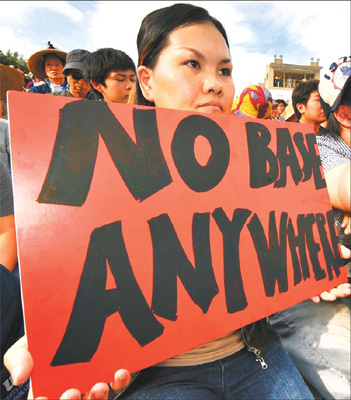 People stage a rally against the US military base in Ginowan, Okinawa Prefecture recently. The rally has raised the heat in a simmering row between the two countries ahead of a visit by US President Barack Obama to Tokyo. [Agencies] |
The slipping support could threaten the ruling Democratic Party's prospects in an upper house election expected in July that the party needs to win to avoid policy deadlock.
The fuss could distract from efforts to craft mid-term plans to boost economic growth, which would weigh on Japanese share prices, and to rein in Japan's massive public debt, which might push up yields.


The concentration of US bases on Okinawa, a major US military forward logistics base strategically located in the western Pacific close to Taiwan and the Korean peninsula, is a legacy of America's occupation of the island from 1945 to 1972.
Many locals associate the bases with crime, noise, pollution and accidents, and outrage flares periodically most strikingly after the 1995 rape of a schoolgirl by three US servicemen.
As part of a 1996 pact to reduce the US military presence, the US and Japan agreed to close Futenma Air Station, home to about 4,000 Marines and located in crowded Ginowan City, within seven years if a replacement could be found in Okinawa.
An initial plan for an offshore facility in northern Okinawa was opposed by locals and environmentalists. The current plan, agreed on in 2006, is for relocation to the city of Nago where it would be partly built within another base and on reclaimed land.
But the new mayor of Nago is dead set against the plan.
The issue is much broader. Washington and Tokyo agreed in 2006 on a "road map" to transform the decades-old alliance, the pillar of Japan's post-World War Il security policies.
Part of a US effort to make its military more flexible globally. The realignment fitted efforts by Japan's then-ruling Liberal Democratic Party (LDP) to shed the constraints of its pacifist constitution and assume a higher security profile.
Central to the pact was a plan to reorganize US troops in Japan, including a shift of about 8,000 Marines by 2014 to the US territory of Guam from Okinawa. The Marines' move, however, depends on finding a replacement site for Futenma.
Hatoyama's Democratic Party, which took power in September, promised in the campaign leading up to its election victory that it would review the realignment pact as well as the Status of Forces Agreement (SOFA) governing the US military in Japan.
Hatoyama said moving Futenma's functions off Okinawa was best, and his two small coalition allies want him to stick to that stance. His room to manoeuvre narrowed further after an anti-base candidate won a local election on Okinawa on Sunday.
He has pledged to decide on the matter by the end of May, ahead of a possible meeting with US President Barack Obama.
Anxiety is exacerbated by questions about the overall future of the five-decade-old US-Japan alliance as both face the challenge of China's rising economic and military might.
New frontier for growth
Japan must look to Asia as its new "frontier" for growth, Prime Minister Yukio Hatoyama said Friday, also pledging continued close ties with the US despite a dispute over a military base.
Hatoyama's center-left government took power four months ago, ending more than half a century of conservative rule and promising to work towards the long-term goal of an East Asian community modelled on the European Union.
"Asia is the frontier that Japan should explore as the arena of our actions in the world economy," Hatoyama told parliament in a key policy speech.
"We shall share prosperity together. This should create new demand in the region and contribute to sustained economic growth."
Japan is slowly recovering from its worst post-war recession, helped in large part by demand for its exports from booming China, which is expected to overtake it soon as the world's number two economy.
The premier said Tokyo will share its technology, such as electric smart grids, mass transport systems and IT technology, with Asia while trying to attract more tourists from the region to the island-nation.
Despite his vision of stronger ties with Asia, Hatoyama also stressed that the US remains Japan's indispensable ally.
Reuters