Global General
Chechen militant claims Moscow subway blasts
(Agencies)
Updated: 2010-04-01 06:33
 |
Large Medium Small |
MAKHACHKALA, Russia – A Chechen militant claimed responsibility for the deadly attacks on the Moscow subway in an Internet message posted Wednesday, hours after two more suicide bombers struck southern Russia in brazen defiance of Prime Minister Vladimir Putin.
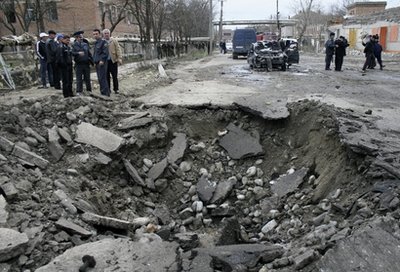 Investigators stand at a site of an explosion in Kizlyar, a town in southern Russian region of Dagestan, Wednesday, March 31, 2010. Two suicide bombers including one impersonating a police officer killed several people and injured many others in the southern Russian province of Dagestan on Wednesday, officials said. [Agencies]? |
Doku Umarov, who leads Islamic militants in Chechnya and other regions in Russia's North Caucasus, said in a video posted on a pro-rebel Web site that Monday's twin suicide attacks were revenge for the killing of civilians by Russian security forces.
Umarov's statement appeared after Putin vowed to "drag out of the sewer" the terrorists who plotted the subway bombings, which killed 39 people and wounded scores of commuters during the morning rush hour.
Wednesday's suicide bombings in Dagestan, a volatile southern province east of Chechnya, could have been planned by the same group behind the Moscow bombings, Putin said.
"I don't rule out that this is one and the same gang," he said at a televised Cabinet meeting. President Dmitry Medvedev later called the attacks "links of the same chain."
| ||||


Umarov blamed ordinary Russians for turning a blind eye to the killing of civilians in the Caucasus by security forces and warned of more attacks.
"I promise you that the war will come to your streets and you will feel it in your lives, feel it on your own skin," Umarov, dressed in fatigues, said in a video posted on kavkazcenter.com, a Web site that rebels use to air their statements.
There was no way to substantiate Umarov's claim, and officials at Russian law enforcement agencies refused to comment on Umarov's claim. The Russian security chief has previously said the subway bombings were carried out by militants from the Caucasus.
Umarov had previously warned that "if Russians think that the war is happening only on television, somewhere far away in the Caucasus where it can't reach them, then we are going to show them that this war will return to their homes."
The 45-year-old Umarov fought Russian forces in both separatist wars in Chechnya over the last 15 years. He took over the leadership of the rebel movement in 2006 following the killing by Russian forces of Abdul-Khalim Sadulayev. Umarov's importance further increased that year after Shamil Basayev, the most feared of the rebels, was killed by security forces. Basayev was accused of — or claimed responsibility for — terrorist attacks on Russia during its wars in Chechnya, including the hostage-taking raid on a school in the town of Beslan in 2004.
Moscow police have been on high alert since the subway attacks, increasing roadblocks on highways into the city. The police chief said thousands of officers have been sent to patrol the subway, check on migrants from southern provinces and inspect warehouses that could hold arms caches.
The militants face logistical challenges in carrying out bombings in Russia's northern cities, since they would need to transport explosives from southern bases and then store them. Natives of the North Caucasus, who tend to have darker hair and complexions, stand out in cities like Moscow and are more likely to draw police attention.
In Wednesday's violence, a suicide bomber in a car detonated explosives when police tried to stop it in the town of Kizlyar near Dagestan's border with Chechnya, Interior Minister Rashid Nurgaliyev said.
"Traffic police followed the car and almost caught up — but then the blast hit," he said.
As investigators and residents gathered, a second bomber wearing a police uniform approached and set off explosives, killing Kizlyar's police chief among others, Nurgaliyev said.
In addition to the dead, at least 23 people were wounded, authorities said. Windows were blown out and bricks tumbled down at a school and a police station nearby.
Grainy cell phone video posted on the life.ru news portal showed the moment of the second blast, with officials wandering past a destroyed building before a loud clap rang out and smoke rose in the distance. Television footage showed a few gutted cars, damaged buildings and a six-foot-deep (two-meter-deep) crater in the road.
The North Caucasus have been destabilized by near-daily bombings and other raids by Islamic militants.
Police and security services are a frequent target because they represent the Kremlin — the militants' ideological enemy — but also because of their heavy-handed tactics. Police have been accused of involvement in many killings, kidnappings and beatings in the North Caucasus, angering residents and swelling the ranks of Islamic militants.
Police recently killed several high-profile militant leaders, including one known for training suicide bombers.
A report by the Center for Strategic and International Studies said 916 people died in the North Caucasus in 2009 in violence related to the clashes, up from 586 in 2008. Another monitoring group, the Caucasian Knot, reported the region had 172 terrorist attacks last year, killing 280 people in Chechnya, 319 in Ingushetia and 263 in Dagestan.
In January in Makhachkala, Dagestan's capital, a suicide bomber blew up a car at a police station, killing six officers. In August, 24 people died and more than 200 were injured when a man crashed a bomb-laden van into the police station in Nazran, Ingushetia.
The bloodshed has continued despite Kremlin efforts to stem it. Medvedev, who claims the militants have spread through the North Caucasus "like a cancerous tumor," this year appointed a deputy prime minister to oversee the region and address its dire poverty and corruption.
The first of Monday's attacks had struck at a symbol of Putin's power by hitting the Lubyanka subway station beneath the headquarters of the Federal Security Service, the successor to the KGB. Umarov referred to the attack as "greetings to the FSB." The second blast hit the Park Kultury station, near Gorky Park.