Asia-Pacific
Japan ruling party reels after vote
(Agencies)
Updated: 2010-07-12 07:50
 |
Large Medium Small |
|
|
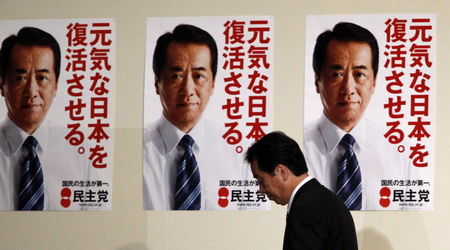
TOKYO - Japan's ruling party, mauled in Sunday's upper house election, faces an uphill struggle to win new allies to back its policies to cut back huge public debt and probably bitter infighting over whether the premier should quit.
Voters dealt Prime Minister Naoto Kan's Democratic Party of Japan a stinging rebuke in the election, depriving the DPJ and its tiny ally of a majority less than a year after the Democrats swept to power with promises of change.
| ||||


It leaves Kan vulnerable to a challenge from inside his own party, though he said he would stay in his job. Kan is already the fifth prime minister that the world's second-largest economy has had in three years.
"I want to accept the election results sincerely and continue responsible policies with the feeling that this is a new start line," Kan told a news conference. He added he felt responsible for failing to fully explain his call for debate on the sales tax but would continue to call for multi-party talks on the topic.
The DPJ won power in a historic landslide just last year, ousting the long-dominant conservative Liberal Democrats with promises to cut waste and focus spending on consumers.
But public backing nosedived due to indecisive leadership and mishandling of a feud over a US airbase.
Public support for the DPJ rebounded when Kan took over last month, but tumbled almost as quickly after he floated a rise in the sales tax from 5 percent to help rein in debt.
Many voters accept the need for an eventual sales tax rise given a public debt already about twice the size of the $5 trillion economy, but the Democrats failed to convince voters they had a coherent plan to cure the country's economic ills.
"Kan lost the election calling for a sales tax hike," said Koichi Haji, chief economist at NLI Research Institute. "That is a huge setback for fiscal reform. Now the question is whether Kan can stay in power or not."
Need new partners
Japanese major newspapers said Kan needs to press ahead with his fiscal reform platform despite the election loss.
"If Prime Minister Kan believes higher taxes are necessary for Japan's future, he should dig his heels and call the LDP for talks. He should try to persuade voters, as well," the Asahi newspaper said.
The Democrats still have a dominant grip on the more powerful lower house. But they will need to seek new partners to control the upper chamber, which can block bills, as they struggle to engineer growth and rein in public debt.
Two of Kan's LDP predecessors threw in the towel after less than a year in face of a similar divided parliament.
Japanese shares and government bonds may face initial selling pressure when markets open on Monday.
But longer term investors will eye which smaller parties the Democrats ally with, what policy compromises it makes, and whether that dilutes fiscal reform.
"It's going to be a weak government ruling with a minority in the upper house because I don't think anyone will join the coalition," said Gerry Curtis, a Columbia University professor.
Kan is now at risk of a challenge from party powerbroker Ichiro Ozawa -- a critic of his sales tax hike proposal -- ahead of a September party leadership vote.
Kan said the Democrats would ask opposition parties to cooperate on a policy-by-policy basis rather than invite them into a formal coalition right away.
The leaders of two potential partners, the pro-reform Your Party and the Buddhist-backed New Komeito, swiftly rejected the idea of joining the government anyway, and LDP leader Sadakazu Tanigaki said his party was willing to talk about policies but ruled out any "grand coalition".
Analysts have said that opposition parties would drive hard policy bargains with the Democrats in exchange for any support, raising hopes among some experts that a deal with the Your Party would foster the deregulation many see as vital for growth.