Science and Health
Japan probe overshoots Venus, heads toward sun
(Agencies)
Updated: 2010-12-08 16:06
 |
Large Medium Small |
|
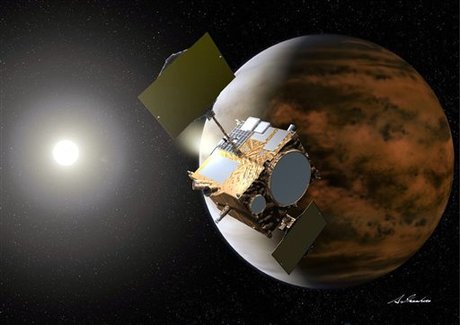 In this artist's rendering by Akihiro Ikeshita released via Japan Aerospace Exploration Agency (JAXA), Japanese probe Akatsuki is reaching Venus, right. [Photo/Agencies] |
TOKYO - A Japanese probe to Venus failed to reach orbit Wednesday and was captured by the sun's gravitational pull in a setback to Japan's shoestring space program, which will have to wait another six years to try again.
| ||||

The probe, called Akatsuki, which means dawn, reached Venus on Tuesday and fired its engines in an attempt to reach an elliptical orbit. Mission officials said they briefly lost contact after that and determined Wednesday that Akatsuki's engines did not fire long enough to attain the proper orbiting position.
|
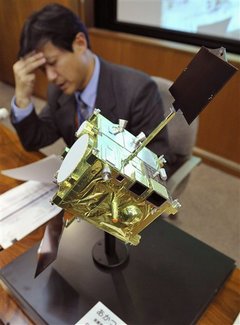 A model of Japanese probe Akatsuki is displayed during a press conference at the office of Japan Aerospace Exploration Agency, in Sagamihara, near Tokyo, Tuesday, Dec 7, 2010. [Photo/Agencies]? |
The probe would have been the first that Japan had put in orbit around another planet. Japan launched a failed mission to Mars in 1998 that was plagued by technical glitches and finally abandoned in 2003.
Still, officials said communication had been restored and Akatsuki appears to be intact and functioning as it heads off into an orbit around the sun.
"Unfortunately, it did not attain an orbit," said Hitoshi Soeno of JAXA, Japan's space agency. "But it appears to be functioning and we may be able to try again when it passes by Venus six years from now."
Akatsuki was designed to monitor volcanic activity on Venus and provide data on its thick cloud cover and climate, including whether the planet has lightning. The probe is equipped with infrared cameras and other instruments to carry out its mission.
The 25 billion yen ($300 million) Akatsuki probe was to maintain an elliptical orbit around Venus ranging from passes 190 miles (300 kilometers) from the planet's surface to outer swings 50,000 miles (80,000 kilometers) away that would allow it to comprehensively monitor weather patterns.
The failure disappointed scientists around the world.
By monitoring the climate of Venus, it was hoped that lessons could be learned about climate change and global warming on Earth.
"The Planetary Society regrets that the innovative Akatsuki spacecraft seems to have missed its opportunity to lock into an orbit of Venus," said Bill Nye, executive director of the US-based private group that supports space exploration. "Although Akatsuki has already accomplished some remarkable things on its voyage, this setback reminds us how difficult space exploration can be."
Japan has long been one of the world's leading space-faring nations. It was the first Asian country to put a satellite in orbit around the Earth -- in 1970 -- and has developed a highly reliable booster rocket in its H-2 series.
Japanese scientists had been hopeful of success with the Venus probe after the country recently brought a probe back from a trip to an asteroid.
Russia, the United States and the Europeans have successfully explored other planets. The Russian space program has been sending missions to Venus since 1961 with more than 30 attempts. Its early missions were marred with many failures.
In recent years, Japan has been overshadowed by the big strides of China, which has put astronauts in space twice since 2003 and was the third country to send a human into orbit after Russia and the United States.
Japan's space program has never attempted manned flight.
Unlike many space programs, it cannot rely on military budgets or projects to develop its rocket capabilities. Public interest is also relatively low, an issue the Akatsuki mission tried to address by packing more than 200,000 names of supporters into the probe as part of a publicity campaign.
JAXA's budget for last year was 180 billion yen ($2 billion), and the agency is seeking a slight increase for fiscal 2011. Japan's spends about one-fourteenth of what the US spends on space exploration, and less than half of what the EU spends, according to Japanese government estimates.
"Akatsuki was an ambitious project considering the price," said Makoto Miwada, a JAXA spokesman. "For years our budget has been at about the same level. Unless we get more funding it will not be enough to increase our activities and we will be soon overtaken by China and India."