Asia-Pacific
Scientists: It's not too late yet for polar bears
(Agencies)
Updated: 2010-12-16 10:55
 |
Large Medium Small |
|
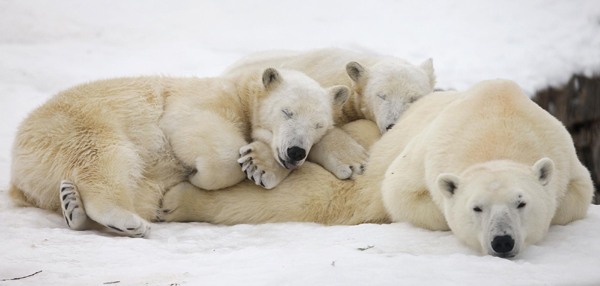 Ganuk and Taiga, the polar bear cubs, sleeps on their mother's back at the St-Felicien Wildlife Zoo in St-Felicien, Quebec, Canada, Nov 30, 2010.[Photo/Agencies]
|
ANCHORAGE,US - Two groups of scientists are suggesting a sliver of hope for the future of polar bears in a warming world.
A study published online Wednesday rejects the often used concept of a "tipping point" or point of no return, when it comes to sea ice and the big bear that has become the symbol of climate change woes. The study optimistically suggests that if the world dramatically changed its steadily increasing emissions of greenhouse gases, a total loss of critical summer sea ice for the bears could be averted.
| ||||


A grim future for polar bears is one of the most tangible and poignant outcomes of global warming. Four years ago, federal researchers reported that two-thirds of the world's polar bear habitat could vanish by mid-century. Other experts foresee an irreversible ice-free Arctic in the next few years as more likely.
The new study, which challenges the idea of a tipping point, says rapid ice loss could still happen, but there's a chance that the threatened bears aren't quite doomed.
"There is something that can be done to save polar bears," said lead author Steven Amstrup, the former senior polar bear scientist for the US Geological Survey in Alaska. "The problem is not irreversible."
His research, published in Nature, shows there's a steady relationship between greenhouse gas emissions, sea ice and polar bear habitat. As emissions rise, sea ice and polar bear habitat decline. But unlike previous research, there's no drop-off tipping point in Amstrup's models.
Essentially until all sea ice is gone permanently in the summer there is still a chance to prevent the worst-case, if global warming is stopped in time, Amstrup's research shows.
"Such a tipping point would mean that future reductions in greenhouse gas emissions would do little to save the polar bear," said Amstrup, who is now chief scientist for the conservation group Polar Bears International. "It seems clear that if people and leaders think that there's nothing they can do, they will do nothing."
Some experts called Amstrup too optimistic, but said his computer models made sense.
"I wouldn't say that we can rule out a tipping point, but it does show that a tipping point isn't inevitable," said Walt Meier, a senior scientist at the National Snow and Ice Data Center in Boulder, Colo.
But that all hinges on reducing greenhouse gas emissions?- carbon dioxide and other pollution from the burning of fossil fuels, said Mark Serreze, director of the center. "Time is running out. Humankind needs to make a choice," he said.
Time has already run out, said Henry Jacoby, a management professor at MIT and founder of its MIT Global Change Joint Program.
Jacoby examined the computer models Amstrup used in his paper and said it is based on a "world that's already long gone". The two scenarios of emission reductions are points that the world has already passed or will pass in the next few years, Jacoby said.
After the global recession led to a one-year dip in carbon dioxide emissions, they are soaring again, according to a recent study. And vague international agreements made in Cancun last week and in Copenhagen last year don't do enough, Jacoby said.
"Even given the pledges on the table, we don't come close to what these guys use in their hopeful scenario," he said.
Study co-author Eric DeWeaver of the National Science Foundation called the scenarios he used "plausible".
But DeWeaver and Amstrup agree the polar bear is in deep trouble if emissions continue to rise as they are now.
A second study was to be presented Thursday at the American Geophysical Union conference in San Francisco. That research considers a future in which global warming continues at the same pace.
And it shows that a belt from the northern archipelago of Canada to the northern tip of Greenland will likely still have ice because of various winds and currents.
The sea ice forms off Siberia in an area that's called "the ice factory" and is blown to this belt, which is like an "ice cube tray", said Robert Newton of the Lamont-Doherty Earth Observatory at Columbia University.
That "sea ice refuge" will be good for polar bears and should continue for decades to come, maybe even into the next century, he said.
Just how many polar bears could live there still has to be figured out, according to the research by Newton and Stephanie Pfirman of Barnard College.
Amstrup's study doesn't downplay the nature of global warming and its effect on polar bears, especially if emissions increase.
"The changes that are occurring in the Arctic are going on at a much more rapid rate than elsewhere in the world," Amstrup said. "So the changes that are occurring and affecting polar bears really foreshadow much more significant changes that are likely to occur worldwide."