Asia-Pacific
US military budget near record level
By Cheng Guangjin and Tan Yingzi (China Daily)
Updated: 2011-02-16 08:05
 |
Large Medium Small |
BEIJING / WASHINGTON - Analysts warned that instability may increase in the Asia-Pacific region if the US Congress approves the nation's increased defense budget.


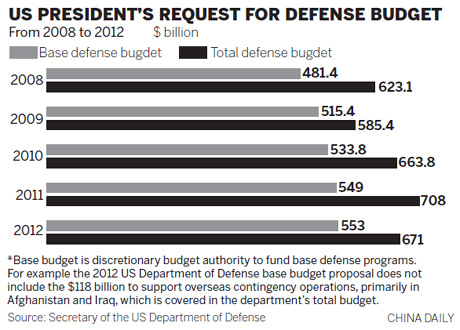
It is set to increase by $4.2 billion from the level the Obama administration requested for the 2011 fiscal year, which was never approved by Congress, leaving expenditure at 2010 levels under a temporary spending bill.
It remains uncertain whether the latest budget request will get approval, as opinion remains divided on the issue on Capitol Hill.
If approved, increased spending on military deployment in the Asia-Pacific region, which the US has been paying increasing attention to, may cause more instability in the region, said analysts.
"This will also increase the pressure on China as it is surrounded by US deployments," said Li Qinggong, deputy secretary-general of the China Council for National Security Policy Studies.
The base budget - excluding the part for the wars in Iraq and Afghanistan - for the 2012 fiscal year beginning Oct 1, reaches $553.1 billion, according to a defense budget blueprint released by the Pentagon.
Growth areas include cyber security, space-based weapons and nuclear security. It also includes $9.7 billion for Lockheed's F-35 fighter.
In addition to the base defense budget, the Obama administration is also requesting $117.8 billion to fund the wars in Iraq and Afghanistan, which is $41.5 billion below the request made for the 2011 fiscal year.
The latest war funding reflects the planned withdrawal of troops from Iraq by the end of this year and a modest decline in funding for operations in Afghanistan, according to the Pentagon.
The Obama administration plans to withdraw troops from Iraq by the end of 2011 and will start to pull out from Afghanistan in July 2011.
Li noted that with increased attention paid to the Asia-Pacific region, some of the increased US military spending will likely go toward supporting its allies and holding joint military exercises with them.
One week before the Pentagon's budget report was announced, Washington witnessed a heated discussion among security experts and defense officials about China's military development, especially in naval and space programs.
Some analysts have said China is an important factor related to the yearly increase in the US defense budget.
China's defense policy is not aimed at any country, Vice-Foreign Minister Cui Tiankai said at a news conference in January.
The policy will always remain defensive in nature, Cui said, adding that there is no reason for any other country to worry about China's defense policy, he added.
Abraham Denmark, the Asia-Pacific regional security expert with the Center for a New American Security and former country director for China affairs in the Office of the Secretary of Defense, said that it is legitimate for China, a major economic power, to enhance its military capabilities.
"The major question for American strategists is how China will use its new-found power, economically, militarily and politically," he said.
Though many defense experts acknowledge that it will take China many years to catch up with US in military development, since the Pentagon is facing possible budget cuts as the administration is trying to reduce the huge federal deficit, these public discussions prior to Congress decision may help the Defense Department get more funding this year, Zheng Wang, senior fellow with the United States Institute of Peace, told China Daily.
However, Li noted it is still unclear whether this spending plan will ultimately be approved by the Congress where opinion remains divided about the scale of the budget cuts and increases.
Some Republican lawmakers are already calling for deeper cuts given the US budget deficit and nearly $1.5 trillion national debt; others want to add to the defense budget.
Li Xiaokun and agencies contributed to this story.
| 分享按鈕 |