Asia-Pacific
Japan defends radioactive dumping
(China Daily)
Updated: 2011-04-06 06:55
 |
Large Medium Small |
TOKYO - Japan defended on Tuesday its dumping of thousands of tons of massive low-level radioactive water from the crisis-hit Fukushima nuclear plant, saying the action does not violate international law, and pledged to fully inform the international community of Tokyo's steps to tackle the ongoing emergency.
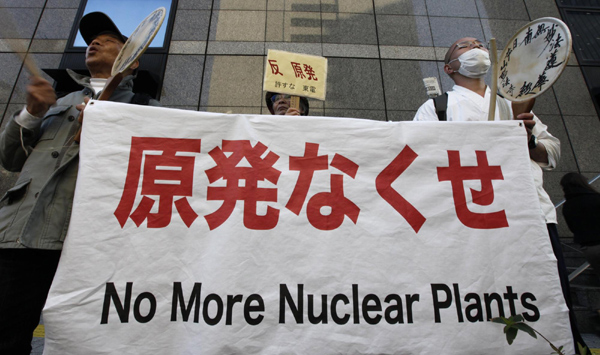 Anti-nuclear protesters and a Japanese Buddhist monk protest outside Tokyo Electric Power Co's headquarters building in Tokyo April 5, 2011. [Photo/Agencies]? |
An estimated 3,430 tons of low radioactive water had been discharged into the Pacific Ocean, Tokyo Electric Power Co (TEPCO), which runs the nuclear plant, said on Tuesday.
Kyodo news agency quoted Japanese Industry Minister Banri Kaieda as saying a total of 60,000 tons of radioactive water is believed to be flooding the basement of reactor buildings and underground trenches connected to them at the Fukushima nuclear plant.
| ||||


Underlining the concern 
 over spreading radiation, the government said it was considering imposing radioactivity restrictions on seafood for the first time in the crisis after a contaminated fish was found in seas well south of the damaged nuclear reactors.
Kaieda maintained that contamination of the sea, caused by the disposal, will pose no major health risk.
Experts said radiation dissipates quickly in the ocean, but that it is unclear what effects large amounts of contamination would have.
TEPCO began dumping the radioactive water on Monday as an emergency step to secure room for the storage of more highly contaminated water. It aims to dispose of a total of 11,500 tons of low-level tainted water until Friday.
"Even though it was an inevitable step to prevent contaminated water with higher levels (of radiation) from flowing into the sea, the fact that we had to intentionally release water contaminated with radioactive substances is very regrettable, and we are very sorry," Chief Cabinet Secretary Yukio Edano said on Tuesday.
Small levels of radiation from the plant have been detected as far away as Europe and the United States, and several countries have banned milk and produce from the vicinity around the plant.
South Korea had expressed concern, through diplomatic channels, at Japan's decision to release contaminated water into the sea, its Foreign Ministry said on Tuesday.
"It is said to be contaminated water. So, isn't it natural if anyone is a little bit concerned?" the ministry's spokesman Cho Byung-jae said, adding that the ministry was submitting questions to the Japanese in order to confirm facts.
The dumping does not violate the 1986 Convention on Early Notification of a Nuclear Accident, which obligates nations to provide data such as the accident's time, location and radiation releases to affected states when harmful trans-boundary radiation release is feared, Japanese Foreign Minister Takeaki Matsumoto said at a news conference on Tuesday.
Matsumoto said that Tokyo had briefed members of the diplomatic corps in Japan on the start of the radioactive water disposal hours before TEPCO began releasing the liquid into the Pacific Ocean on Monday evening.
In desperation, emergency workers have turned to what are little more than home remedies to stem the flow of contaminated water. On Tuesday, they used "liquid glass" in the hope of plugging cracks in a leaking concrete pit.
After seeking help from France and the US, Japan has now asked Russia to send the floating radiation treatment plant Suzuran, used to decommission Russian submarines in nearby Vladivostock, Interfax news agency reported.
The Suzuran, one of the world's largest liquid radioactive waste treatment plants, treats radioactive liquid with chemicals and stores it in a cement form. It can process 35 cubic meters of liquid waste a day and 7,000 a year.
TEPCO said it would also build tanks to hold contaminated seawater, was towing a floating tank that will arrive next week and was negotiating the purchase of three more.
Engineers also plan to build two giant "silt curtains" made of polyester fabric in the sea to block the spread of more contamination from the plant.
TEPCO also said on Tuesday it had started paying "condolence money" to local governments to aid people evacuated from around its stricken plant or affected by the radiation crisis.
TEPCO faces a huge bill for the damage caused by its crippled reactors, but said it must first assess the extent of damage before paying actual compensation.
Reuters-AP
| 分享按鈕 |