Science and Health
Flipping Jupiters! Why some planets spin backward
(Agencies)
Updated: 2011-05-12 10:05
 |
Large Medium Small |
WASHINGTON - ?Some planets are just flipping backward.
|
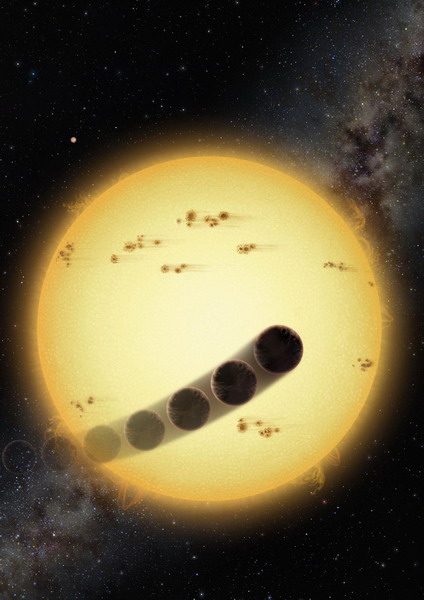 A retrograde hot Jupiter: the transiting giant planet orbits very close to the star and in a direction opposite to the stellar rotation, in this artist's rendering released May 11, 2011.??[Photo/Agencies] |
Of the more than 500 planets detected around stars besides our Sun, the vast majority appear to spin the same way the star does, scientists reported on Wednesday in the journal Nature.
But some of these extrasolar planets spin in the opposite direction of the stars they orbit, astronomers found. These strange, backward-spinning planets are usually gassy giants called hot Jupiters, not rocky orbs like Earth.
Besides their backwards twirling, which the astronomers call flipped orbits, these big planets huddle close to their stars, unlike Jupiter, which is about 483 million miles (778 million km) from the Sun, more than five times as distant from the Sun as Earth.
"That's really weird, and it's even weirder because the planet is so close to the star," Frederic Rasio of Northwestern University said in a statement.
"How can one be spinning one way and the other orbiting exactly the other way? It's crazy. It so obviously violates our most basic picture of planet and star formation."
Astronomers have long theorized that big gas planets form further away from their stars, while Earth-like rocks are born closer in.
But just because a Jupiter-like planet forms in the planetary boondocks doesn't mean it stays there, Rasio and his colleagues reported.
When planetary systems contain more than one planet, in addition to a star, each planet has its own gravitational force, causing the planets to interact and eventually pulling the gas giants close to the star and even reversing its orbit, the scientists found.
This process is known as gravitational perturbation, or an exchange of angular momentum.
Astronomers have been detecting extrasolar planets since 1995, but have seen only a handful. The others are inferred by the gravitational pull they exert on the stars they orbit, creating a starry wobble that indicates one or more planets present but unseen in the planetary system.
The National Science Foundation supported this research.??
| 分享按鈕 |