Global General
Egypt: Security forces clash with protesters
(Agencies)
Updated: 2011-06-29 16:12
 |
Large Medium Small |
CAIRO?-- Egyptian security forces firing tear gas clashed with more than 5,000 rock-throwing protesters in central Cairo late Tuesday, leaving dozens injured in the latest unrest to rattle the country, witnesses and medical officials said.
 Protesters throw rocks and run away from tear gas in Tahrir Square in Cairo June 28, 2011. Police fired teargas in Cairo's central Tahrir Square overnight on Wednesday at several hundred mainly Egyptian youths, some of whom threw stones and demanded that trials of former senior officials proceed more swiftly. Clashes broke out late on Tuesday in a nearby area of Cairo where families of some of the more than 840 people killed in the uprising that led to Hosni Mubarak's overthrow in February had gathered to honour those killed.[Photo/Agencies] |
Clouds of tear gas and the wail of police sirens engulfed Tahrir Square as lines of security forces in riot gear battled to regain control of the central plaza from the demonstrators, many of them family members of the more than 850 people killed during the revolution that toppled Egypt's longtime ruler, Hosni Mubarak.
The families are frustrated with what they perceive as the slow prosecution of security officers believed to be responsible for the deaths of some 850 protesters during the 18-day uprising.
Rocks and shattered glass littered the streets around Tahrir, as protesters chanted: "Down with the military junta." Injured demonstrators lay on the ground, some bloodied and dazed, before the clashes ended after Interior Minister Mansour el-Essawy issued an order before dawn Wednesday for the security services to stand down.
The confrontation began Tuesday, when security forces cleared a sit-in outside the state TV building by the families of the slain protesters, said Nourredine, an engineer who gave only his first name.
"I was in front of the state TV building this morning when the security forces attacked," he said. "Since then, things have been escalating."
|
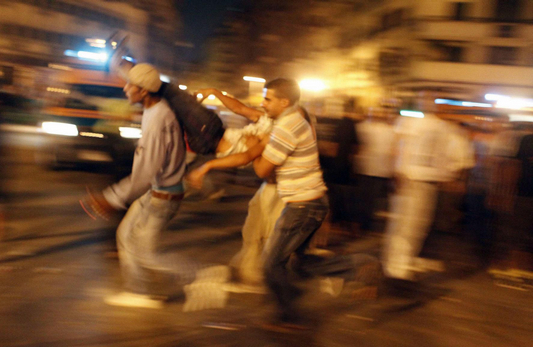 Protesters carry an injured man in Tahrir Square in Cairo June 29, 2011. Police fired teargas in Cairo's central Tahrir Square overnight on Wednesday at several hundred mainly Egyptian youths, some of whom threw stones and demanded that trials of former senior officials proceed more swiftly. Clashes broke out late on Tuesday in a nearby area of Cairo where families of some of the more than 840 people killed in the uprising that led to Hosni Mubarak's overthrow in February had gathered to honour those killed.[Photo/Agencies]? |
The protesters regrouped Tuesday evening outside the Interior Ministry, where rumor had it that two demonstrators wounded earlier in the day had been taken. It was not immediately clear what sparked the violence outside the ministry, but eventually protesters were hurling stones and security forces firing volleys of tear gas and blocking off streets around the building.
The clashes then shifted to nearby Tahrir Square _ the epicenter of Egypt's revolution. In a sight unseen since the early days of the uprising, lines of central security troops in riot gear sealed off the main streets leading into the square, while dozens of security vehicles were parked in side streets.
The government response shocked many of the protesters, who compared it to the heavy-handed tactics used by the security forces before Mubarak's fall.
"The security forces' violence is the same," said Al Maataz Hassan, an engineer. "They accuse the people of being thugs, then crackdown. It's the same mentality as before the revolution."
Tuesday's clashes, perhaps of the most serious between security forces and protesters since the revolution, are an offshoot of the tumultuous transitional period the country is going through as it struggles to shift from an authoritarian to democratic system.
That transition took a step forward earlier Tuesday with an Egyptian court's ordering the dissolution of more than 1,750 municipal councils, seen as one of the last vestiges of Hosni Mubarak's rule.
The administrative court decision, announced by presiding judge Kamal el-Lamei, meets a major demand of the protest movement that drove Mubarak from power.
The local councils, with over 50,000 seats filled by elections widely viewed as rigged, were a backbone of support for Mubarak's ruling party. They became particularly important after 2005 constitutional amendments required presidential candidates to obtain support from a quota of local council officials, as well as from national parliament members. Critics saw this as a stepping stone for Mubarak's son, Gamal, to succeed his father in office.
The court decision can still be appealed, but popular opposition may make it difficult for Egypt's current military rulers to challenge it.
Hamdi el-Fakharani, an engineer who filed the court case against the councils, said 97 percent of council members belonged to Mubarak's now-dissolved National Democratic Party.
"They had already begun campaigning, using municipal services to influence people in favor of the party's comeback and saying the revolution has negatively impacted the economy," he said.
He said he was joined in the complaint by 10 independent council members who attested to council corruption.
The dismissal of all council members will leave Egypt's municipalities under the control of unelected local executives and provincial officials, until new councils are elected.
A major rally is planned next week to, among other things, show support for dissolving the local bodies' membership. Activists say the councils, criticized as corrupt and flush with government funds, could help the campaigns of supporters of the former regime in parliamentary elections, scheduled for September.
"This is, of course, an important decision. If we are having parliamentary elections, these municipal councils were set to play a big role," said Hafez Abu Saada, a human rights lawyer who monitored and criticized the councils' 2008 elections.
| 分享按鈕 |