Exchanges crucial to warm China-Japan ties
Updated: 2011-08-12 07:34
By Ma Liyao (China Daily)
|
|||||||||||


BEIJING - Chinese and Japanese people lack direct knowledge of each other, according to a poll, and analysts say this indicates much can be gained by encouraging people-to-people exchanges.
"Exchanges between China and Japan should become wider and deeper, and this will require the joint efforts of the two countries' media and publics," said Li Wei, director of the Institute of Japanese Studies at the Chinese Academy of Social Sciences.
 |
|
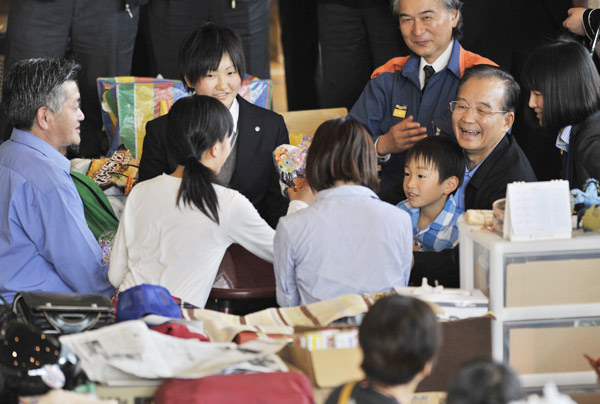
Premier Wen Jiabao (second right) meets tsunami survivors during his visit to the makeshift shelter at Tatekoshi Elementary School in Natori, Miyagi prefecture, on May 21. Wen arrived in northeastern Japan and mourned victims of the country's massive earthquake and tsunami, ahead of the three-way summit among Japan, China and the Republic of Korea. [Kazuhiro Nogi / Agence France-Presse] |
The poll found that more than 97 percent of the Chinese general public and 92.9 percent of college students have never been to Japan. Only 1.5 percent of the general public has close Japanese friends, and 6.8 percent of college students have an acquaintance from Japan.
More than 80 percent of Chinese respondents get much of their information about Japan through Chinese media reports, according to the poll jointly released by China Daily, Japan NPO Research Association and Horizon Research Consultancy Group this month.
The lack of first-hand knowledge is even more pronounced among the Japanese. More than 90 percent of those interviewed said they learn about China from Japanese news media.
Because people in both countries rely on the media, they are likely to develop incomplete - though not necessarily bad - views of each other, and they can be more easily influenced by biased reports, Li said.
"People may have never been to Japan or China, yet everyone has an image in his mind about the other country and its people," Li said.
The most prominent characteristics of the Japanese, according to the Chinese general public, are diligence and creativity. "Love of peace" ranks the lowest.
Nearly half of the Japanese respondents think of the Chinese as diligent - a statistic that has not changed much from last year's survey. But about half also think of the Chinese as stubborn, having poor teamwork skills and self-interested.
People's views seem slightly more objective when they consider the other country as a whole.
For the Chinese general public and college students alike, the overriding view of Japan is as a capitalist country. But 36.5 percent of the general public also considers it a militarist country, and 62.5 percent of college students view it as nationalist.
Japan shows a similar blend of objective and subjective viewpoints. Sixty-nine percent of its general public regards China as a socialist country, but only around 3 percent describe it as pacifistic.
"These impressions came mainly from media reports, some of which, to my knowledge, are actually sponsored by certain pro-US forces that try to feed the public information - not good for the healthy development of the Sino-Japanese relationship," Li said.
"Overreacting reports about the Chinese aircraft carrier provide an obvious example. Why did they make it sound as though China was about to attack Japan with its carrier, even though it was not yet completely built?"
The poll, however, shows that people in both countries are also aware of this tendency toward bias on a certain level.
Around half of the Chinese respondents said that Japanese media reports about China are not objective, and only 16.6 percent of the Japanese think the Chinese media reports are objective, down by 3 percentage points from last year.
The media gives intensive coverage to the words and actions of political leaders, so these leaders should be careful of what they do and say in both countries, where people rely so heavily on the media, Li said.
The best-known Japanese politician among the Chinese is Junichiro Koizumi, a former prime minister who was famous for his hard line in China affairs and multiple visits to the Yasukuni war shrine, which angered the Chinese. Less familiar is Kakuei Tanaka, who pushed for the normalization of the Sino-Japanese relations, the poll shows.
Young people, according to the poll, are attracted more to cultural goods, which convey a more everyday and less politically charged sort of information, according to the poll.
Japanese comics and cartoons rank high on the list of "words used in reference to Japan", especially among college students.
In June, China and Japan jointly held a comics and cartoons festival in Beijing. At the opening ceremony, Premier Wen Jiabao said the event would bring young Chinese and Japanese together to enhance their understanding and friendship with each other.
Related Stories
Rising enmity haunts China-Japan relations 2011-08-12 07:10
China-Japan relations vital: poll 2011-08-11 12:07
China, Japan urge global talks on economic crisis 2011-08-05 17:02
Japan under fire for 'China threat theory' 2011-08-05 07:53







Hot Topics
The European Central Bank (ECB) held a conference call late on Sunday ahead of the market opening, pledging the ECB will step in to buy eurozone bonds with efforts to forestall the euro zone's debt crisis from spreading.
Editor's Picks
|
|

|

|
|

|