Addressing climate change: China's internal demand
Updated: 2011-11-24 08:47
(Xinhua)
|
|||||||||||


BEIJING - In a newly-published white paper, China said that it will make further efforts to address the climate change issue -- a commitment to fulfill not only international obligations, but also its domestic need for sustainable development.
The white paper, "China's Policies and Actions for Addressing Climate Change," said China will strengthen its legal system and strategic planning, accelerate economic restructuring, optimize energy diversification and develop clean energy.
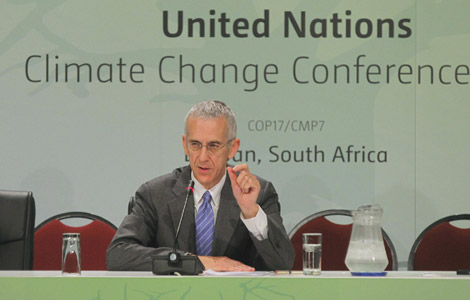
It came just one week before the UN Framework Convention on Climate Change in Durban, South Africa, where world leaders will discuss the implementation of the convention and the Kyoto Protocol, as well as the Bali Action Plan.
China is committed to its obligations in the world's efforts to address climate change, and the country views the issue as one of the most important challenges that it is facing.
After over three decades of economic acceleration, China has developed from a poor, closed country into the world's second largest economy in terms of GDP, just after the United States.
But this has come at a high price as environmental degradation, increased carbon emissions, accelerated consumption of natural resources and aggravated water shortages in some areas are all putting pressure on people's daily lives.
According to the Second National Assessment Report on Climate Change released earlier last week, climate change increases the frequency of natural disasters, extreme weather and climate events, which will have significant and largely adverse influences on human health and could also cause changes in the country's ecosystems.
Fortunately, the potential crises have raised public awareness, as officials and experts believe that China cannot afford its fast-paced growth.
Addressing climate change coincides with development ideals held by the ruling Communist Party of China (CPC). Its "Scientific Outlook on Development" urges transforming the economic mode to an environmentally-friendly, energy-saving one.
The outlook means China aims to switch from an over-reliance on a cheap labor force, funds and natural resources to well-educated workers and the improvement of science and technology -- a development mode that values quantity and speed as well as high quality.
Accordingly, addressing climate change has been given more attention by the Chinese government. In the 12th Five-Year Plan for Economic and Social Development (2011-2015), the government will "actively respond to climate change" by cutting greenhouse gas emissions and afforestation, among others, marking the first time that climate change has appeared in the national Five-Year Plan.
Meanwhile, China is also translating its words into actions. During the 11th Five-Year Plan period (2006-2010), the country achieved average annual economic growth of 11.2 percent, with an average growth of 6.6 percent in energy consumption per year.
More practical actions are being taken. The white paper said that China will make laws dedicated to addressing climate change. This came after China's new resource tax policy was unveiled earlier this month, which levies a tax on crude oil and natural gas products at 5 percent of sales nationwide rather than production volume.
However, there is still a long way to go for sustainable development. Due to limited science and technology in new energy and materials, it is more difficult for China than developed countries to cut greenhouse emissions.
As a developing country, China is in a different development period than developed countries. This provides a reason for different thinking on practical measures for addressing climate change, as well as the reason for the common but differentiated responsibilities that China promotes in international climate change negotiations.
The country urges developed countries to recognize the different conditions of developing countries, and promote the transfer of environmental technology in a bid to achieve sustainable global development.






Hot Topics
HIV/AIDS, Egypt protest, Thanksgiving, climate change, global economic recovery, home prices, high-speed railways, school bus safety, Libya situation, Weekly photos
Editor's Picks

|
|
|

|

|

|