Comments()
  Print
Print  Mail
Mail  Large Medium Small
分享按鈕
0
Large Medium Small
分享按鈕
0Fresh from a visit with allies in Asia, a top Pentagon official on Wednesday dismissed concerns that the US' strategic rebalance of the Asia-Pacific region is intended to counter a rising China.
"This rebalance is not about any single country or group of countries. It is not about China or the United States. It's about a peaceful Asia-Pacific region, where sovereign states can enjoy the benefit of security and continue to prosper," Deputy Secretary of Defense Ashton Carter told a crowd at the Asia Society in New York.
 |
|
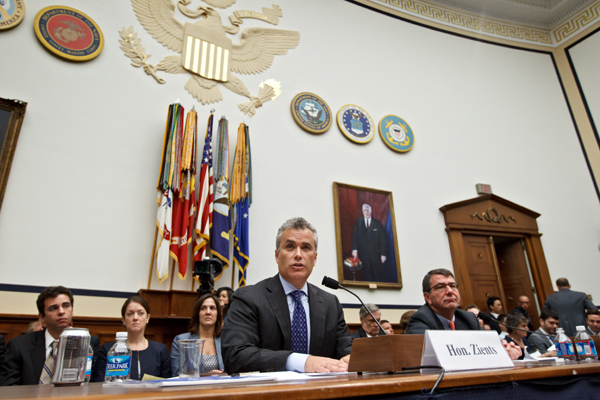
Acting Budget Director Jeff rey Zients with Deputy Secretary of Defense Ashton Carter (right) testifi es before the House Armed Services Committee hearing on defense cuts on Capitol Hill in Washington on Wednesday. [Photo/Agencies] |
"We seek to strengthen our very important relationship with China, and believe that China is key to developing a peaceful, prosperous and secure Asia-Pacific region," he said.
Carter, who just returned from a 10-day trip to the Asia-Pacific region with stops in India, Japan and the Republic of Korea, described the rebalance as one of the most prominent and important areas of US strategy.
Since US President Barack Obama announced the new defense strategy in the Pentagon in January, many top US officials — Obama, Secretary of State Hillary Clinton and Defense Secretary Leon Panetta — have visited Asia.
The US is committed to developing a sustainable military-to-military program with the Chinese to improve mutual understanding and reduce risk, Carter said.
"The leaders of both countries have spoken to their respective militaries and said we don't want a zero-sum or less than zero-sum game. The Chinese leaders said exactly the same thing and we hear that," he said.
Vice-President Xi Jinping paid a visit to the Pentagon during his trip to the US in February while Defense Minister Liang Guanglie visited the US in May, the first by a Chinese defense minister in nine years.
It's impossible for Washington to neglect cooperation with China in the region, but its increasing military disposition and intensive drills that excluded China have harmed mutual trust, said Shen Yamei, a researcher on American studies with the China Institute of International Studies.
Washington's closer military ties with its Asian allies, especially with countries that have competing territory claims with China, have aroused concerns about US interference in regional issues.
The US position on freedom of navigation, including the South China Sea, is not to take sides in territorial disputes, Carter said. But he noted that Washington will take sides with a collective approach to common problems, without clarifying which issues he was referring to.
Carter also said the US leverages "multilateral forums, like ASEAN, to address international law and norms issues, like the excessive claims being made on the South China Sea", without mentioning whether the South China Sea isles claimed by both China and the Philippines fall into a mutual defense treaty signed between Washington and Manila in the early 1950s.
Bonnie Glaser, a senior fellow at Center for Strategic and International Studies, said last week that the US has been careful not to state that the disputed area falls under the treaty.
"We don't want to alienate China. The goal is not to have a zero-sum competition between the US and China in the region," said Glaser, admitting that the US is in a dilemma when different groups of countries have different hopes for the US in the Asia-Pacific.
While some have questioned the US' capability to accomplish its strategic rebalance given the poor economic and tight budgetary situation, Carter expressed confidence that the US will have the resources to accomplish all of the tasks.
The US often begins its strategic shift with strong military investment instead of consolidating economic or political ties, Shen said. "Once the regional tension escalates, Washington's interference will be logical and feasible."
Contact the writers at chenweihua@chinadaily.com.cn and zhaoshengnan@chinadaily.com.cn
Copyright 1995 - 2010 . All rights reserved. The content (including but not limited to text, photo, multimedia information, etc) published in this site belongs to China Daily Information Co (CDIC). Without written authorization from CDIC, such content shall not be republished or used in any form. Note: Browsers with 1024*768 or higher resolution are suggested for this site.
License for publishing multimedia online 0108263 Registration Number: 20100000002731