


 Comments
  Print
Print  Mail
Mail  Large Medium Small
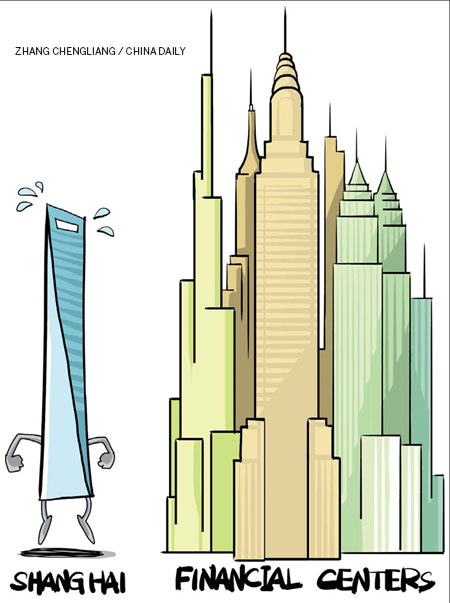
More development necessary before China can create viable international financial center
China has set a strategic goal of creating an international financial center. Shanghai aims to become one by 2020. Such a goal is highly desirable, but it is also necessary to analyze realistically what is required to accomplish it.
China's domestic financial strength is the foundation of this strategy. The "raw material" of a financial system is the accumulation of savings and their transformation into investment. In this respect, China is already world No 1 domestically.
By 2010, China's savings were $3.1 trillion (2.5 trillion euros), compared to the US' $1.7 trillion, Japan's $1.2 trillion, and Germany's $0.8 trillion. China's lead over the US increased further in 2011 - China's savings being $3.6 trillion compared to the US' $2 trillion. The domestic resources that can flow through China's financial system are therefore already the highest of any country.
This financial strength has pushed China's banks to leading positions in global rankings. The Industrial and Commercial Bank of China and China Construction Bank are the world's first and second-biggest banks by market capitalization. In banking, China therefore faces no insuperable obstacle in establishing an international financial center.
But what preconditions must be in place to accomplish this? Some envisage that purely regulatory or financial changes, notably establishing renminbi convertibility, are sufficient. More serious analysis shows this is a misconception.
International financial centers are the world's largest and most complex economic units. They have among the highest productivity of world cities. The appropriate unit of measurement for their assets is a trillion dollars. In New York and London, employment in finance-related sectors exceeds 1 million, many being from other countries.
The world's most important financial centers, London and New York, developed in what were, at the time of their creation, the world's most productive economies. US productivity remains the highest of any major economy. London is the only European city matching US productivity. The world's second-tier international financial centers, Singapore and Hong Kong, are likewise situated in highly developed economies. The GDP per capita of both, in real terms, is higher than the US.
In contrast, China's GDP per capita, at market exchange rates, is only 11 percent of US levels. Shanghai's is less than one-third of Singapore's, 23 percent of London's, and 21 percent of New York's. China is therefore attempting to create an international financial center in an economy at a much earlier stage of development.
China's Justin Yifu Lin, former senior vice-president of the World Bank, rightly stresses that it is impossible to develop individual parts of an economy artificially, without taking into account its overall stage of development. His own case examples were new oil-rich countries finding that when they purchased state-of-the-art German chemical factories, and put them in their less developed economies, they did not approach German levels of productivity. This was because the transport system was not up to German standards and there was an inadequate supply of trained staff. The same principle applies to international financial centers.
The high productivity of international financial centers such as London or New York is based on large-scale high- productivity companies in a wide range of service sectors, and not simply in finance. The idea that an international financial center can consist of large banks and insurance companies, surrounded by other service sectors still dominated by low-productivity small-scale companies, does not correspond to the reality of such centers. This is necessarily the case because the financial sector relies on enormous numbers of interconnections with other high-productivity service sectors.
In London, the finance sector absorbs 58 percent of the output of IT companies, 37 percent of professional service companies (such as law and accountancy) and 36 percent of creative industries' output (media, architecture and advertising). Without high-productivity interconnections with such sectors, the financial companies themselves cannot be globally competitive.
This process can be seen clearly in the fact that development of jobs in sectors inputting into financial services in an international financial center is much greater than that directly in financial services themselves. For example, in a 25-year period after 1982, London completed the transition from a city with a significant manufacturing industry to one based almost entirely on services. The number of manufacturing jobs fell by 65 percent, or 430,000, whereas jobs in financial services, banks and insurance, rose by only 69,000. But jobs in service sectors not directly in finance, but necessary to sustain it - such as advertising, law, accountancy, labor recruitment and consultancy - rose by 738,000 jobs, more than 10 times as many as directly created in finance.
These service jobs were in large companies - London has a lower percentage of small companies than the UK average. The service sectors dominating London, outside of banks and insurance, are accountancy, advertising, retailing, IT and law. These are all dominated by large global service sector companies such as accountants PwC, legal giants Allen and Overy, the world's largest advertising company WPP, large media companies such as News International, and retailers such as Wal-Mart and Tesco.
In London and New York, the banks and insurance companies required for an international financial center are surrounded by very large service sector companies, needed to sustain their high levels of productivity
China today simply does not possess such companies yet. It has 9.2 percent of the banking revenue of the world's top 2,000 publicly listed companies, but in large-scale non-financial service sector companies that sustain finance in London or New York, China remains extremely weak. It has only 0.1 percent of the turnover in business services, 0.9 percent in general retailing, 1.3 percent in software, and nothing in media.
The low level of productivity of China's cities, compared to international financial centers, is because service sectors are still dominated by small-scale, low-productivity service companies. These are far too weak to sustain an international financial center.
A precondition for constructing such a center is therefore to create an entire spectrum of large Chinese high-productivity service companies. Without them, an international financial center cannot function.
Neither can one be created by just changes in regulation or within the financial sector itself. It requires a strengthening of China's companies across a very wide range of service sectors.
China will eventually succeed in establishing an international financial center, but it will be more difficult than is envisaged.
The author is a visiting professor at Shanghai Jiao Tong University. From 2000 to 2008, he was London's Director of Economic and Business Policy. The views do not necessarily reflect those of China Daily.
(China Daily 08/03/2012 page9)

 US honors its veterans with ceremonies, parades
 Carnival season kicks off in Cologne
 Typhoon Haiyan hits Vietnam
 UK's Royal Air Force marks ties with Bahrain
 Red Cross Red Crescent holds meetings in Sydney
 Intl space crew returns Olympic torch to Earth
 Philippines storm kills estimated 10,000
 Games of Indigenous People kicks off in Brazil

Copyright 1995 - . All rights reserved. The content (including but not limited to text, photo, multimedia information, etc) published in this site belongs to China Daily Information Co (CDIC). Without written authorization from CDIC, such content shall not be republished or used in any form. Note: Browsers with 1024*768 or higher resolution are suggested for this site.
License for publishing multimedia online 0108263 Registration Number: 20100000002731