Comments
  Print
Print  Mail
Mail  Large Medium Small
Editor's note: The China-Europe Dialogue, organized by China Daily and the Guan Tong Foundation, invites prominent Chinese and European leaders and experts to express their esteemed views and facilitate mutual understanding and trust. The latest dialogue of this year saw Zheng Bijian, chairman of China Institute of Innovation and Development Strategy, and Felipe Gonzalez, former prime minister of Spain, discussing the potential and benefits of strengthening Sino-European relations. The two articles are summaries of their views.
Related: Convergence of interests by Zheng Bijian
 ?
?
EU should articulate to China that it needs to improve demand, employment and competitiveness
No visit to China, whatever the frequency, fails to cause a surprise as a historic phenomenon reflecting the new world situation. We continue referring to China as an emerging country, together with the others in the BRICS group, well aware that the expression does not convey the reality in which we live.
 |
This time, the purpose of my visit to China was the start of a dialogue, which should allow both parties to obtain a deeper knowledge of reciprocal realities.
For Zheng Bijian, chairman of the China Institute of Innovation and Development Strategy, Beijing, and my counterpart at the dialogue, the initiative of mutual approach is reflected in a "decalogue" under a forceful and interesting idea: "to analyze the convergence of interests, with the aim of building lasting and solid communities of interests."
The 10 points of his strategy include China's own challenges in the short, medium and long terms, his vision about the problems of the European Union, including the debt crisis and the concerns about its more serious by-products of growth and employment, and his analysis of bilateral and global shared or shareable interests.
Zheng spoke on his own behalf, but he represented a strategic approach assumed by the Chinese authorities. My analysis of the European challenges, the perception about China, the potentialities of the relationship between both parties and the points of reciprocal interest in other areas of the world, was personal, with no representation. Perhaps the assignment to the Reflection Group on the Future of Europe, which I chaired between 2008 and 2010, weighs on the invitation to dialogue.
The first imbalance for the progress of a fruitful relationship for both parties is the speakers. In the EU, there are common institutions of representation: the European Commission and the Presidency of the Council of the EU - there is even a common document to define bilateral relationship, which is not comparable to the one I am mentioning on the Chinese part. But make no mistake, the EU does not have a true common strategy with China. Beyond what the treaties say, member states prioritize their bilateral and direct relationship with China, according to national, and not common, interests.
It is very difficult, under the circumstances, for China to regard the EU as a true speaker for the whole of the European area with a population of 500 million. Not because it may not wish to do so, for it proposes it and analyzes the realities and potentialities of that relationship, but because we, the countries of the EU, take very scant account of common interests, and we continue prioritizing national ones.
The resultant reality of a shared public space, with a single currency, the eurozone, with the largest and most powerful domestic market without borders in the world up to now, but without a true exterior projection of these elements, together with the lack of a common economic and fiscal governance, is weakening us all, the bigger ones and the not-so-big.
To speak to China, as the first "emerging" power of the new world reality, one must do so with a single voice, on behalf of all the countries and citizens of the EU. Or, at least, what is said and done from the institutions that represent all of us, and what is proposed by each one of the countries of the EU, must be harmonized clearly and without contradictions. The current situation weakens us, confuses the speakers, and limits the advances in the interest of all.
China bases its strategy on two basic concepts: convergence of interests and communities of interests. I will try to delve into these ideas, both contained in the long and interesting dialogue initiated, and I will save the analysis of the proposals of that "decalogue" for a later date and with more extension.
The idea of studying the "convergence of interests" between China and the EU has a pragmatic sense, a "Confucian" sense like the rest, if you wish, stemming from the reciprocal knowledge of the realities and the challenges faced by both parties, in their own domestic or shared (EU) spaces, to which the outside ones affecting both must be added. For example, the Middle East.
I must say that I was surprised by the frankness with which my dialogue partner explained to me the internal challenges that China must face in the short, medium and long terms. Even with no representation, I expounded with the same candor my vision of the European issues, including the difficulty of finding an answer to the current crisis and to the adaptation of the EU to the challenges of globalization.
From his point of view, which I believe to be more effective, "the convergence of interests" should lead to shared positions in matters to be considered by both parties. This is an exercise of dialogue between officers capable of deciding upon those shared areas of interest.
Upon these coincidences, a second step would be taken to create "communities of interests" with long-term and solid prospects over time, and therefore, with a middle- and long-term outlook.
I will offer a highly topical example of the latter. The EU has proposed that China participate in the Financial Stability Facility. Already in the G-20 meeting in southern France, the Chinese presented reasonable objections to the proposal. Among others was the lack of clarity and decision of the EU to configure the facility and to make it operational. I would add, besides, that China already owns more than $500 billion (401 billion euros) of sovereign debt of the European countries.
I asked, as an alternative, whether China would be willing to participate, with the European Investment Bank, in a fund to channel 400-500 billion euros into investment, indispensable for the recovery of the increasingly depressed economy of the EU. Infrastructures of great significance for the competitive future of the EU would be part of the package without affecting public debt, and overcoming this self-destructive obsession with adjustment at the expense of everything else.
Obviously, it is up to China to state its opinion on something like this, if the EU is able to articulate the answer that we need to improve demand, employment and competitiveness. I can only advance that it is a more understandable language for China than the one being used to date, and that my feeling is that it would enter such an operation more easily and willingly than the one currently being proposed to them.
The author is former prime minister of Spain. The views do not necessarily reflect those of China Daily.
(China Daily 08/24/2012 page9)

 US honors its veterans with ceremonies, parades
 Carnival season kicks off in Cologne
 Typhoon Haiyan hits Vietnam
 UK's Royal Air Force marks ties with Bahrain
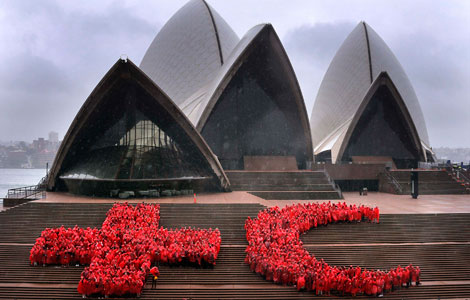 Red Cross Red Crescent holds meetings in Sydney
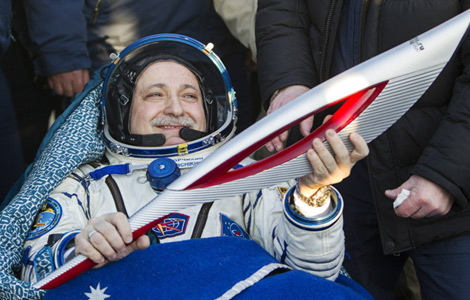 Intl space crew returns Olympic torch to Earth
 Philippines storm kills estimated 10,000
 Games of Indigenous People kicks off in Brazil

Copyright 1995 - . All rights reserved. The content (including but not limited to text, photo, multimedia information, etc) published in this site belongs to China Daily Information Co (CDIC). Without written authorization from CDIC, such content shall not be republished or used in any form. Note: Browsers with 1024*768 or higher resolution are suggested for this site.
License for publishing multimedia online 0108263 Registration Number: 20100000002731