Vision 2035: Road map for Cameroon's economic takeoff
Updated: 2012-09-25 08:06
(China Daily)
|
|||||||||||


|
Headquartered in Yaound, the Cameroon's Hydrocarbons Prices Stabilization Fund plays a key role as a socioeconomic regulator. |

|
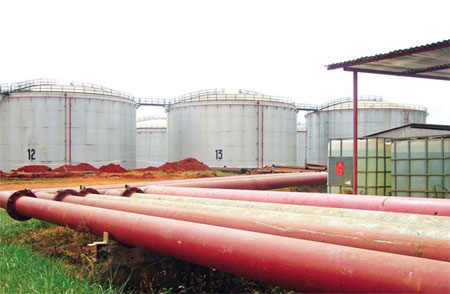
The society of Petrol Depots ensures the safe storage and distribution of refined products all over Cameroon. Photos Provided to China Daily |
Resource-rich country boasts one of the most promising futures in Central Africa
Cameroon offers an excellent business environment for investors as it looks toward becoming an industrialized nation by 2035. Since 2002, laws have been put in place to both attract and protect savvy investors looking for lucrative deals in this natural resource-rich country.
Cameroon today is a market economy in which the government plays the role of regulator, giving priority to private initiatives, multilateral cooperation and regional integration. It is a founding member of the African Union, the Economic Community of Central African States and the Economic and Monetary Community of Central Africa, and it has Africa's most populous country Nigeria as a neighbor. With these links, Cameroon has a potential market of some 250 million consumers and strongly supports the notion of a free trade agreement at continental level within five years.
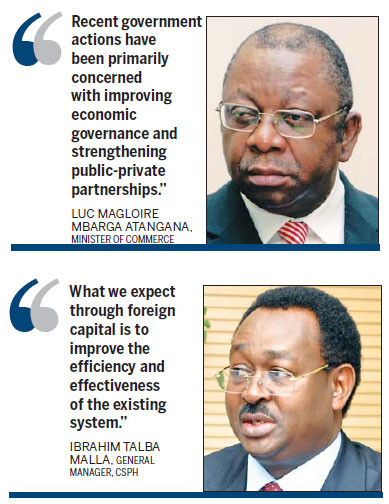
Minister of Commerce Luc Magloire Mbarga Atangana paints a picture of Cameroon as an increasingly important hub for the region.
"All government actions in recent years have been primarily concerned with improving economic governance and strengthening public-private partnerships," he said. "The creation of the Anti-Corruption National Commission and the Financial Investigation National Agency illustrates this political will. The Cameroon Business Forum and the Regulation and Competitiveness Council have been established and these represent both the government and the private sector."
Red tape has been cut and an Investment Promotion Agency serves to get the word out about Cameroon's many opportunities and incentives on a global level. Among its many comparative advantages, Cameroon boasts a cheap, industrious and well-trained workforce, and an Investment Charter that allows investors to repatriate profits, and have access to internationally ratified arbitration or court services to settle any disputes.
A diverse economy
Thanks to its diverse ecology and landscape, Cameroon has one of the most promising primary commodity economies in sub-Saharan Africa. Good agricultural conditions have led it to become the breadbasket of Central Africa, and it also boasts a wealth of forests, petroleum, bauxite, iron ore and hydropower.
The challenge, the minister acknowledged, is in harnessing the means to manufacture the final products at home, thereby adding greater value to the economy.
"In our quest to achieve greater competitiveness, we are transitioning to second generation agriculture. Our main stake lies within a greater local processing of these cultures, in line with the government's fight against rural poverty," he said. "Our agricultural products enjoy a comparative advantage thanks to their taste quality. After that, it is just a question of standard-setting, packaging and cost control."
The minister and his team take part in numerous trips and government missions to promote their products in Africa, Europe, the US and other emerging economies.
"The importance of the Chinese market is undeniable and one of our targets," Atangana says. "At this stage, the volume of our exports is not enough to keep up with demand, so they remain tied to crude oil, cotton and wood. Our imports have accelerated over the last three years.
"Our action is primarily based on a spirit of partnership and technology exchange. We export rice, but it would be even better if the Chinese brought their technology here in order to produce and process the rice locally. Cameroon is also a major fruit producer. In these areas, it is important that our discussions focus on the technical cooperation.
"China is already participating very actively in the energy sector, and in building infrastructures of all kinds. Next, we would like to build wholesale markets in certain regions of the country as platforms to sort goods for national, sub-regional, regional and international level. China can make a great contribution to the development of these infrastructures."
Bringing oil to the door
Cameroon has been an official oil producer since 1977, with the exploitation of the Kol field. In the 1990s, in an effort to boost national oil production the state undertook a number of incentives designed to accelerate the sector's liberalization, attract foreign investors and distribute further exploration permits.
"The sector needs high foreign capital now because our oil investments were made in the 1980s. We need to increase storage capacities and renovate our refinery infrastructure to ensure supplies security," said Ibrahim Talba Malla, general manager of Cameroon's Hydrocarbons Prices Stabilization Fund.
"The state must ensure the continuity of supply for local people and play the role of arbiter. To this effect, we have pilot stations in place in unprofitable areas that are supported by the state. All private operators have to do is support operating costs and the people can access products.
"We operate some oil fields, but we are not a big producer. What we expect through foreign capital is to improve the efficiency and effectiveness of the existing system."
Cameroon's President Paul Biya qualified the Sino-Cameroonian relationship as a model for Africa because, he said, "it can help materialize a strategy for major achievements."
Chinese partnerships are heartily welcome to support Cameroon's oil production program. The Addaz group, which has been controlled by China's SINOPEC since 2009, recently acquired 80 percent of the Pecten Cameroon Corp, and is now consolidating its position as Cameroon's second-largest oil producer.
This acquisition has given China access to 11 pools of 42 exploration and production areas. There is room for more investment, however, and President Paul Biya has been consistently calling for further Chinese participation.
"The only difference between Cameroon and countries like Guinea or Nigeria is the level of oil and gas production. We have access to the sea, which opens us up to offshore field opportunities," Talba said. "All we need to do is revisit the tax incentive system. The framework is fully liberalized, and there are two laws that facilitate public private partnerships. Everyone can choose what suits them best. CSPH is a shareholder in many companies in the sector, and as such we are open to any offer for partnership."
Another instrumental player, the Society of Petrol Depots is working to ensure there is sufficient storage of refined petroleum products across the country. With demand increasing at a rate of 10 percent a year, it is a major undertaking, and in response, the SCDP is upgrading existing capacity, and constructing three new oil depots.
The largest, the Kribi oil terminal, will serve as a hub, providing at least 200,000 square meters of storage space that will facilitate 60 days of safety stock, and supply the entire southern part of Cameroon until 2050. Gaston Eloundou Essomba, SCDP's General Manager, sees Kribi as an integrated project that will serve the whole country.
"We need to transport the product from Kribi to the other depots, so are planning to build a pipeline from Kribi to Yaound, the country's capital," he said. "These projects require large investments that go beyond our financing capacities so we need strategic partners. We are a very credible organization and for the past three years have obtained positive net results. Even so, our turnover doesn't allow us to raise funds for this important project so we need strategic partners.
"With the government's investment program driving up demand for energy and petroleum products, it is safe to say SCDP is a good risk!"
(China Daily 09/25/2012 page16)





Editor's Picks

|

|
|

|

|

|