Comments
  Print
Print  Mail
Mail  Large Medium Small
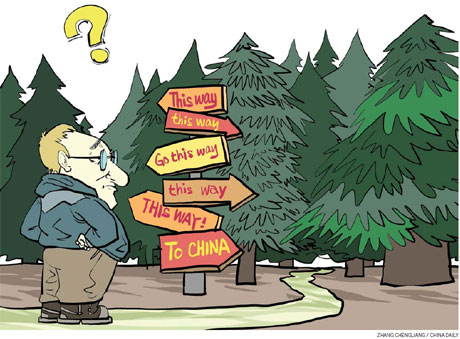
Compass the EU uses as it looks for the right path in dealing with China is faulty
Last month in Brussels the Chinese Premier Wen Jiabao attended his last China-EU summit. On the surface it was a resounding success, with a joint statement of 49 paragraphs and seven pages promising consultation, dialogue and the preparation of mandates for future talks on everything from agriculture and risk management to space and nuclear power via the Arctic and ocean energy.
The atmosphere was warm and cordial as the two sides celebrated Wen's birthday and the EU-China comprehensive strategic partnership. One EU diplomat waxed lyrical that this was the second summit this year - conveniently forgetting last year's summit was never held because of bad blood at the time between Brussels and Beijing seeming to think, like the drafters of the final statement, that quantity can substitute for quality.
Before the summit, Beijing had proposed that the comprehensive cooperation agreement between the two sides should be upgraded to incorporate a series of broad and deep agreements on trade - even a free-trade agreement - political partnership and cooperation on global common issues, such as climate change, water and maritime security. Brussels responded that it needed more time, but failed to specify whether this was weeks, months or years.
The problem is Brussels does not see the world as it is and is becoming, but instead sees some reflection of the world as it was and how Brussels wishes it would remain. The emerging global economic architecture has three powers, the EU, the US and China, with the potential to shape the world for good or ill in the coming decades. The US is a military superpower with an economy in decline and in hock to China, Europe is the world's biggest and richest trading bloc, and China is the emerging economic superpower with a growing military capacity.
Traditionally the EU has been a junior partner to the US as Brussels slowly created industrial, economic and monetary union from the building blocks of the small and medium-sized nation states left over from the two European "civil wars" of the first half of the 20th century. Europe's politics have echoed and resonated with those of Washington. European exceptionalism - but a vitally important one for its population - has been limited to its social model. But even this is now under attack with the neo-liberals' claim of inevitable necessity to resolve the financial crisis.
During the Cold War, Europe crouched under the Pentagon's nuclear umbrella waiting for the day when Soviet tank battalions were going to stream across the German plain. But the Soviet empire collapsed under its own contradictions nearly a quarter of a century ago. Even so, Europe has failed to notice that it has stopped raining. The constraints, real and imaginary, from that short half century have long gone. Europe and its politicians frame their decisions inside a paradigm that the rest of the world has long discarded.
The future global triangular relationship and Europe's self-interest are served by ensuring balance and simultaneous cooperation as much as competition.
Yet many would argue that bizarrely the EU's common foreign and security policy is closer to Washington's best interests than its own. At the summit, one of the issues was ending the arms embargo imposed on China in 1989. China is one of only three countries to face such an EU embargo. The other two are Myanmar and Zimbabwe, and one suspects that the first of these will soon be swept away by the political wind blowing there. Europe has an arms export control policy that is seen as capable of managing this process for every other country outside the EU, including Syria and Iran. The spin in Brussels was it would have made the EU look weak to lift the embargo.
In fact it might have been seen as a gesture of friendship to a strategic partner, to remove China from that list of embargo. In fact it was weakness rather than strength not to lift the embargo - weakness toward Washington.
At least at the summit the commission did not give priority to complaints about the undervaluation of the Chinese yuan when its value against the euro has risen steadily.
Instead this time, trailing Washington again, days before the summit the commission launched a dumping investigation into the import of solar panels from a group of Chinese companies after complaints from competitors in Germany, now compounded by a further complaint on unfair state subsidies implicating the whole of the Chinese government. Now, photovoltaic cells are not advanced technology, and the companies complaining have generally been run to maximize profit rather than longevity. As a result, in order to protect thousands of jobs - yes, they are really at risk - the EU may impose draconian dumping duties that will cost 10 times more jobs in the installation industry and its dependent sub-contractors while simultaneously undermining its ability to achieve its own renewable energy targets. As Nietzsche said, "madness is rare in individuals, but common in parties, groups and organizations".
China is in a period of transition, as new leaders prepare to take the helm. The future direction for Beijing will be a choice made during their mandate. There are those who want to see China look outward not just in trade, but in political and economic cooperation with its partners. But for this to happen, the rest of the world must be prepared to signal its willingness to engage. China increasingly feels embattled at all levels. The US drive to create a Trans-Pacific Partnership in trade that will literally circle China has not gone unnoticed, and Beijing's more assertive stance in the South China Sea is not unconnected: who fired the first shot is not the answer to who started the war.
History is moved by broad forces. Europe needs to look to its own longer-term interests as the tape of history unwinds. Is it in our interest for China to retreat into isolationism, one might wonder. With more than a sixth of the world's population, China may even be able to sustain a semi-autarchy that would be devastating for global trade, but in particular for the EU as the world's largest and richest trading bloc. When China sneezes Europe gets a cold.
Europe shares many values, certainly not all, with China. Both are secular societies that, with all their failings, still cling to the commitment of providing social safety nets to protect the old, the sick and the poor. We have complementary industrial economies, and between us more than a quarter of the world's population. Yes, it is good news that Europe and China will look to negotiate a new investment treaty that will incorporate the two sides' concerns in investment protection, market access and equal treatment, and that they will work together in innovation, intellectual property rights and cybersecurity, but there is a danger that both parties miss the larger picture absorbed in the detail.
As the 17th century English writer Matthew Henry wrote, "None so blind as those that will not see". Europe does not need a comprehensive strategic partnership with China; Europe needs a strategy.
The author is a former member of the European Parliament and board member of the European Institute for Asian Studies, Brussels. The views do not necessarily reflect those of China Daily.
(China Daily 10/12/2012 page9)
 US honors its veterans with ceremonies, parades
 Carnival season kicks off in Cologne
 Typhoon Haiyan hits Vietnam
 UK's Royal Air Force marks ties with Bahrain
 Red Cross Red Crescent holds meetings in Sydney
 Intl space crew returns Olympic torch to Earth
 Philippines storm kills estimated 10,000
 Games of Indigenous People kicks off in Brazil

Copyright 1995 - . All rights reserved. The content (including but not limited to text, photo, multimedia information, etc) published in this site belongs to China Daily Information Co (CDIC). Without written authorization from CDIC, such content shall not be republished or used in any form. Note: Browsers with 1024*768 or higher resolution are suggested for this site.
License for publishing multimedia online 0108263 Registration Number: 20100000002731