Experts say tough talk could harm bilateral relations in the long run
China-bashing is fiercer in the 2012 US presidential election than any previous election campaign, with both the Republican and the Democratic candidates attacking China, observers said.
Experts also warned that bipartisan hostility toward China in the US presidential election will not help the country's slow economic recovery and could even be harmful to relations between the two nations in the long run.
 |
|
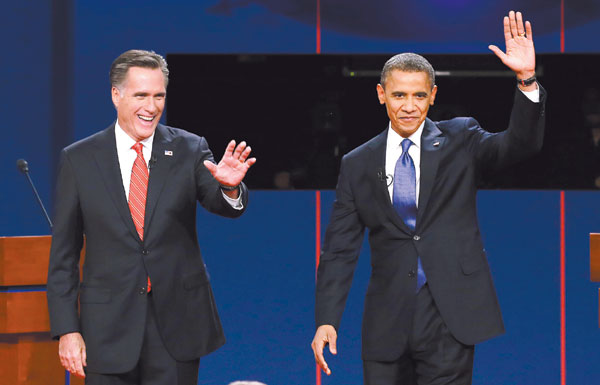
US Republican presidential candidate Mitt Romney and President Barack Obama wave to the audience during the first presidential debate at the University of Denver in Colorado on Oct 3. Charlie Neibergall / Associated Press |
On Friday, Mitt Romney, Republican presidential nominee claimed he would "label China a currency manipulator" on "day one" of his presidency, and accused the Obama administration of "passing the buck" after the US Treasury Department delayed releasing a report on international trade and exchange rates in which they would have had to say whether China was a currency manipulator.
Harsh criticism of China has been prevalent in this year's US presidential campaign, although it is not unusual for US presidential candidates to have a harder stance during the election campaign but revert to a milder policy afterward.
Ronald Reagan repeatedly criticized Jimmy Carter for establishing diplomatic relations with Beijing. However, bilateral relations between Beijing and Washington during the Reagan administration worked exceptionally well.
It was a similar situation with Bill Clinton, who promised to stand up to China on both trade and human rights issues in the 1992 campaign, but trade between the two countries expanded rapidly after he took office.
Analysis in some Western media, however, suggests that the campaign hostility toward China could be more than a political gesture.
Romney has appointed several advisers who are famously anti-China, such as John Bolton, the former US ambassador to the UN.
This week a report labeling Chinese telecommunication companies Huawei and ZTE as national security threats may suggest a change in the Obama administration's policy tone.
Experts said China bashing is "inevitable" for the US presidential candidates to win more voters.
Romney has denounced the Obama administration for being "a near-supplicant to Beijing" on trade and human right issues. An Obama campaign advertisement accused the Republican nominee of transporting US jobs to China when he worked for Bain Capital financial group. Democrats also charge that Romney as president would not protect US firms when competing with Chinese rivals.
"The slow recovery in the US has been the consequence of an unbalanced economic structure. Washington has focused on the 'new economy' or the virtual economy for years while its manufacturing industry is withering. And all the past Republican and Democratic administrations should be blamed. But it is hard for candidates to blame the past, so they just picked up 'China' as a convenient excuse," said Qu Xing, president of the China Institute of International Studies.
Shi Yinhong, an expert on international politics at Renmin University of China, said both Romney and Obama would keep playing tough on China during the coming debate. "We can expect more focus on China in the next two debates. Romney will keep hammering Obama for going easy on China over 'unfair trade practices'. And Obama, I think, will defend his policy as 'necessary and effective' to face up to China's rise."
Former US ambassador to China Stapleton Roy told a panel discussion before the first presidential debate that both candidates are making "two fundamental mistakes" when dealing with China in the campaign.
"First, the issue is not currency manipulation," he said from the Carnegie Endowment for International Peace, a Washington-based think tank. "China's current account has been declining sharply. Its accumulation of foreign exchange reserves has slowed markedly, and its currency has appreciated over 30 percent since 2005, and it's continuing to appreciate."
What really concerns the US business community, he said, was intellectual property protection, market access and investment conditions.
"The second mistake is when you're trying to manage a difficult relationship, you don't make it more difficult," he said. "We are trying to have a constructive, strong relationship with China, and the candidates are talking about China in ways that undermine public support for the concept of a strong, cooperative relationship with China."
Elizabeth Economy, director of Asia studies at the Council on Foreign Relations, told the same panel discussion that both candidates have targeted China as a scapegoat for US economic ills instead of engaging with the Asian country in a "serious or substantive" manner.
"What should they be talking about?" she said. "I think (they should be talking about) the issues that we're going to discuss today - namely, how can the US enhance its economic position vis-a-vis China and the bilateral relationship? Are there opportunities for the US and China to cooperate more on global issues? And does the US have it right when it comes to the pivot or rebalancing, as I guess it's now called, more broadly within Asia?"
Tao Wenzhao, a specialist on US studies with the Chinese Academy of Social Sciences, said the two presidential nominees argued on their stance on China because the US trade deficit with China was a "reality" that cannot be neglected.
Shi at Renmin University said regardless of who wins the Nov 6 election, Washington will keep "squeezing" the development space of China. "The winner, either Romney or Obama, may not be as tough as he has appeared during the campaign. But the substance of the US strategy will not change," he said.
Qu said the US presidential candidates competing with each other on who could appear tougher was "a negative proof" of China's growing influence.
"If China's rapid growth is insignificant, it is just not worth discussing. But too many extreme remarks will not only hurt China but also damage the interests of the US."
Contact the writers at wangchenyan@chinadaily.com.cn and tanyingzi@chinadaily.com.cn

Copyright 1995 - . All rights reserved. The content (including but not limited to text, photo, multimedia information, etc) published in this site belongs to China Daily Information Co (CDIC). Without written authorization from CDIC, such content shall not be republished or used in any form. Note: Browsers with 1024*768 or higher resolution are suggested for this site.
License for publishing multimedia online 0108263 Registration Number: 130349