Comments
  Print
Print  Mail
Mail  Large Medium Small
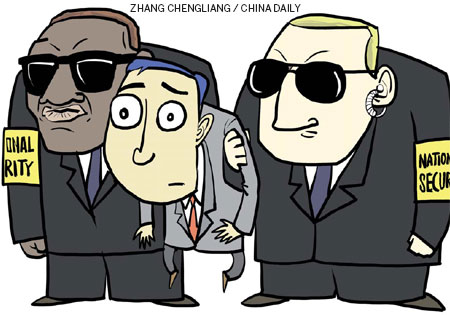
US intelligence committee report on Huawei, ZTE holds an important lesson
In February last year the Chinese telecommunications equipment maker Huawei wrote an open letter to the US government that complained of being unfairly excluded from the US market, and asked for a formal investigation into its business activities in the US. In response, in November the US government body responsible for overseeing national security and intelligence, the House Intelligence Committee, began investigating the suitability of Huawei and another big Chinese telecoms supplier, ZTE, as suppliers to national communications networks in the US. On Oct 8 the committee published a report on the US national security issues posed by Chinese telecommunication companies Huawei and ZTE.
It concluded that the US should "view with suspicion" the continued penetration of the US market by Chinese telecoms companies; that US network providers should seek other, non-Chinese, suppliers; that the US Congress should investigate the alleged unfair trade practices of Chinese telecoms companies; that Chinese companies should become more open and transparent; and that Congress should legislate to limit access to US communications systems by non-US companies that it determines should not be trusted to build critical infrastructure.
The report not only struck at Huawei and ZTE, respectively the second and fourth-largest telecoms equipment suppliers in the world, but also at their Western business partners, in the US and elsewhere.
Since both of these companies were founded 20 or 30 years ago they have become huge and successful, and have become deeply entwined in the fabric of global commerce and telecommunications. Huawei is a supplier to a number of Western telecoms operators such as British Telecom, and is also a large buyer of Western equipment for the telecoms systems that it builds worldwide.
One of Huawei's most important US partners, IBM, has worked closely with it and has used it as a supplier since 1997. The Boston Consulting Group, PricewaterhouseCoopers, Mercers and the Hay Group are some of the other big Western companies that have supported Huawei on its journey to becoming a global player.
It is not surprising, then, that the Financial Times writer John Gapper, writing on Oct 10 about the congressional committee's report in the London edition of the newspaper, should comment that it's "too late for America to eliminate Huawei".
In his opinion, the world in which each country aims to control its national communications systems by way of a national telecoms monopoly, such as AT&T in the US, British Telecom in Britain and France Telecom in France, no longer exists.
His inference is widely shared: that in our globalized world, the West should welcome competitors from emerging economies, in particular from the largest, China, which only re-entered the global economic system a couple of decades ago.
Gapper argues that the complaints made in the committee's report about breach of patents and soft-loan support by Huawei and ZTE to win contracts should not strike at the heart of Sino-US trade relations, but instead should be matters for national arbitration by the World Trade Organization and intellectual property lawyers.
Certainly, the committee's report does not hold back in its comments about the threat that it perceives from these two flagships of Chinese business abroad. It says "China has the means, opportunity and motive to use telecommunication companies for malicious purposes" and that "it appears that under Chinese law ZTE and Huawei would be obligated to cooperate with any request by the Chinese government to use their systems or access them for malicious purposes under the guise of state security".
The report complains of the lack of information ZTE and Huawei provided in response to the committee's repeated requests. It says it was particularly concerned that it had not received enough information from either of the two about their relations with the Chinese government and about the role of the Communist Party office within their organizations.
Huawei, in particular it said, did not completely clarify to the committee its corporate structure, history, ownership, operations, management or financial arrangements.
Many would agree with the view Gapper expressed that this dispute should not strike at Sino-US trade relations, but is something to be ironed out by both sides by reference to international bodies such as the WTO and the United Nations Conference on Trade and Development and experts on international law. Perhaps, too, the US should employ security-cleared private intermediaries to vet the work done by the Chinese, as the British government does when it awards contracts to Chinese telecom equipment companies.
But the US government is no different to any national government in owing a duty of care to its people to protect and maintain national security. Whether or not China is the demon portrayed by the committee's report, isn't the committee entitled to demand a heavy burden of proof from Huawei and ZTE to permit the Chinese companies to supply equipment to its national communication networks? Is it unreasonable for the US to expect complete disclosure from foreign companies that help build communications networks in the US?
Why did Huawei and ZTE not provide much of the information that the committee requested? And following completion of the investigation, why does the committee still not comprehend the role of the Communist Party within Huawei?
Despite Huawei's comments that the committee's report is "a monstrous, market-distorting, trade-distorting policy precedent that could be used in other markets against American companies", it is ZTE and Huawei, and behind them the Chinese business system, that must carry much of the blame for the negative (for them) outcome of the committee's investigation.
Given China's evolution into a global economy, it was only a question of time before its companies became deeply intertwined with Western economies and societies, as Huawei and ZTE have done. Continued economic and social integration between China and the rest of the world is inevitable, as long as China and the West, led by the US, wish to continue peaceful co-development. But the committee's report demonstrates that China's global integration cannot flourish without a significant upgrading in the way that Chinese companies operate in terms of openness and transparency.
The congressional report on Huawei and ZTE is an important milestone in China's journey to the outside world, a journey that started at the end of the "cultural revolution" (1966-76). The commentators from both East and West who blame the US intelligence committee for taking a short-sighted and protectionist approach to Huawei and ZTE are missing an essential point: namely, that China cannot achieve its full economic potential and become a full-fledged world citizen without subscribing and submitting to the values of fairness, openness and transparency accepted by the global community.
The author is a visiting professor at Guanghua School of Management, Peking University. The views do not necessarily reflect those of China Daily. Contact the writer at gileschance@yahoo.com
(China Daily 10/19/2012 page10)

 US honors its veterans with ceremonies, parades
 Carnival season kicks off in Cologne
 Typhoon Haiyan hits Vietnam
 UK's Royal Air Force marks ties with Bahrain
 Red Cross Red Crescent holds meetings in Sydney
 Intl space crew returns Olympic torch to Earth
 Philippines storm kills estimated 10,000
 Games of Indigenous People kicks off in Brazil

Copyright 1995 - . All rights reserved. The content (including but not limited to text, photo, multimedia information, etc) published in this site belongs to China Daily Information Co (CDIC). Without written authorization from CDIC, such content shall not be republished or used in any form. Note: Browsers with 1024*768 or higher resolution are suggested for this site.
License for publishing multimedia online 0108263 Registration Number: 20100000002731