


 Comments
  Print
Print  Mail
Mail  Large Medium Small
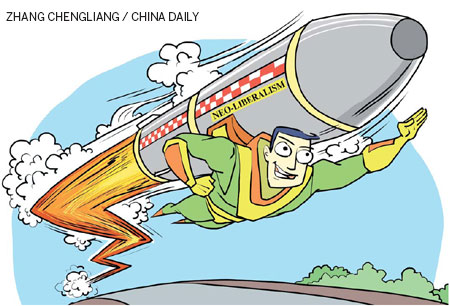
The economic downturn provides the chance to take stock, and one need is for China to undertake the reform of its State-owned monopolies
The tenets of neo-liberal economics are right in preferring the market to the government in allocating resources. This principle also reminds us that an economy cannot expect fast and sustainable growth based on government control. This is borne out not only by what happened in the former Soviet Union, but in China as well until 36 years ago.
However, the essence of Western mainstream economic theories is not about development and growth. It is about maximizing the static efficiency of resource allocation; but in economic development there is movement, including phenomena such as capital accumulation, structural change, industrial upgrading and technological advances, which can be explained by theories other than that of static efficiency. In fact, governments have played an important role in the primary stage of economic development in the countries that have successfully developed their economies.
This does not seem to tally with neo-liberalism, but economists ought to give it special attention. There is just one basic principle of economics, one on which different economic theories are based. These theories, no matter on what logic they are based, never provide perfect answers. Good policies can be formulated and put into effect only if these theories take real life into account. Dogmatism cannot save China any more than it can save any other developing economy. In China at present, government aid is needed in some industries not fully developed, but the government cannot lead an industry forever. It eventually needs to exit so the market can function in a healthy way, harnessing the power of fair competition.
Following measures of macroeconomic austerity and real estate regulation in 2010, the growth of the Chinese economy has slowed since the fourth quarter of that year, the figure being less than 8 percent this year, the first time since 1998.
This has attracted widespread attention, and economists everywhere have debated the reasons for the slowdown, its impact, duration and prospects.
There can be no doubt about the magnitude of growth in China over the past 20 years, an annual average of 10.5 percent, yet it is clear that growth has slowed. Over the next 15 to 20 years annual growth will not be particularly low, anything under 5 percent being unlikely.
When economic problems are at the worst is often a good time to take stock, figure out what went wrong, and lay down a path for reform. In China that time is now.
In any debate about China's economic development one constant bone of contention is the function of the government and the market. Development economist Gustav Ranis, of Yale University, has said that economists once argued about whether it was the market or the government that contributed to the economic boom in East Asia. However, the most valuable lesson from that region is that the policymakers knew how to adapt the economy to a changing environment, and to make successful changes when economic growth demanded policy changes.
In economic development, new challenges occur about every 10 years, and they can be successfully dealt with if an economy is resilient enough to meet new demands. Such a description seems apt for present-day China.
Some incorrectly attribute its high-speed growth over the past 20 years to Keynesian economics, but this misses the fact that by their nature Keynesian policies are measures taken in expedience, aimed at dealing with short-term economic fluctuations.
Faced with sudden economic crises, short-term demand decreases and slumps begin. At that point a government needs to increase spending. In the wake of the latest financial crises, economists are re-evaluating the use of Keynesian economics, knowing that their misuse can aggravate economic problems.
China's rapid growth can be attributed to the precious opportunities we have grasped since the 1990s, when the then premier Zhu Rongji spearheaded the push for radical reform. From 1993 to 2003 the key word was reform, and the economic system changed dramatically. This included structural reform that embraced large-scale privatization of state-owned assets.
Foreign investment has also had a hand in speeding up industrial modernization, and the large-scale cross-regional flow of labor and capital has given development even more momentum. At the same time China has taken advantage of idle resources, including land, labor and savings.
As it became clear that social development could not be neglected and that unbalanced growth needed to be avoided, the country's current leaders have shifted their attention from reform to development with a focus on people's livelihoods. This has resulted in improved rural and urban integration, social security, healthcare and education. Against that, structural reform has slowed, exacerbating structural conflicts in the economy. It has not happened overnight. Figures going back five years show the trend, and it has become more pronounced since 2010.
Short-term factors that have contributed to the slowing economy could be macroeconomic policies or debt crises, which are comparatively easy to solve. For China, any gradual improvement in Western economies will provide some relief from its slowdown.
However, what is of particular concern is a mid- and long-term slowing trend. Shifting the policy focus to people's livelihoods will affect the economy significantly. Such a focus implies a heavier tax burden on business, which, while putting more revenue into government coffers, will also put a brake on the economy.
At the heart of such fiscal policy, apart from the revenue-raising opportunities it gives, is a desire by the government to protect state-owned enterprises, themselves generators of government funds. Before 2000 the state-owned enterprises were perennial money losers soaking up government subsidies; these days they are cash cows that monopolize industries and create huge profits.
So now is the time for economic reform. The most important measures to take are to adjust the relationship between the state-owned and non-state economy and to acknowledge the function investment has in economic development.
A tenet of the Austrian School of economics is that government should not interfere with the economy. However, we acknowledge that the market is immature in its early stages and may need government to play a role.
In China the state-owned enterprises have grown so quickly that they directly affect the business environment of small and middle-sized companies, and now is the breakthrough point for the next round of reform.
China needs to adopt supply-side economics, the kind of policies put into effect by the US president Ronald Reagan in the late 1970s and early 80s. Such policies aim to increase the returns and efficient investment of enterprises, especially non-state ones, by reducing taxes and financing costs, deregulation, breaking the monopoly of big state-owned enterprises, promoting the marketization of interest rates and improving market competition.
When an economy reaches a certain point, big enterprises become monopolies with little competition, making many industries inaccessible to others. One of the keys of supply-side economics is deregulation, which encourages competition, breaking up big enterprises, lowering access barriers and establishing a multi-level financial system to match diversified industries.
The author is director of the China Center for Economic Studies at Fudan University in Shanghai. The article is based on the transcripts of a recent interview with China Daily. The views expressed in the article do not necessarily reflect those of the newspaper.
(China Daily 11/02/2012 page8)

 US honors its veterans with ceremonies, parades
 Carnival season kicks off in Cologne
 Typhoon Haiyan hits Vietnam
 UK's Royal Air Force marks ties with Bahrain
 Red Cross Red Crescent holds meetings in Sydney
 Intl space crew returns Olympic torch to Earth
 Philippines storm kills estimated 10,000
 Games of Indigenous People kicks off in Brazil

Copyright 1995 - . All rights reserved. The content (including but not limited to text, photo, multimedia information, etc) published in this site belongs to China Daily Information Co (CDIC). Without written authorization from CDIC, such content shall not be republished or used in any form. Note: Browsers with 1024*768 or higher resolution are suggested for this site.
License for publishing multimedia online 0108263 Registration Number: 20100000002731