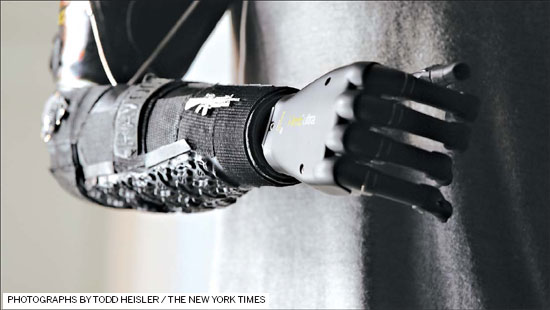
A Marine learns to accept, and master, his $110,000 mechanical arm
San Antonio, Texas - After the explosion, United States Marine Corporal Sebastian Gallegos awoke to see the October sun glinting through the water, an image so lovely he thought he was dreaming. Then something caught his eye, yanking him back to grim awareness: an arm, bobbing near the surface, a black hair tie wrapped around its wrist.
The elastic tie was a memento of his wife, a dime-store amulet that he wore on every patrol in Afghanistan. Now, from the depths of his mental fog, he watched it float by like driftwood on a lazy current, attached to an arm that was no longer quite attached to him.
He had been blown up, and he was drowning at the bottom of an irrigation ditch.
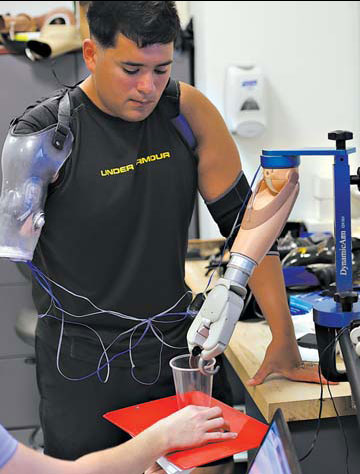
Two years later, the corporal finds himself tethered to a different kind of limb, a $110,000 robotic device with an electronic motor and sensors able to read signals from his brain. He is in the office of his occupational therapist, lifting and lowering a sponge while monitoring a computer screen as it tracks nerve signals in his shoulder.
Close hand, raise elbow, he says to himself. The mechanical arm rises, but the claw-like hand opens, dropping the sponge. Try again, the therapist instructs. Same result. Again. Tiny gears whir, and his brow wrinkles with the mental effort. The elbow rises, and this time the hand remains closed. He breathes.
Success.
|
Corporal Sebastian Gallegos received pioneering surgery to simplify the use of a prosthetic arm. |
"As a baby, you can hold onto a finger," the corporal said. "I have to relearn."
It is no small task. Of the more than 1,570 American service members who have had arms, legs, feet or hands amputated because of injuries in Afghanistan or Iraq, fewer than 280 have lost upper limbs. Their struggles to use prosthetic limbs are in many ways far greater than for their lower-limb brethren.
Among orthopedists, there is a saying: legs may be stronger, but arms and hands are smarter. With myriad bones, joints and ranges of motion, the upper limbs are among the body's most complex tools. Replicating their actions with robotic arms can be excruciatingly difficult, requiring amputees to understand the distinct muscle contractions involved in movements they once did without thinking.
To bend the elbow, for instance, requires thinking about contracting a biceps, though the muscle no longer exists. But the thought still sends a nerve signal that can tell a prosthetic arm to flex. Every action requires some such exercise in the brain.
"There are a lot of mental gymnastics with upper limb prostheses," said Lisa Smurr Walters, an occupational therapist who works with Corporal Gallegos at the Center for the Intrepid at Brooke Army Medical Center in San Antonio.
While prosthetic leg technology has advanced rapidly in the past decade, prosthetic arms have been slow to catch up. And the most common electronic arms, pioneered by the Soviet Union in the 1950s, have improved with lighter materials and microprocessors but are still difficult to control.
Upper limb amputees must also cope with the critical loss of sensation. Touch - the ability to differentiate baby skin from sandpaper or to calibrate between gripping a hammer and clasping a hand - no longer exists. For all those reasons, nearly half of upper limb amputees choose not to use prostheses, functioning instead with one good arm. By contrast, almost all lower limb amputees use prosthetic legs.
But Corporal Gallegos, 23, is part of a small vanguard of military amputees who are benefiting from new advances in upper limb technology. Earlier this year, he received a pioneering surgery known as targeted muscle reinnervation that amplifies the tiny nerve signals that control the arm.
The surgery creates additional "sockets" into which electrodes from a prosthetic limb can connect. More sockets reading stronger signals will make controlling his prosthesis more intuitive, said Dr. Todd Kuiken of the Rehabilitation Institute of Chicago, who developed the procedure. Rather than having to think about contracting the triceps and biceps just to make a fist, the corporal will be able to simply think and the proper nerves should fire automatically.
Corporal Gallegos noticed the difference almost immediately. No longer did he have to think so hard about contracting various muscles: when he wanted the arm to move, it did, faster and more fluidly. That did not mean, however, that it behaved as he wanted. He still has problems with "cross talk," where certain nerves dominate over others. If a wrist nerve dominates, for instance, a patient may have to think about bending the wrist to make the hand close. But with repeated use, the nerves sort themselves out and the need for trickery fades, Dr. Kuiken said.
For all his gains with the prosthesis, Corporal Gallegos has not overcome the embarrassment he feels when wearing his robotic arm in public. He will not wear short-sleeve shirts to restaurants.
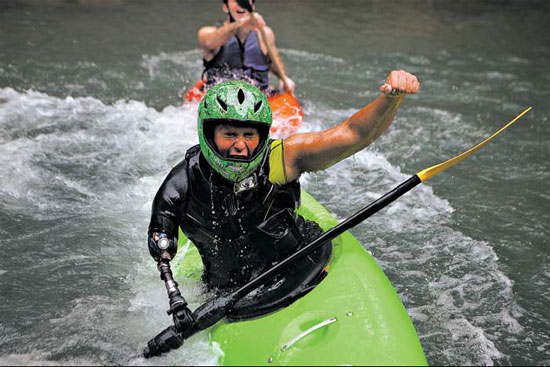
For a year after nearly drowning, Corporal Gallegos could not go near water, any water. But a therapist pushed him to overcome his anxiety, first by swimming, then kayaking, then surfing.
Ben Kvanli, a former Olympian who runs a kayaking program for disabled troops, said Corporal Gallegos was an ambivalent paddler at first. But his technique was good. And he was fast. Fast enough that Mr. Kvanli is encouraging him to try out for the national Paralympic team next year. "Independence is a big part of this," Mr. Kvanli said.
Corporal Gallegos has struggled with losing independence after losing his arm. Suddenly, he had to ask for help with buttons, zippers and shoelaces. And he still cringes at the memory of barking orders at his wife, Tracie, while she assembled a living-room furniture set that he could not assemble himself. "Stuff is a lot more complicated," he said. "I'm still figuring out what my norm's going to be, just on a day-to-day basis."
For that reason, he no longer makes big plans for the future, as he once did. Keep it simple, he tells himself: Get out of the Marine Corps. Go to college. Learn how to tie his shoelaces with a robotic hand. And maybe, just maybe, become a Paralympian.
The New York Times
|
Corporal Sebastian Gallegos, who nearly drowned after being injured in Afghanistan, has overcome his fear of water through kayaking. Todd Heisler / The New York Times |

Copyright 1995 - . All rights reserved. The content (including but not limited to text, photo, multimedia information, etc) published in this site belongs to China Daily Information Co (CDIC). Without written authorization from CDIC, such content shall not be republished or used in any form. Note: Browsers with 1024*768 or higher resolution are suggested for this site.
License for publishing multimedia online 0108263 Registration Number: 130349