Comments
  Print
Print  Mail
Mail  Large Medium Small
NEW YORK - If Dr Karl Deisseroth were an architect, he might be replacing stone or brick walls with floor-to-ceiling glass to build transparent houses. But since he is a neuroscientist at Stanford University, he has done the biological equivalent: invented a technique to make brains transparent, a breakthrough that should give researchers a truer picture of the pathways underlying both normal mental function and neurological illnesses from autism to Alzheimer's. In fact, the first human brain the scientists clarified came from someone with autism.
Deisseroth and his colleagues reported in the online edition of the journal Nature on Wednesday that they had developed a way to replace the opaque tissue in brains (harvested from lab mice or donated by people for research) with "hydrogel," a substance similar to that used for contact lenses.
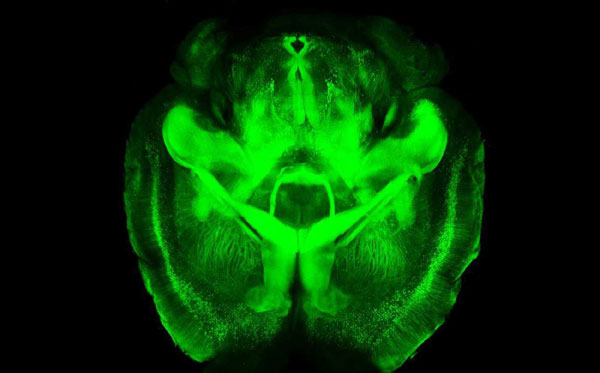
The result is see-through brains, their innards revealed in a way no current technique can: Large structures such as the hippocampus show up with the clarity of organs in a transparent fish, and even neural circuits and individual cells are visible.
 |
|
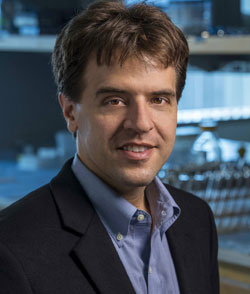
Dr Karl Deisseroth is pictured in this undated handout photo courtesy of Steve Fisch via the Stanford School of Medicine.[Photo/Agencies] |
The announcement comes just a week after President Barack Obama announced a $100 million initiative to plumb the mysteries of the brain, and offers hope that at least some of the technological breakthroughs the project envisions are within reach.
Neuroscientist William Newsome, who will co-lead Obama's initiative, called the hydrogel technique "a major technological innovation" that "will speed our mapping of the brain's 'circuit diagram.'" That mapping, he said, is "an essential goal of neuroscience, and will probably be a substantial focus" of Obama's brain project.
Until now, the only way to trace neural connections was by cutting a brain into ultra-thin slices, examining each slide under a microscope to map the cells and then using a computer to virtually reassemble the slices to reveal the entire circuit.
But slicing the brain like so much salami deforms the tissue and makes it difficult to work out long-range connections, like those between such far-flung regions as the prefrontal cortex and the amygdale.
Neuroscientists have therefore long dreamed of studying intact brains, said Deisseroth: "That would give you a better chance of working out connections over large distances, which would help you determine structure-function relationships." ? ?
CIRCUITRY AND SYNAPSES
Deisseroth's process, dubbed CLARITY (an anagram for the technique), works by a delicate feat of biochemical engineering. It turns out that what makes the brain opaque are the fatty membranes that surround and support its cells. Removing these layers by brute force, however, would make the brain tissue collapse in a puddle of neuro-glop.
Instead, Deisseroth and his colleagues immersed the brains of three-month-old mice in a vat of soft, jelly-like hydrogel. Molecules of the hydrogel seeped into the brain and took the place of the lipid bilayers, which were then removed through an electro-chemical process.
Once the hydrogel was in place, the scientists heated it to just above body temperature, causing the molecules to connect to one another and form a sturdy mesh that acted like a shell holding in the contents of each brain. After eight days, the scientists had just what they had hoped for: an intact, see-through mouse brain.
 |
|
A CLARITY scan of an entire intact mouse brain is seen in this undated handout image courtesy of Kwanghun Chung and Karl Deisseroth, of Howard Hughes Medical Institute at Stanford University.[Photo/Agencies] |
CLARITY "is a giant step forward from having to slice the mouse brain into 1,000 pieces and looking at them each individually, then trying to reconstruct the relationships of all those slices," said neuroscientist Cori Bargmann of Rockefeller University, also a co-leader of Obama's brain initiative. Because neural connections can be mapped in an intact brain, she said, "I think it will accelerate research in neuroscience."
The Stanford scientists could see the thalamus and the brainstem, the cortex and hippocampus with the naked eye. Using a microscope revealed the white matter that serves as a brain's transmission lines, carrying signals from one neuron to another in far-flung circuits that underlie mental function.
The scientists posted a three-dimensional tour of the transparent mouse brain on YouTube.
Crucially, the hydrogel is not only transparent but also permeable. That allows scientists to infuse into the brain special fluorescent dyes and other molecules that attach to just one of the thousands of different kinds of brain cells, and even to individual proteins and other molecules, turning the circuitry a neuroscientist wants to study into chartreuse and other can't-miss hues when viewed in special light.
"You can paint different wires different colors," said Deisseroth, who is one of 15 experts on the team that will map out goals for Obama's brain initiative. "We could see structures down to paired neurons on each side of a synapse," the neural version of seeing that the toe bone is connected to the foot bone and the foot bone to the ankle bone.
Perhaps even more remarkably, the process worked on human brains, despite concerns that the use of preservatives like formalin or formaldehyde might block the hydrogel process. (Mouse brains are studied fresh.)
The scientists clarified one healthy human brain and one autistic brain. Even though the latter had been pickled for more than six years, it took to the new method, revealing numerous "dendritic bridges," ladderlike connections within the brain's white matter that resemble those in Down syndrome.
"CLARITY has the potential to unmask fine details of brains from people with brain disorders without losing larger-scale circuit perspective," said Dr Francis Collins, director of the National Institutes of Health, which helped fund the research.
Once other scientists begin to clarify brains, it could "transform the way we study the brain's anatomy and how disease changes it," said Dr Thomas Insel, director of the National Institute of Mental Health. "The in-depth study of our most important three-dimensional organ" will no longer be "constrained by two-dimensional methods," and the black box that is the brain could become downright luminous.

 3 killed, hundreds injured in Argentina train crash
 White Dinner celebrated in Paris
 Bikers celebrate Harley-Davidson's 110th aniversary
 Wildfire destroys 360 homes in Colorado
 Murdoch files for divorce from wife Wendi
 Long-lost diary of top Hitler aide found
 E3 kicks off in Los Angeles
 Activists demonstrate against dragnet spying
Copyright 1995 - . All rights reserved. The content (including but not limited to text, photo, multimedia information, etc) published in this site belongs to China Daily Information Co (CDIC). Without written authorization from CDIC, such content shall not be republished or used in any form. Note: Browsers with 1024*768 or higher resolution are suggested for this site.
License for publishing multimedia online 0108263 Registration Number: 20100000002731