Comments
  Print
Print  Mail
Mail  Large Medium Small
|
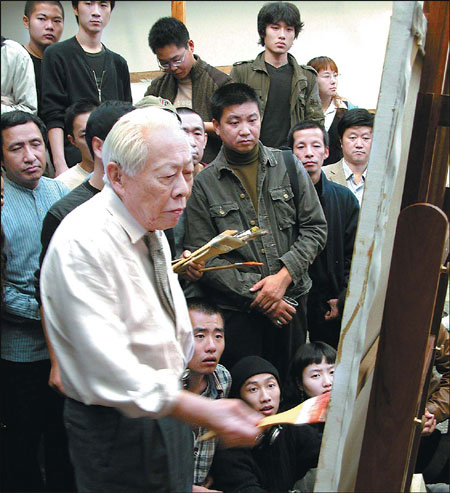
Top: Zao Wou-ki teaching at his alma mater in Hangzhou, Zhejiang province. Below: Zao's 10.03.83 fetched HK$37 million ($4.8 million, 3.7 million euros) at Sotheby's Hong Kong sales on April 6. Photos Provided to China Daily |

The late Chinese-French artist Zao Wou-ki drew on his international perspective and Oriental spirit
A reformer who mixed both Eastern and Western styles, Zao Wou-ki was one of China's most influential artists.
In 1948, he went on to leave his native land for France, where he was one of the first Chinese painters to win international recognition.
Zao, who died at his home in Switzerland on April 9, aged 92, was a success both in terms of artistic accomplishment and performance at auction, his painting 10.1.68 setting a record in 2011 when it sold for HK$68.98 million ($8.9 million) at Sotheby's in Hong Kong.
Hailed as a reformer of Chinese art, his artwork appeals to collectors around the world thanks to his international perspective and the spirit of the Orient that he embodied.
Zao became a French citizen in 1964 and is a respected artist in his adopted country. He was known as one of the "three overseas Chinese art treasures", with the architect Ieoh Ming Pei and the composer Chou Wen-Chung.
Born in Beijing in 1921, Zao soon moved with his family to Nantong, Jiangsu province, when he was young. He was the oldest of seven children in an intellectual family. His banker father was an art lover and owned a large collection of antiques and Chinese painting and calligraphy, from which Zao cultivated his early appreciation for art. He had a special favor for Mi Fu, one of the four greatest calligraphers of the Song Dynasty (960-1279).
Zao demonstrated an early interest in Chinese bronze ware and began his art studies in 1935 at age 14, at Hangzhou National School of Art, now the China Academy of Art, Zhejiang province.
Over the following six years, Zao studied traditional Chinese and Western painting techniques from art masters including Lin Fengmian (1900-1991). His time at the school also exposed him to the art of European masters Cezanne (1839-1906), Matisse (1869-1954) and Picasso (1881-1973), who provided the visions he believed were "closest to nature".
After graduating he became a young teacher at his alma mater and held his first solo exhibition in 1941.
In 1948, Zao went to France to chase his dream of becoming a successful artist, helped by a gift of $30,000 from his father.
It took 36 days to reach Marseilles by ship. The day Zao arrived at Paris by train, he went straight to the Louvre Museum.
Over the next 18 months the young artist spent every afternoon at a museum or gallery. In 1949, his first Paris solo exhibition was held at the Creuze Gallery. It was the first of 160 exhibitions worldwide.
Strongly influenced by the Swiss-German painter Paul Klee (1879-1940), Zao gradually abandoned details, moving away from representational painting and turning toward abstraction.
He believed abstraction provided the greatest freedom and strength. His canvases became a mesh of lines and color blocks invoking scenes from the Earth, such as ocean and fire.
He stopped naming his works after completing Cloud in 1958, only noting down the finishing date on the back of every painting.
Zao took traditional Chinese art as a reference point to create a new sense of space full of rhythm, color and light. By doing so he claimed to have rediscovered the artistic origins of China and was considered to represent the school of Western modern lyrical abstraction.
"People submit themselves to one tradition, while I submit to two," Zao once said of his artistic style. "Although different in presentation, realism and abstractionism are both artists' expressions toward the objective existence."
Yang Feiyun, dean of the Chinese Academy of Oil Painting, says: "Zao is undoubtedly a world-class master. His abstract painting mixes the spirit of both Chinese and Western arts - the idea, form and material come from the West, while the inner core carries the qi (essence) of oriental shan shui (mountains and waters) spirit."
Zao continued to work hard, even in his later years. He especially loved making large paintings, that required a ladder to complete. He was often so caught up in his work that he fell from the ladder several times, injuring his arm, waist and shoulder. Despite this, he never had an assistant.
In 1985 the then 64-year-old returned to China to give a one-month painting master class at his alma mater in Hangzhou, Zhejiang province. Twenty-seven teachers and students from eight art institutions took part, 12 more than planned.
"He was in high spirits every day, looking neat and clean. He was an old man with a Chinese cultural personality," recalls Zhang Xiaoming, deputy director of China Academy of Art's Oil Painting Department, who was the class monitor.
"He was always on time and spent the whole day in the class. And he made revisions to every student's work. During the break he sat on a wicker chair, chatting with us and talking about his association with Picasso.
"Thanks to his class, we got to know painting genres other than Russian realism. We learnt how to apply the concept and line techniques of Chinese painting and calligraphy to oil painting."
Zao even let his wife be the model.
Xiao Feng, the academy's former director, says Zao kept close contact with the academy after he returned to France, sending books, post cards and a print machine. "He said he would provide whatever the alma mater needed."
Once academy teachers held an exhibition in Paris and Zao arrived an hour early, taking the subway to avoid traffic jams.
Zao revisited the school in 2001 and 2004 to teach.
Zao's only son Jialing Zhao says his father had long hoped to build a museum of his art in Hangzhou.
Zao became a member of the French Academy of Fine Arts (Academie des Beaux-Arts) in 2004. In 2006 he was made an officer of the Order of the Legion of Honor by president Jacques Chirac.
Zao's last years were clouded by a feud over the ownership of several of his works between his third wife Francoise Marquet and Jialing Zhao, son with his first wife.
The market for Zao's work has expanded from Europe and the United States to Taiwan, Hong Kong and Southeast Asia over the past 20 years. An increasing number of Chinese mainland collectors also compete for Zao's art at auction.
The website Artprice.com ranked Zao 23rd in the Top 500 artists by auction revenue last year and ninth among Chinese painters, in its latest report on international art market.
"I am not afraid of being old or dead," Zao once said. "As long as I can paint, I am fearless."
Contact the writers at zhangzixuan@chinadaily.com.cn and linqi@chinadaily.com.cn.
(China Daily 04/19/2013 page28)

 Filipinos suffer from shortage of typhoon aid
 Healthy baby born to brain-dead mom in Hungary
 Abe honors heroic Chinese student
 Twin panda cubs at Zoo Atlanta
 Hawaii legalizes gay marriage
 Graduation celebration for Santas
 One World Trade Center deemed tallest US skyscraper
 US honors its veterans with ceremonies, parades

Copyright 1995 - . All rights reserved. The content (including but not limited to text, photo, multimedia information, etc) published in this site belongs to China Daily Information Co (CDIC). Without written authorization from CDIC, such content shall not be republished or used in any form. Note: Browsers with 1024*768 or higher resolution are suggested for this site.
License for publishing multimedia online 0108263 Registration Number: 20100000002731