Japan can learn from Germany in improving ties


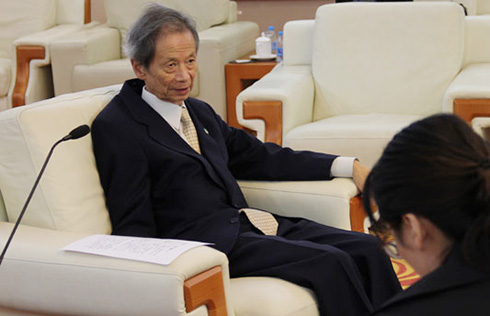
BERLIN - Reflecting on Germany's coping with its Nazi past, prominent German historian Hans-Ulrich Wehler said Japan could learn from Germany in improving ties with its neighbors.
Speaking on occasion of the 68th Anniversary of Victory in Europe Day, Wehler said: "I find it unbearable that more than 60 years after the war Japan still insists on an obstinate attitude."
The 82-year-old historian, known for his role in promoting social history through the "Bielefeld School" and for his critical studies of 19th century Germany, told Xinhua in a recent telephone interview that Japan must finally make a candid public debate on its war past possible.
"For a German, British or U.S. observer, it is obvious that the Japanese must admit the grave guilt," Wehler said. "They have to teach in the schools about the issue. They must encourage lectures and seminars at the universities."
The Japanese themselves also suffered from grave losses due to the atomic bombings during the war, he said, adding that, although they have every reason for self-reflection on the war, they did not do it.
Strangely, after the Tokyo Trial the United States did not push further on the issue in Japan, Wehler said.
"Things were different in Germany. After the trials of leading war criminals in Nuremberg, the German had their own courts pursue and arrest many Nazi war criminals year after year." He said. "These kind of clean-up efforts are missing in Japan."
Reviewing Germany's attitudes toward its war past, Wehler said massive demonstrations in the 1970s against the history of persecution in concentration camps including Auschwitz prompted the public to widely reflect on the history.
Holocaust, a Hollywood TV series broadcast at the end of the 1970s in West Germany about the tragic story of a Jewish family under Nazi persecution, allowed millions of German people to learn about the truth of the Nazi regime's massive persecution of Jewish people, he said.
"It caused a great stir in the society, and many people stopped shirking responsibility after open and extensive discussions. An opinion has finally prevailed in the society that the war started by Germany caused the death of six million Jewish people and millions of Slavs. It is such a grave problem that people cannot gloss over it," he added.
Wehler said his students had a clear idea of the history and would ask detailed questions such as why the ethnic cleansing policy came into being.
"This would not be possible in Japan. The Japanese have until now no textbook for their pupils that give a realistic portrait of their war crimes," he said.
During a speech at the ceremony commemorating the 40th anniversary of the end of war in Europe and of National-Socialist Tyranny on May 8, 1985, the then president of the Federal Republic of Germany Richard von Weizsaecker defined the 8th of May as "a day of liberation" for Germany.
Wehler said Weizsaecker, who experienced the World War II as a soldier himself, had very nicely brought home to the Germans the ambiguous memory of the end of the war.
"To many people, the war is a grave disaster that saw the death of half of the German population and turned 12 million Germans into refugees after being expelled from eastern Europe. But the end of the war also liberated the German people from the Nazi dictatorship," he said.
He said he believes a wise Japanese politician could also achieve such a result by making it clear to the Japanese people that, the war was indeed a disaster to Japan, but Japan must finally face the issue that it had brought great sufferings to millions of Chinese, Koreans and Vietnamese since the early 1930s.
"I think it is a wise attitude to frankly and candidly deal with its own error, but the Japanese political culture apparently finds it very very difficult," he said.
Taking the reconciliation between Germany and Poland as an example, Wehler said the German-Polish relations did not improved markedly until former West German Chancellor Willy Brandt dropped to his knees in front of a monument in remembrance of the victims in Warsasw in 1970.
"Nowadays, Germany and Poland enjoy the closest kind of cooperation within the European Union. We hope Japanese relations with its Asian neighbors could gradually follow suit," Wehler said.