Japan, India eager to forge closer ties


Japan and India are eager to forge closer ties to enhance their economic growth and regional influence.
After Japanese Prime Minister Shinzo Abe and Indian Prime Minister Manmohan Singh held talks in Tokyo on Wednesday, Japan pledged a substantial amount of overseas development assistance to India. The countries decided to accelerate talks on civilian nuclear cooperation and regularly hold bilateral maritime security drills.
Japan is putting its immediate neighbors on the back burner of its foreign policy agenda given that a rather complex Sino-Japanese relationship is coupled with border disputes with South Korea and Russia. The back-up players are Southeast and South Asia countries.
 |
|
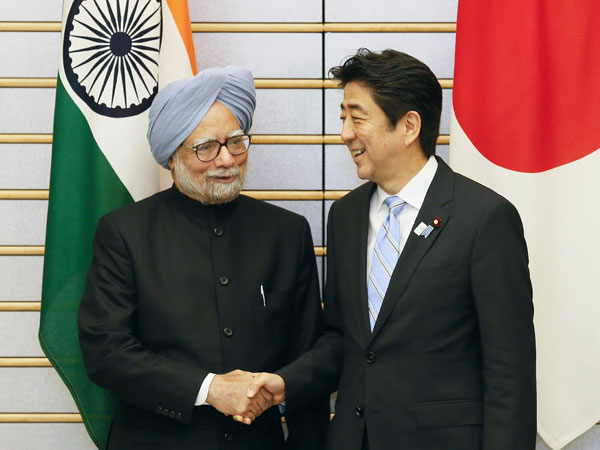
India's Prime Minister Manmohan Singh (L) shakes hands with his Japanese counterpart Shinzo Abe at the start of talks at Abe's official residence in Tokyo May 29, 2013. [Photo/Agencies] |
Singh is on a five-day visit to Japan and Thailand with an eye on adding depth and new meaning to India's "Look East" policy.
Singh talked about the responsibility of India and Japan to address multiple challenges in the India-Pacific region and to chart a new course for Asia this century.
Japan-India relations have historically lacked both depth and breadth. For decades, the two sides remained aloof, first due to the Cold War, and then because of Japan's reflexive opposition to India's nuclear quest. Japanese interest in India is of recent origin, beginning with the advent of Japanese automobiles in the 1980s.
The Abe administration plans to promote international business for Japan's economic growth strategy, dubbed as Abenomics. Singh said India aims to achieve economic growth of 8 percent within two to three years, and needs to increase investment from Japanese companies in renewable and clean energy and urban railway construction.
Civilian cooperation
Singh called Japan his country's natural and indispensable partner. He is a frequent traveler to Japan - visiting the country in December 2006, October 2008 and again in October 2010.
Tonohika Taniguchi, a member of the Japanese prime minister's strategic team, said that "both countries have agreed to an early commencement and conclusion of an agreement" on civilian nuclear cooperation.
The negotiations between the two countries have remained stalled since the disaster in Fukushima in 2011. Abe wants the nuclear reactors in Japan to resume operations once their safety is confirmed, and is looking to push the sale of Japanese reactors to boost the country's economy, which has suffered multiple recessions in the recent past.
India has not signed the Non-Proliferation Treaty or the Comprehensive Test Ban Treaty. Since 2000, three Japanese prime ministers have visited New Delhi, culminating in Abe's visit in August 2007 during his first stint as prime minister.
He expanded Japan-India ties to an "arc of freedom and prosperity" stretching from East Asia to South Asia with shared values and strategic interests as part of a regional core group excluding China.
Malacca Strait
The two countries are approaching each other for a host of obvious and not-so-obvious motives. They claim to share a desire for security of vital sea lanes in the region, primarily in the Malacca Strait. Japan and India have navies that are among the largest in Asia, and both have shown an avid interest in maritime cooperation. Eighty percent of Japan's oil passes through the Strait of Malacca, and 20 percent of ships passing through the strait are Japanese owned. More than 50 percent of India's trade passes through the strait.
India and Japan held their first maritime exercise off the coast of Tokyo in June, paving the way for greater security cooperation. During his New Delhi trip earlier this month, Japanese Deputy Prime Minister Taro Aso called for more regular joint naval exercises with India, stressing that Asia's "two largest maritime democracies" should step up cooperation "to become net providers of regional security".
Trade potential is another important motive for the Japan-India relationship. Bilateral trade levels remain quite low at $6.6 billion - equivalent to just 4 percent of Japan's trade with China. Yet Japan is the third-largest investor in India, with valuable expertise in areas such as manufacturing and infrastructure that India aims to improve in the coming years. Both countries hope to take advantage of the many economic opportunities to enhance ties.