EU firms eye China's clean-tech market


European environmental companies lend a helping hand to reduce the nation's carbon footprint
An increasing amount of energy needed to fuel China's urbanization has caused serious concerns about carbon emissions and environmental pollution, but also opened up a market for some of the best clean-technology companies in Europe.
 |
 |
 |
China overtook the United States as the world's largest producer of carbon emissions in 2007, and two years later its energy consumption also surpassed that of the US to become the largest.
When the World Bank identified the 20 most polluted cities in the world, 16 were in China. The severity of China's pollution was further highlighted by this January's heavy smog in Beijing, when the level of PM2.5 (air pollutants with a diameter of 2.5 micrometers or less) at its peak was 36 times higher than the World Health Organization's recommended standard.
"Energy consumption and emissions generally rise during a country's urbanization process due to rising income levels. When we are traveling or entertaining ourselves in the cities, energy consumption increases," said Jonathan Woetzel, director of McKinsey & Co in China.
Encouragingly, the Chinese government has actively introduced policies to tackle emissions, and one successful example is China's Top-1,000 Energy Consuming Enterprises Program, Woetzel said.
Implemented as a part of China's 11th Five Year Plan (2006-10), the program helped China's largest 1,000 companies achieve a total energy saving of 150 million tons of coal equivalent (Mtce) during the five-year period, surpassing its target of 100 Mtce. In 2012, China consumed 3,620 Mtce.
Woetzel said that other key areas China should focus on to improve energy efficiency are buildings and private vehicles.
"A lot of old buildings are energy intensive and they need more energy-efficient insulation for windows, better use of combined heating, and more efficient central heating in some areas in the north in particular," he said.
Pollution resulting from urbanization is not specific to China. Some of the early-industrialized countries such as the United Kingdom and Germany have gone through the same path and learned lessons the hard way.
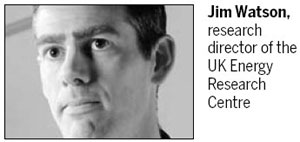
"Like China, the UK also experienced development first and implemented environmental protection measures later," said Jim Watson, research director of the UK Energy Research Centre.
Watson said that Britain relied heavily on coal for its urbanization, which caused air pollution, but major changes happened with the implementation of the Clean Air Act in 1956.
One key measure introduced by the Act was designating "smoke control areas" in some towns and cities where only smokeless fuels could be burnt. It also led to the relocating of power stations away from cities, and increased the height of some chimneys.
Watson said the UK significantly reduced domestic reliance on coal by switching to gas in the 50s, which was supported by government incentives to develop gas resources in the North Sea.
"When the domestic sector made the shift to gas in the 50s, it was still expensive. But when the British industries made the shift mainly in the 90s, gas became a lot cheaper. So what drove it was an economic advantage," Watson said.
"The challenge for China to make a similar shift is lack of access to gas at reasonable prices. China has done well to develop renewable energies, but they are still not at a capacity big enough to replace coal."
Coal currently accounts for 60 percent of China's energy consumption, while oil and natural gas together account for 20 percent.
Germany is another country that has introduced powerful measures to clean up pollution incurred early in the urbanization process.
Marco Voigt, managing director of VKPartner, a German clean-technology consultancy, said an "environmental awakening" came about in the 1980s and 1990s when pioneering studies on air and water quality in Germany's industrial Ruhr area were published.
"These paradigm-shifting studies drew attention to the shocking effects of pollutants on local forests, fish and water resources, which are influential factors in social, economic and political vitality," Voigt said.