Flight attendants ejected during crash


SOUTH SAN FRANCISCO, Calif. - Two flight attendants working in the back of an Asiana Airlines Flight 214 were ejected and survived when the plane slammed into a seawall and lost its tail end during a crash landing at San Francisco's airport. Both women were found on the runway, amid debris.
 |
|
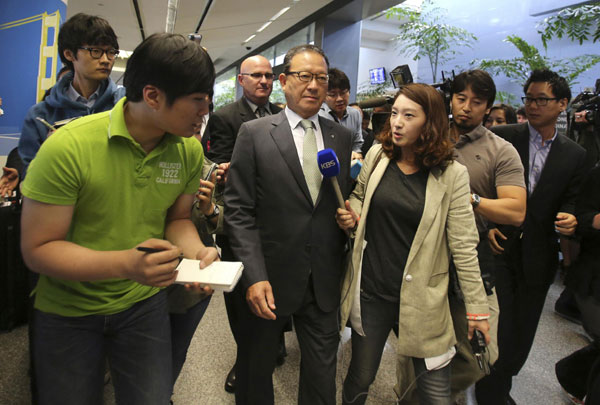
The president and CEO of Asiana Airlines, Yoon Young-Doo arrives at San Francisco Airport International Airport July 9, 2013. Yoon arrived in San Francisco on Tuesday to meet with US investigators and survivors of the Saturday plane crash that killed two people and injured more than 180. [Photo/Agencies] |
In a news conference Tuesday, National Transportation Safety Board officials didn't explain fully why the plane approached the notoriously difficult landing strip too low and slow, likely causing the crash.
NTSB Chairwoman Deborah Hersman said the pilot at the controls was only about halfway through his training on the Boeing 777 and was landing at the San Francisco airport for the first time ever.
Hersman also said his co-pilot was also on his first trip as a flight instructor.
The NTSB hasn't ruled anyone at fault in the crash, but the new details painted a fuller picture of an inexperienced crew that didn't react fast enough to warnings the plane was in trouble.
Audio recordings show pilots tried to correct the plane's speed and elevation only until seconds before hitting the seawall at the end of the runway, a calamitous impact that sent the fuselage bouncing and skidding across the airfield.
Here is what is known: Seven seconds before impact, someone in the cockpit asked for more speed after apparently noticing that the jet was flying far slower than its recommended landing speed. A few seconds later, the yoke began to vibrate violently, an automatic warning telling the pilot the plane is losing lift and in imminent danger of an aerodynamic stall. One and a half seconds before impact came a command to abort the landing.
The plane's airspeed has emerged as a key question mark in the investigation. All aircraft have minimum safe flying speeds that must be maintained or pilots risk a stall, which robs a plane of the lift it needs to stay airborne. Below those speeds, planes become unmaneuverable.
Because pilots, not the control tower, are responsible for the approach and landing, former NTSB Chairman James Hall said, the cockpit communications will be key to figuring out what went wrong.
"Good communication with the flight crew as well as the flight attendants is something I'm sure they're going to look at closely with this event," he said Tuesday. "Who was making decisions?"
Hall was on the transportation board when a Korean Airlines Boeing 747 crashed in Guam in 1997, an accident investigators blamed in part on an authoritarian cockpit culture that made newer pilots reluctant to challenge captains.
Since then, the industry has adopted broad training and requirements for crew resource management, a communications system or philosophy airline pilots are taught in part so that pilots who not at the controls feel free to voice any safety concerns or correct any unsafe behavior, even if it means challenging a more senior pilot or saying something that might give offense.
If any of the Asiana pilots "saw something out of parameters for a safe landing," they were obligated to speak up, said Cass Howell, an associate dean at the Embry-Riddle Aeronautical University in Daytona Beach, Fla.
"There are dozens and dozens of accidents that were preventable had someone been able to speak up when they should have, but they were reluctant to do so for any number of reasons, including looking stupid or offending the captain," said Howell, a former Marine Corps pilot.
There's been no indication, from verbal calls or mechanical issues, that an emergency was ever declared by pilots. Most airlines would require all four pilots to be present for the landing, the time when something is most likely to go wrong, experienced pilots said.
"If there are four pilots there, even if you are sitting on a jump seat, that's something you watch, the airspeed and the descent profile," said John Cox, a former US Airways pilot and former Air Line Pilots Association accident investigator.
Investigators want to nail down exactly what all four pilots were doing at all times.
"We're looking at what they were doing, and we want to understand why they were doing it,." Hersman said Monday. "We want to understand what they knew and what they understood."
It's unlikely there was a lot of chatter as the plane came in. The Federal Aviation Administration's "sterile cockpit" rules require pilots to refrain from any unnecessary conversation while the plane is below 10,000 feet so that their attention is focused on taking off or landing. What little conversation takes places is supposed to be necessary to safely completing the task at hand.
Choi Jeong-ho, a senior official for South Korea's Ministry of Land, Infrastructure and Transport, told reporters in a briefing Tuesday in South Korea that investigators from both countries questioned two of the four Asiana pilots, Lee Gang-guk and Lee Jeong-min, on Monday. They planned to question the other two pilots and air controllers Tuesday.
Choi said recorded conversation between the pilots and air controllers at the San Francisco airport would be investigated, too.
In addition, authorities were reviewing the initial rescue efforts after fire officials acknowledged that one of their trucks might have run over one of the two Chinese teenagers killed in the crash. The students, Wang Linjia and Ye Mengyuan, were part of a larger group headed for a Christian summer camp with dozens of classmates.
Asiana President Yoon Young-doo arrived in San Francisco from South Korea on Tuesday morning, fighting his way through a pack of journalists outside customs.
He said he will look at the efforts of airline employees to help injured passengers and their family members, visit with the NTSB and other organizations to apologize for the crash and try to meet injured passengers.
Yoon said he can't meet with the Asiana pilots because no outside contact with them is allowed until the investigation is completed.
More than 180 people aboard the plane went to hospitals with injuries. But remarkably, more than a third didn't even require hospitalization.
The passengers included 141 Chinese, 77 South Koreans, 64 Americans, three Canadians, three Indians, one Japanese, one Vietnamese and one person from France.
South Korea officials said 39 people remained hospitalized in seven different hospitals in San Francisco.
The flight originated in Shanghai, China, and stopped over in Seoul, South Korea, before making the nearly 11-hour trip to San Francisco.