|
 |
|
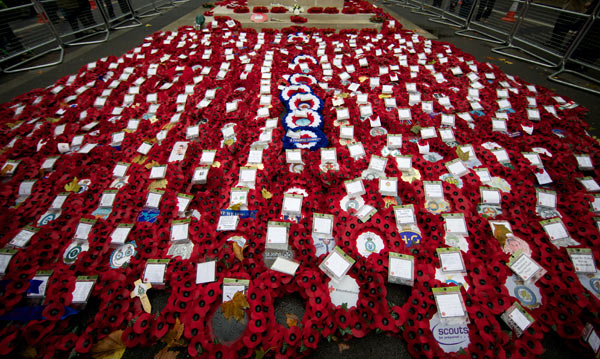
Poppy wreaths lie on the ground during a commemorative service on Armistice Day at the Cenotaph in central London on Monday, in memory of Britain’s war dead. In the run-up to Armistice Day, many Britons wear a paper red poppy — symbolizing the poppies that grew on French and Belgian battlefields during World War I. [Photo/Agencies] |
Monday was Armistice Day, marking the end of World War I (1914-18), one of the deadliest conflicts in history. Preparations are already underway in many countries for the war's centenary next year.
At special moments of remembrance, families, relatives and friends of the war dead, along with surviving war veterans, have visited cemeteries, ruins of battlefields, museums and churches across Europe to express love and pay tribute to the fallen.
The Great War was not confined to the European continent but spread to Asia as well.
In 1914, Japan declared war on Germany, but its main battlefields were in China's Shandong Peninsula, which was under German control at the time. In 1917, China sought to regain those territories that had fallen under Japanese control, and in the process, China also declared war on Germany.
China only regained this territory and others following its victory in the War of Resistance Against Japanese Aggression (1937-45).
On these days of remembrance, the world should heed the warning of such a humiliating period in history, when the two opposing sides fought on Chinese territory. This should not be forgotten. And it should not be repeated.
In fact, China's involvement in the Great War was both humiliating and honorable. More than 140,000 Chinese people, aged 20 to 35, were recruited by the United Kingdom and France to perform support work for their military forces on the western front, starting in 1916.
They served as laborers in the rear echelons or helped build munitions depots. They carried out essential work to support frontline troops, such as unloading ships, building dugouts, repairing roads and railways, digging trenches and filling sandbags.
I have been hearing their stories for many years. During my childhood, I even heard the story of Y.C. James Yen (1893-1990), whose Chinese name was Yan Yangchu. Yen was a Yale graduate from Sichuan province who pioneered urban literacy training. In his hometown, less than 50 kilometers from my own, he taught laborers how to write letters to their families during wartime.
With all this in mind, last Sunday, amid the chilly weather of autumn, I paid a visit to the cemeteries and battlefields near the western front of the Great War. I arrived in Poperinge, a small town about 14 km from the frontline at Ypres.
And just a few minutes drive from the town center, I came to the final resting place for up to 10,000 soldiers: Lijssenthoek Military Cemetery, one of 900 such cemeteries in Belgium and France.
Before I left Brussels, I had discovered that there were 35 Chinese laborers buried in the cemetery. In a solemn mood, I carefully read the headstones, under the shadows of trees and surrounded by flowers. As one Belgian writer says, every death of a frontline soldier, at such a young age, consisted of a bloody chronicle of war.
I was a little bit disappointed because I could not find a single headstone of a Chinese laborer. At this moment, a British couple in their 60s attracted my attention. They told me they had come for the special service on Monday and they came nearly every year to remember not only their families, but former pupils from Plymouth Grammar School in southern England.
The man told me that 130 "old pupils" from his school had fought in the war and six of them were buried in the cemetery. The man is now doing research and will edit a book for the "old pupils" next year.
He knew that the Chinese labor corps had made a "tremendous contribution" to the Allied effort in the Great War. And he said he hoped the dead would rest well and there would be no third world war. "This is my hope," said the old man as he waved goodbye to me.
Hearing this, I sensed the strong anti-war commitment of ordinary Europeans, whose families or relatives experienced two world wars during the first half of the last century. This is the very foundation of the European Union.
I paid my respects to them because their efforts achieved peace and prosperity in Europe in previous decades.
However, at the special moment of remembrance, we should not forget that some European powers, such as the UK and France, together with the US, are still behind modern wars in Africa, the Middle East and other regions of this world. And we should also not forget that some hard-liners in Japan and the Philippines are still contributing to insecurity in East and South Asia.
Learning from history and preventing similar tragedies should be an essential part of remembering the dead.
|
|
|
|
|
|
|
|

Copyright 1995 - . All rights reserved. The content (including but not limited to text, photo, multimedia information, etc) published in this site belongs to China Daily Information Co (CDIC). Without written authorization from CDIC, such content shall not be republished or used in any form. Note: Browsers with 1024*768 or higher resolution are suggested for this site.
License for publishing multimedia online 0108263 Registration Number: 20100000002731 















 Op Rana
 Berlin Fang
 Zhu Yuan
 Huang Xiangyang
 Chen Weihua
 Liu Shinan