|
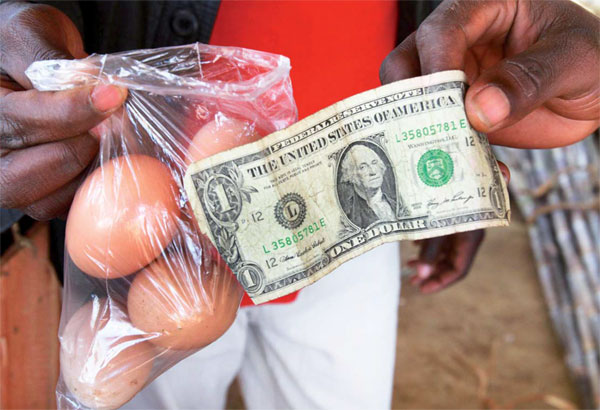
A man buys eggs with $1 at a market in Harare, Zimbabwe. Philimon Bulawayo / Reuters |
Renminbi becomes legal tender, a move which can help trade relations
American greenback or Chinese yuan? Zimbabweans are now being given more options as to which money they prefer to put in their pockets.
The southern African country, without its own currency at the moment, has allowed nine of the world's major currencies to trade as legal tender since January.
Along with the Japanese yen, the Indian rupee and the Australian dollar, the Chinese yuan was officially added in the basket of currencies accepted as legal tender in Zimbabwe in January. Acting central bank governor Charity Dhliwayo, who made the announcement, says it was done because trade and investment ties between Zimbabwe and China, India, Japan and Australia have grown appreciably.
Dhliwayo says individuals and businesses can now open bank accounts denominated in the four new currencies, in addition to Botswana pula, British pound, South African rand and the US dollar.
For the dominating currency, market analysts have placed their bets on the US dollar, which most Zimbabweans have been using since 2009, at least for the near future. The yuan is a likely challenger to the greenback as trade and economic interaction grow.
Zimbabwe abandoned its currency in 2009 after hyperinflation rendered it worthless and has since adopted the multi-currency system. But four years on, prices across the country are almost all denominated in the greenback with rand and pula being used as changes smaller than a dollar. The pound and euro, however, are rarely seen.
Dhliwayo confirmed that the government, led by veteran President Robert Mugabe, had made it clear that the widespread "speculated" re-introduction of the Zimbabwean dollar can be "put to rest".
John Robertson, an independent economic analyst, says the four new currencies will likely meet the same fate as the pound and euro. He also refuted that the move would solve the severe liquidity crunch the country faces.
"The additional currencies that can now be officially used in Zimbabwe will not make the slightest difference to anything," Robertson says. "We price our exports in the US dollar, we price our imports in either the US dollar or rand and the additional currencies on the list won't affect the quantities of money flowing either way," he says.
Although four currencies were added to the already circulating currencies, people reacted to the Chinese yuan more than other currencies probably because "made in China" products flourish in the Zimbabwean market.
Some banks - like BancABC and Stanbic - have already launched yuan services while others like Standard Chartered and Barclays say they haven't officially received the directive from the central bank.
Economist and University of Zimbabwe lecturer Edgar Muhoyi says with the recent move China will transact more easily with Zimbabwe than before.
Trade between China and Zimbabwe has grown by more than $1 billion annually for the past two years. And China has been Zimbabwe's biggest source of foreign investment since 2009. Chinese investments cover a wide range of sectors from mining, and manufacturing, to agriculture and social services.
"Now with the Look East policy, we are much involved in transactions with China compared to the rest of the world. The yuan may even beat the US dollar in the market," Muhoyi says.
He says the preferred currency will be the one that is more stable and will also depend on the transactions being made.
A young businessman who sells electronic gadgets and identifies himself as Popula welcomes the central bank's move as he buys most of his goods from China.
"I think the addition of the Chinese yuan in the basket will make transactions easier than before since we no longer need to convert the money first," he says.
But some forex dealers and retailers were caught off guard by the central bank's move, raising concern that with more currencies, transactions will become more tedious and time-consuming. There are no signs yet that more Chinese notes are flooding into the market. In shops, people still get their change in rand, credit notes, phone top-up cards, candies and popsicles.
"We are already having trouble exchanging the US dollar and the rand in shops, now we have Chinese and Indian money. It means we have to make calculations every time we serve a customer," says Gladys Ruziviso, a salesperson at a chain shop.
"Customers don't like to make conversions and will not be happy to receive change in other currencies other than the rand," she says.
Russel Mutyambizi, a foreign currency dealer, says he fears that people might be fooled by fake notes as most Zimbabweans, including forex dealers, are not familiar with the new currencies.
"How many Zimbabweans can differentiate a fake yuan from an original one," asks Mutyambizi.
Xinhua News Agency
(China Daily Africa Weekly 02/21/2014 page20)

Copyright 1995 - . All rights reserved. The content (including but not limited to text, photo, multimedia information, etc) published in this site belongs to China Daily Information Co (CDIC). Without written authorization from CDIC, such content shall not be republished or used in any form. Note: Browsers with 1024*768 or higher resolution are suggested for this site.
License for publishing multimedia online 0108263 Registration Number: 130349