|
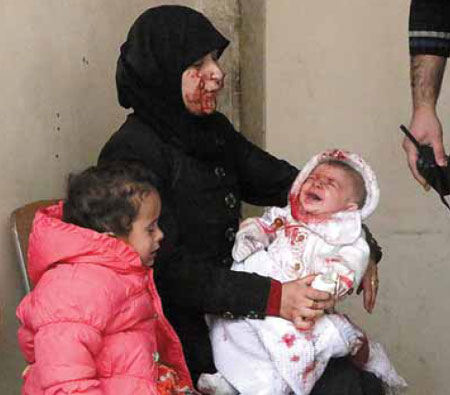
A woman holds her baby at a hospital in Aleppo's al-Sakhour district, after what activists said was a barrel bomb dropped at Aleppo's Haydariye district by forces loyal to Syria's President Bashar al-Assad, on Sunday. Hosam Katan / Reuters |
Newborns freezing to death in hospital incubators, doctors cutting off limbs to stop patients from bleeding to death, surging cases of polio: A new report published on Monday paints a dire picture of Syria's collapsing healthcare system.
The report, issued by charity Save the Children, said some 60 percent of Syria's hospitals have been damaged or destroyed since the start of the 3-year-old conflict and that nearly half of its doctors have fled the country.
More than 140,000 people have died in the civil war after protest against President Bashar al-Assad degenerated into civil conflict fueled by regional and international rivalries.
In its report, Save the Children described the fallout from the collapse of the medical system as "horrific", as remaining hospitals and medical staff struggle to treat hundreds of thousands of people wounded by the fighting.
"Syria's health system is now in such disarray that we have heard reports of doctors using old clothes for bandages and patients opting to be knocked unconscious with metal bars, because there is no anesthetic," the report said.
"The lack of clean water means sterilization for bandages is nearly impossible, causing the threat of infection and possible death."
Children's limbs have been amputated because clinics did not have the equipment to treat their wounds, it said. Newborns have died in incubators because of power cuts and parents have administered intravenous drips to their children because there was not enough medical staff to help them.
Patients have died from receiving wrong blood types, and transfusions have in some places been performed directly between people because of a lack of power, according to the report.
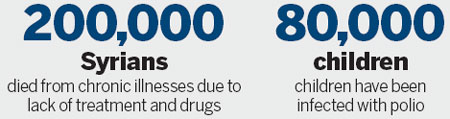
The report quoted the Syrian American Medical Society as estimating that, since the start of the conflict, 200,000 Syrians had died from chronic illnesses because of a lack of access to treatment and drugs.
Syria's vaccination coverage has also been hit hard. Before the war, coverage was 91 percent, but fell to 68 percent just a year after the conflict's start, and is probably much lower now, the report said.
Measles and meningitis have spread, and polio - which the report said was eradicated across Syria in 1995 - has now infected up to 80,000 children, it added.
"The breakdown of Syria's vaccination program has resulted in the re-emergence of polio in Syria," it said.
"Children born after 2010 have not been vaccinated for two years. There have been heavy restrictions in access to vaccines and health workers have not been able to reach children in need."
Factors including overcrowding and poor living conditions, water and sanitation have meant skin diseases including Leishmaniasis - a parasitic disease caused by the bite of the sandfly - have increased.
There were fewer than 3,000 cases before the war, and now there are more than 100,000.
Save the Children called for humanitarian groups to be given freedom of access to all areas and aid to be allowed across conflict lines, after cease-fires if necessary.
"Immediate investment in, and access to, child-focused health services is needed to ensure that children are not dying from preventable and treatable injuries and illnesses," it said.
Report's findings
Syria's health system is now in such disarray that there are reports of doctors using old clothes for bandages and patients opting to be knocked unconscious with metal bars, because there are no anaesthetics. The lack of clean water means sterilization for bandages is nearly impossible, causing the threat of infection and possible death.
Patients have died from receiving wrong blood types, and transfusions have in some places been performed directly between people because of a lack of power.

Copyright 1995 - . All rights reserved. The content (including but not limited to text, photo, multimedia information, etc) published in this site belongs to China Daily Information Co (CDIC). Without written authorization from CDIC, such content shall not be republished or used in any form. Note: Browsers with 1024*768 or higher resolution are suggested for this site.
License for publishing multimedia online 0108263 Registration Number: 130349