Arrows and tear gas canisters fly near Brasilia's new stadium
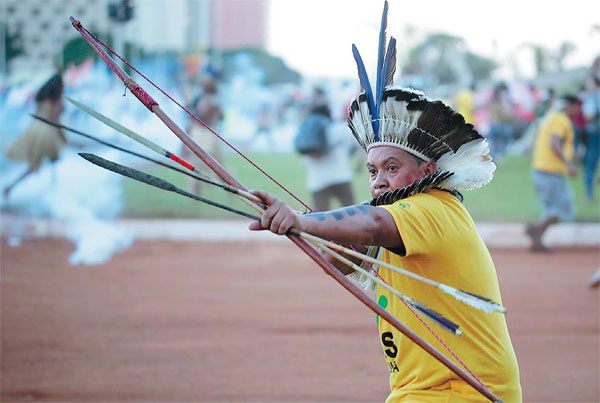
Indigenous protesters wearing traditional headdress clashed with police in Brazil's capital on Tuesday, resulting in one officer being shot in the leg with an arrow and the cancellation of a ceremony to open the exhibition of the World Cup trophy.
In clashes broadcast live on television, riot police fired tear gas into small pockets of protesters as they approached Brasilia's new stadium, which will host World Cup matches. Protesters were seen picking up the gas canisters and tossing them back at officers, along with stones and pieces of wood.
|
An indigenous Brazilian man aims an arrow at riot police who fired tear gas to prevent a group of Indians from approaching the Mane Garrincha soccer stadium during a demonstration in Brasilia on Tuesday. Indigenous people from different tribes protested against the government's Indian policy and the costs of the 2014 World Cup. Joedson Alves / Reuters |
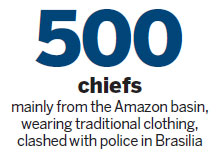
Wearing traditional clothing including feather headdresses and face paint, about 500 chiefs, mainly from the Amazon basin, joined another 500 protesters rallying for various social causes in Brasilia's government square and began marching toward the stadium.
As mounted police moved to block the march, some of the demonstrators rushed their horses and fired arrows in their direction.
Globo TV showed images of a police motorcycle that had been peppered with arrows.
Some of the indigenous protesters could be seen throwing stones at some of the 700 police encircling the stadium. Protesters also blocked streets around the government plaza, where the congress, presidential palace and Supreme Court are located.
Earlier, the aboriginal leaders climbed a ramp onto the roof of the congress building in a protest they said was aimed at protecting their rights.
The protest, which brought together 100 ethnic groups from across Brazil, included Kayapo chief Raoni, an 84-year-old leader famous for fighting to protect the Amazon rain forest alongside British pop music star Sting.
"Climbing onto the congress building was an act of bravery, it shows we're warriors who defend our rights," said Tamalui Kuikuru, an indigenous leader from the Xingu region in the western state of Mato Grosso.
Protesters align
They soon came down from the roof and rejoined the rest of the protesters along the main avenue where Brazil's government ministries are located.
"Who is the Cup for? Not us!" shouted demonstrators. "I don't want the Cup, I want money for health and education."
Full-blooded indigenous people in Brazil - who make up 0.3 percent of the country's population of 200 million - have staged a series of protests in recent months, accusing President Dilma Rousseff's government of stalling the demarcation of their ancestral lands and pursuing policies that favor large-scale farming.
In the runup to the World Cup, which opens on June 12, Brazil has also faced a wave of demonstrations by protesters angry over the $11 billion budget for the tournament, money they say should have been spent on programs to benefit the poor.
The indigenous leaders, who opened their protest with traditional prayers and drumming, aligned themselves with the broader anti-World Cup cause.
"Before organizing the World Cup, Brazil should have thought more about health, education and housing," said Neguinho Truka, a leader of the Truka people in the northern state of Pernambuco who was wearing a headdress of red and blue feathers.
Last year when Brazil hosted the Confederations Cup - a World Cup dress rehearsal - protests brought a million people into the streets and turned violent at times, to the embarrassment of tournament organizers.
Since then the protests have drawn smaller numbers but grown more radical. In recent weeks they have mainly been organized by established unions, leftist parties and activist groups such as the Landless Movement and the Homeless Workers' Movement, which was present at Tuesday's protest.
Brazil has also been hit by a series of strikes ahead of the World Cup and a presidential election in October. Police, teachers, bus drivers and bank security guards have all gone on strike in recent weeks.
Bus drivers in Rio de Janeiro called a new 24-hour strike for Wednesday. Two weeks ago they trashed hundreds of buses and caused traffic chaos during a similar strike.
Strikes have also paralyzed the bus networks in World Cup host cities Salvador and Sao Paulo recently.
AFP-AP
(China Daily 05/29/2014 page10)

Copyright 1995 - . All rights reserved. The content (including but not limited to text, photo, multimedia information, etc) published in this site belongs to China Daily Information Co (CDIC). Without written authorization from CDIC, such content shall not be republished or used in any form. Note: Browsers with 1024*768 or higher resolution are suggested for this site.
License for publishing multimedia online 0108263 Registration Number: 130349