|
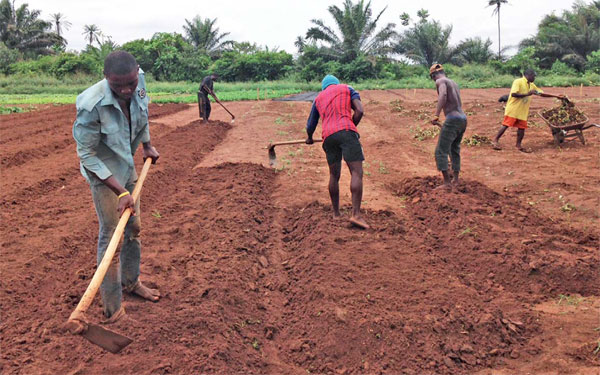
Workers in the fields of Seven Star Farm Ltd, a company started by a Chinese businessman in Nigeria. Photos provided to China Daily |

The Chinese founder of an expanding farm in southwestern Nigeria says more focus should be put on the largely sidelined sector
Nigeria's economy used to be dominated by agriculture, meaning strong exports of food and other related products, and plenty left over to feed its own population.
However, since vast reserves of oil and gas were found in the late 1950s, its agriculture industry has been gradually sidelined, and the country now has to depend on imports for its domestic needs.
Now some people, such as Ni Mengxiao, are hoping to change that trend.
The president of Seven Star Farm Ltd says agriculture not only has a promising future here, but should be given stronger priority in the country's development.
"I think Nigeria has a lot more than oil, and that the government gives too much preference to it," he says.
Seven Star is in the town of Agbara in southwestern Ogun State, and covers 12 hectares.
Its daily sales of more than 40 kinds of fruit and vegetables is between one and two tons, depending on seasonal harvests and demand.
"Our main customers are Chinese companies and some local supermarkets," Ni says.

"The local people have quite a limited choice, mainly yams, cassava, corn or potatoes, but foreigners here demand different types of vegetables."
Through the introduction and trial of new varieties, Ni says he has tried to expand local tastes, especially for the leafy green vegetables so popular back in China.
"Initially I chased after local wholesale agents to sell them our new types of vegetables, but now they are chasing me on behalf of local costumers, especially to buy green kidney beans, cucumbers and bitter gourd," he says.
One sales agent, who wanted to remain anonymous, says he is very much a convert to Ni's new leafy greens, and adds, "I tell people, 'If you don't try them, you will never find out the magic of them'.
"I am always convincing my old customers to try new vegetables, and many of them now like them, so my partnership with Seven Star will continue to be strong."
But Ni says his farm is not only about fostering new eating habits for local people, or strengthening the country's food safety. It is more about re-creating the largely forgotten commercial value of agriculture as a whole.
"The export of agricultural products is a significant part of many countries' exports, and Nigeria still enjoys the perfect natural condition for this, as it has for the past century," he says.
"So as our business grows, I plan to start exporting quality Nigerian fruit and vegetables around the world."
As in other West African states, Nigeria's south is the best growing region for cash crops because its forests and savannas benefit from abundant rain and a relatively short dry season.
But smallholder farmers have often used simple production techniques and methods of farming, which do not achieve the kind of yield Ni is aiming for.
"To make us more commercially valuable, we now need to expand our farm, and that's why we have bought another 1,200 hectares and we hope to bring in even more commercial crops for this second phase of the farm."
One of those is likely to be highly valued moringa seeds, which he says have a host of nutritive uses for both people and livestock.
The seeds are especially prized in China, Ni says, to control high blood pressure and constipation.
He is working with local authorities to try to import some newer types of produce, but despite the demand, local laws and regulations can be strict.
"It can be challenging, given that local policies tend to change quickly, but we are trying."
Ni first arrived in Nigeria in 2003 and started a business selling shoes, but that proved tricky as the import of foreign shoes is restricted, and all shoes have to be produced in the country to protect the local industry.
"The business went well enough, but I wanted to try something else and so I bought 12 hectares of land in Osun, next to Lagos, and planned to build a paper mill."
But with the local currency, the naira, fluctuating erratically in 2008, outsiders like himself were reluctant to take on larger investments.
"But I still needed to make the best use of the land, at the lowest cost. I had grown up in villages in China and had a natural love toward planting vegetables.
"After six years of living in Nigeria, I found it difficult to find fresh vegetables with green leaves, so I saw this as a great opportunity."
After his first three years of farming, profits were low, but he was hooked on the project.
"It's hard to earn big money as in other industries, but it's meaningful to me and to the local people.
"The market clearly existed and I could only see it growing."
He says that at times he found life on the farm lonely, and very hard work, and he had to accept that it could take him 10 years to get his business firmly established - "but that's the nature of agriculture".
Ni says his goal is to expand into neighboring countries and then open processing factories.
At times, he says, he is limited by the expertise of his employees, and will need more specialized outside help to develop.
"It's a sad reality here, that even employees from local villages have little proper agricultural experience, and I have to hire specialists from China to teach them how to grow and maintain the farm.
"We now have more than 100 local employees and we hope to continue growing that number."
His workers, he says, are excellent at communicating among themselves, and teaching each other. His job is to identify team leaders, and teach them the skills they need, which can then be passed down the ranks.
"Inevitably, when my staff wants to go to school or find better paid work, I feel so proud because that means my farm has taught them some really valuable skills," he adds.
Agbata Peter Ebuka, 31, a worker who has been at Seven Star for three years, says the farm is not only the job that feeds him and his family, but a way to learn agricultural skills.
"I didn't have any proper education when I was young and I also didn't have the chance to do anything related to agriculture, so before I came here I felt lost.
"But Seven Star is my starting point to learn something new, and I see it as something to live up to in future."
Ni says he sees the development of a second phase of the farm as the perfect opportunity to bring in new varieties of fruit and vegetables, and the chance for him to learn new skills.
An evaluation done for him recently by the Chinese Academy of Agricultural Sciences suggests that this could cost $50 million, and so he plans to make the transition gradual.
"It's so expensive, because I want my farm to be totally organic and sustainable, so most of that expense will be the installation of a solar energy system.
"I will have to start small and then attract more investment."
Unlike some Chinese private investors in Africa, whose integration with the local society has been limited, Ni says he has participated in and sponsored many local events, with or without the help of other Chinese.
"I have been working and living in Nigeria for a long time, so I see myself as part of its society.
"My employees make me feel like I am living in a family, so it's natural to support them by offering my skills as a social entrepreneur."
Last month, that local support was sponsoring a primary and middle school intelligence competition, organized by the local television station. His 3 million naira ($1,8500), he says, was money really well spent.
lilianxing@chinadaily.com.cn

Copyright 1995 - . All rights reserved. The content (including but not limited to text, photo, multimedia information, etc) published in this site belongs to China Daily Information Co (CDIC). Without written authorization from CDIC, such content shall not be republished or used in any form. Note: Browsers with 1024*768 or higher resolution are suggested for this site.
License for publishing multimedia online 0108263 Registration Number: 130349