|
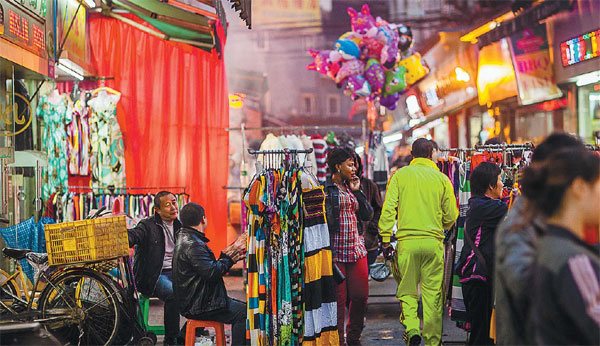
When night falls, street stands selling clothes quietly spring up in Baohanzhijie Road, Guangzhou. These stands are run by Africans, and mostly sold to African people nearby. Li Dong / China Daily |
|
Photography has opened a new chapter in Li Dong's life. Provided to China Daily |
Li Dong has abandoned his life as an engineer and now focuses on portraying the lives of migrants in Guangzhou
Li Dong once made a good living designing plants for foreign and domestic manufacturers.
But the days the chemical engineering graduate from Zhejiang University finds far greater rewards from a source - photographing the lives of Africans living in Guangzhou, Guangdong province.
A month-long exhibition of 63 pieces of his works has drawn acclaim for its ability to capture the highs and lows of their existence. And after the shots were put onto the Internet, they also triggered wide online discussion.
His lens was first drawn to the colorful lives of Africans after taking photographs in informal migrant settlements, known as chengzhongcun in China.
The areas often stand out against the backdrop of the high-rise buildings surrounding them.
The Dengfeng community, particularly, in central Guangzhou, is home to many Africans seeking their fortunes.
Along a 300-meter stretch of its Baohanzhijie Road, close to several wholesale markets favored by African traders, he found thousands of workers living mainly in subdivided apartments - a perfect microcosm, thought Li, and he set about cataloguing the ups and downs of their lives.
However, he soon found that his subjects could prove a little reluctant to take center stage.
"Some shouted at me when I aimed my camera at them, afraid that I was a news reporter or someone else who might bring the police there, suspecting that they might not have valid visas.
"It was hard to meet them, too, because many left for work early in the morning and returned late at night.
"Then there was the language barrier, many speaking French or Arabic, and I only spoke a little English."
Anxious to get his project off the ground, Li decided in March last year to get closer to them by renting an apartment in Baohanzhijie Road.
He eventually stayed for six months.
"I was a little scared at the start. It can be daunting to arrive somewhere new, especially when you have little understanding of the entire group of people living around you."
He soon got to know Monem from Sudan, one of four Africans living in his block, who had come to Guangzhou to work with his brother who ran a trading company nearby.
He joined Monem at the China Import and Export Fair, best known simply as the Canton Fair, eating with him at a local Sudanese restaurant, visiting his mosque, and meeting his friends.
Baohanzhijie Road is home to mainly low-income workers. It is quiet by day, but comes to life after dark, as workers return home to shop and eat, possibly to drink, and finally to sleep.
For some, getting used to their new surroundings, the drinking went on well into the night, Li says.
He learned that many of his neighbors were simply there to make a better living.
"As was the case for me, moving from Chongqing to Guangzhou, they needed to get to know the city, and how to integrate - but for them it was far more difficult, and often that meant getting a visa, simply to stay," Li says.
He saw that in history China is not really a migrant country, but it has now started to evolve into an immigrant society.
He met people from many different places who had made their homes in Guangzhou, and realized that in this particular place, there were now very few actual local people left.
"The cultural and social lessons learned from the photos I took were very valuable.
"It's easy to take beautiful photos but much harder to express the meaning behind what I am shooting.
"Through this form of documentary photography, I wanted to achieve something enlightening, which really showed what life was like here, and what really mattered to people."
Li says he has been observing the interaction between Chinese and foreigners since he was young.
He first noticed the foreign experts employed at the chemical fiber plant where his parents worked at in Chongqing, for example, being surrounded by curious people when they visited the local wet market in the 1970's.
Earlier in his life as an engineer, he says, he was able to learn from foreign colleagues in areas such as project management and the technical aspects of plant design.
His real home is a villa in Guangzhou, "a tolerant and inclusive city", he adds, and he is able to travel abroad with his family every year, and buy almost whatever they want.
Wang Shaobo, a part-time researcher with the Institute of African Studies at Zhejiang Normal University, and a photographer friend of Li who lived in Africa himself for six years, says he was initially surprised by what he called the "highly internationalized community" when he first visited Baohanzhijie Road with Li a year earlier.
But he thinks Li's collection of work has managed to sensitively capture the essence of chengzhongcun life.
Zhou Daming, director of the China Cross-Cultural Consulting Center at Guangzhou-based Sun Yat-sen University, says academics have been studying international immigrants for years, but also agrees Li's images have been able to illustrate the issues they face much better.
Although his life in engineering was financially more rewarding, Li says, it rarely allowed him and his fellow workers anything like a true understanding of the city.
But as a photographer, his experiences in Baohanzhijie Road with his African neighbors have given him a far deeper and richer appreciation of the southern metropolis.
Li says he has been approached by some foreign researchers to help in their studies of Africans, and even Indians, living and working in China.
His photos will be put on show in Paris, Rome and later this year at the University of Cologne, and Li now plans to write a book on his experiences.
Meanwhile, he is now also turning his sights on a new address in the city, the long Zhongshan Avenue, which links some of its most important economic development zones with the ancient Nanhai God Temple, one of the starting points of the ancient Maritime Silk Road at Huangpu Port.
He Xiaotong contributed to this story.
liwenfang@chinadaily.com.cn

Copyright 1995 - . All rights reserved. The content (including but not limited to text, photo, multimedia information, etc) published in this site belongs to China Daily Information Co (CDIC). Without written authorization from CDIC, such content shall not be republished or used in any form. Note: Browsers with 1024*768 or higher resolution are suggested for this site.
License for publishing multimedia online 0108263 Registration Number: 130349