 |
|
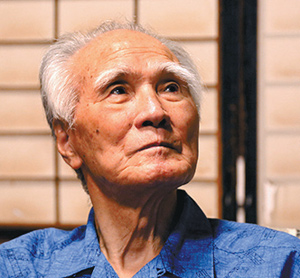
Former Japanese prime minister Tomiichi Murayama blames the United States for conflicting views on the war in Japan. [CAI HONG / CHINA DAILY] |
A young man who would become the country's prime minister lived near the base and saw the pilots' anxiety as they awaited orders that would send them to their deaths.
"These were boys of my age, and I could see how nervous they were," Tomiichi Murayama, now 90, recalled in an exclusive interview with China Daily at his home in Oita, a city near Usa.
Murayama was drafted into the Imperial army in 1944 and was discharged shortly after Japan surrendered in 1945.
"Japan insisted on the suicide tactics even though its defeat was in sight,'' he said.
Memories of the young suicide pilots, who did not have enough fuel to make it back to base even if their nerve failed, still haunt Murayama and he wants to pass on his experiences to younger Japanese who have no idea about the ravages of war.
"When the war drew to a close, Japan was running out of food and weapons. Many areas had been burned down and were lying in ruins."
Time has not lessened, nor dulled, his memories and he is as active as men half his age as he crisscrosses Japan to deliver speeches on the war and speak against what is called collective self-defense.
The talks are well received by his audiences, many of whom are of the age that could see them don a uniform and be sent overseas.
Japanese Prime Minister Shinzo Abe's Cabinet decided on July 1 to reinterpret the Constitution to allow Japanese soldiers to fight alongside allies, marking a dramatic shift as it overrode Article 9 of the Constitution.
The reinterpretation has to be approved by parliament, which Abe's Liberal Democratic Party controls. Reinterpreting the article means there is no need to call a referendum.
Japan adopted a pacifist Constitution after its surrender in 1945. Since then, its troops have not engaged in combat, although some have taken part in UN peacekeeping missions.
Murayama, a Democratic Socialist, led a three-party coalition government from 1994 to 1996 that included the Liberal Democratic Party.
On Aug 15, 1995, the 50th anniversary of Japan's surrender, Murayama delivered an unprecedented statement of remorse and apology for Japan's wartime aggression and the atrocities it had committed. This is usually referred to as the Murayama statement.
Since taking office in 2012, Abe has publicly questioned the meaning of the word "aggression" in the Murayama statement and said there is no academic or international consensus on its definition.
Abe suggested that his Cabinet does not necessarily support Murayama's entire apology, and intends to issue his own "21st-century-oriented" statement.
Murayama was gratified by his countrymen's support and by praise from the international community for his statement.
But Japanese people remain divided on the causes of the war. For some, it was a result of the country's aggression. For others, it was a reaction to Western powers setting up colonies in Asia and depriving Japan of resources, especially oil.
Murayama blamed the United States for conflicting views on the war in Japan. "The US did not leave a clear-cut settlement of Japan's war responsibilities," he said.
He is suspicious of Abe's motives in shifting Japan away from its post-war status.
Abe claims that the US imposed a post-war constitution on Japan and believes that a new constitution is needed.
Murayama is proud of the way the Japanese abided by the pacifist Constitution. "This supreme law helped Japan shun conflicts and wars, such as those in the Korean Peninsula, Vietnam and the Gulf.
"Thanks to their own efforts, Japanese people have lived in peace and this made growth and prosperity possible. So any attempt to break away from this path and allow Japan to launch or participate in wars again is going to meet opposition," he said.
Memories of the war are so painful that the country's military is not called an army or navy but a self-defense force.
The constitutional legitimacy was challenged as recently as the 1980s and Murayama faced harsh criticism because he dared not mobilize more SDF soldiers to help with rescue work after the Kobe earthquake in 1995.
But in 2011, when the earthquake and tsunami struck on March 11, the SDF won widespread praise for its relief efforts.
Murayama was born into a fisherman's family, the sixth of 11 children.
He entered politics "by happenstance". Starting with an Oita city assembly seat, he became prime minister in 1994 when he took over leadership of the Social Democratic Party, which was already in Cabinet.
Like many Japanese prime ministers, Murayama had a short premiership and in 1995 his party lost a number of seats, paving the way for the return of the LDP, the dominant force in Japanese politics. He stood down as party leader in 1996.
caihong@chinadaily.com.cn

Copyright 1995 - . All rights reserved. The content (including but not limited to text, photo, multimedia information, etc) published in this site belongs to China Daily Information Co (CDIC). Without written authorization from CDIC, such content shall not be republished or used in any form. Note: Browsers with 1024*768 or higher resolution are suggested for this site.
License for publishing multimedia online 0108263 Registration Number: 130349