TOKYO - Located in Kudankita in Chiyoda Ward in central Tokyo, Yasukuni Shrine is regarded as the most notorious Japanese shrine worldwide, especially in the international political arena, as each and every visit here by officials upsets and incenses Japan's neighboring countries.
|
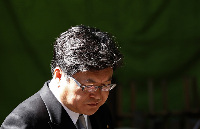 |
| Abe sends offering to Yasukuni Shrine, cabinet ministers visit? |
|
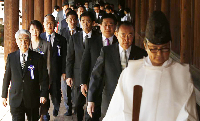 |
| Yasukuni Shrine visits face strong criticism in Japan |
Such a benign public feeling toward the shrine is exactly what the government here wants -- to pretend the shrine is ordinary and to make people neglect or even forget the background of the shrine, and by doing so tacitly approve the shrine continuing to spread its war-honoring spirit. However, it is easy to reveal the true secret of Yasukuni and the key just lies in a nearby museum, namely the Yushukan museum.
The Japanese captions on the so-called "treasures" the Yushukan exhibits -- mostly relics of the Japanese war dead -- are much different from their English version in an effort to relax and appease foreign visitors, but such lies are not difficult to uncover.
"When a crisis arose, Japan's first warriors took up their weapons and headed for the front lines. There they fought bravely, defending their homes, their villages, and their nation. Yasukuni Shrine was established to honor the courageous soldiers who laid the foundation for modern Japan and to pray for the repose of their souls," said the Yushukan in its entranceway under the title "Spirit of the Samurai."
Photos, including Aritomo Yamagata, Iwao Oyama, Heihachiro Togo, Akihito Komatsu, Sukeyuki Ito and some others, who served in the Japanese army or government and participated in Japan's aggressive war since the Meiji Restoration, are placed around the entranceway, showing that they are the very people Yasukuni worships, not to mention the 14 class-A convicted Japanese war criminals during World War II enshrined in Yasukuni secretly in 1978.
On the Pacific war waged by Japan during the World War II, the Yushukan called it "the Greater East Asia War" and said that "not until Japan won a stunning victory in the early stages of the Greater East Asia War, did the idea of independence enter the realm of reality," indicating that the independences of India, Pakistan, Malaysia, Indonesia, the Philippines and Vietnam could be attributed to the unjust war initiated by Japan.
Yushukan's exhibition blames sanctions imposed by the United States and Britain on Japan for the start of Japan's aggression to Southeast Asian countries as it needed to fight for survival under such suppression.
"Japan's economy relied heavily on the United States, especially for oil and scrap iron. However, Southeast Asia possessed abundant resources...the chief obstacle to Japan's obtaining those materials were Great Britain and the Netherlands," said the museum, proving, however, that Japan's invasion in the region was not to liberate it, but to grab resources from it.
Yushukan states that Japan was trying to avoid the war so that it began negotiations with the United States before the war, adding even after the war started, Japan was willing to end the war at an early date.
"At the beginning of 1942, Foreign Minister Togo Shigenori gave an address of instructions to study how to end the war as a top priority...but the US had no interest in negotiating for peace. The Japanese had no choice but to accede to the conditions set forth in the Potsdam Declaration, and then endeavor to reconstruct a ruined nation," it said.
With items like the Kaiten suicide torpedo and the Sakura suicide aircraft displayed in the museum, it is easy to conclude that the exhibitions here aim to entirely whitewash Japan's war- related history -- brutal aggression to its neighboring countries - - and to propagandize its "war glory values" formed since the Meiji Restoration.
Yushukan's loosely-veiled ideology reflects Yasukuni Shrine and that's why repeated visits by Japanese ministers and lawmakers really anger Japan's neighboring countries that were brutalized by Japan, especially China and South Korea, as such visits are no longer a national issue, but an international one related to the feelings of the victim countries.
Japanese Prime Minister Shinzo Abe worshipped at the notorious shrine last year and said his Yasukuni visit is no different than a US president's visit to Arlington National Cemetery when he was interviewed by a US Foreign Affairs magazine.
"The Yasukuni Shrine is about declaring victory. The Emperor God was right, the victorious foreigners were wrong. Yasukuni is not about contrition or reflection, but about certainty. There, Japan did not lose the war. Imperial Japan, when Japanese were said to be noble, selfless and brave, is longed for as a better time. Yasukuni is a place of defiance, and this is what separates it most from places of memory like Arlington National Cemetery," said an article titled "Sorry, Japan: Yasukuni Is Not Arlington" in an American magazine the National Interest.

Copyright 1995 - . All rights reserved. The content (including but not limited to text, photo, multimedia information, etc) published in this site belongs to China Daily Information Co (CDIC). Without written authorization from CDIC, such content shall not be republished or used in any form. Note: Browsers with 1024*768 or higher resolution are suggested for this site.
License for publishing multimedia online 0108263 Registration Number: 130349