Steps taken by Beijing in the wake of outbreak are a good model for Ebola-stricken nations
It has been more than six months, and there is no sign of the Ebola epidemic in West Africa abating. In fact, its spread may have accelerated in some parts of the region. The outbreak has reached its current scale largely due to an inadequate public health infrastructure and a general lack of social trust. This is especially apparent in Sierra Leone, Guinea and Liberia, where the outbreak is particularly troublesome. A vast number of unreported cases was just another indication of a governance crisis in the region. The most affected countries still suffer from internal strife, and most critically, do not have the necessary human, financial and organizational capacity to break the negative spiral of death, destitution and destruction.
Despite the growing international assistance in fighting other outbreaks of infectious diseases over the past three decades, most took the form of stand-alone, "vertical" programs that have focused on particular diseases such as HIV/AIDS and malaria. These programs have proven difficult to significantly contribute to building overall health system capacity at the horizontal and institutional level. Also, because major disease outbreaks such as SARS and H1N1 flu have thus far largely spared Africa, combating acute infectious disease outbreaks has not been at the top of policymakers' priorities. So it should come as no surprise that countries in West Africa were caught off guard when Ebola hit the region in full force.
Like Ebola, the SARS virus led to a similar governance crisis in China in the first half of 2003. While SARS killed no more than 800 people, its profound and negative impacts on development and stability turned the outbreak a large socio-political crisis in China. But once the issue reached the top of the political agenda, the Chinese government was able to rapidly mobilize the whole of society to cope with the crisis. Furthermore, in the wake of SARS, China moved to invest tremendously in building health system capacity, which has been crucial in handing other disease outbreaks, including H5N1, H1N1 and H7N9 influenza.
China's relatively robust capacity in disease surveillance and response is built on a strong state system that makes it easier for Chinese leaders to mobilize the necessary resources for crisis management compared with their African counterparts.
Given that the Ebola crisis is reducing state capacity in Western African countries when ever-increasing capacity is what is needed to tackle the crisis, purely endogenous solutions are unlikely to be effective in addressing the immediate crisis, and resources will have to be imported from external sources in the form of massive foreign aid.
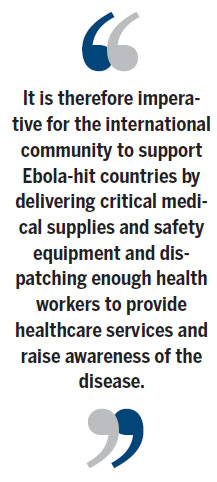
It is therefore imperative for the international community to support Ebola-hit countries by delivering critical medical supplies and safety equipment and dispatching enough health workers to provide healthcare services and raise awareness of the disease. China has responded to the World Health Organization's call for international aid with impressive generosity. It has sent nearly 200 medical experts and pledged an aid package of nearly $50 million.
With adequate emergency aid, the ability of Western Africa countries to fight Ebola can be strengthened, which could lead to the effective containment of the virus in the coming months. But foreign aid is unlikely to provide a viable and sustainable solution to future disease outbreaks. The requisite institutions, skills and capabilities fundamental to effective health governance take time to develop, and have to be developed independently and domestically.
In order to avoid another Ebola-type crisis in the future, countries in the region should start planning for investment in their national health systems, particularly their disease surveillance and response. China's experience in the post-SARS era has proven that this is the first step in the right direction.
The author is senior fellow for global health at the Council on Foreign Relations and an associate professor at Seton Hall University's School of Diplomacy. He is also the founding editor of Global Health Governance. China&US Focus.
(China Daily Africa Weekly 10/24/2014 page8)

Copyright 1995 - . All rights reserved. The content (including but not limited to text, photo, multimedia information, etc) published in this site belongs to China Daily Information Co (CDIC). Without written authorization from CDIC, such content shall not be republished or used in any form. Note: Browsers with 1024*768 or higher resolution are suggested for this site.
License for publishing multimedia online 0108263 Registration Number: 130349