 |
|
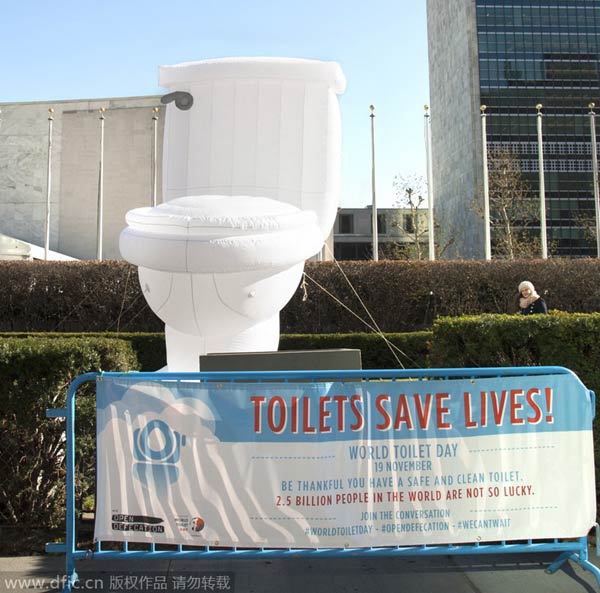
A 15-foor-high inflatable toilet stands in front of United Nations headquarters, Nov 19, 2014. [Photo/IC] |
UNITED NATIONS -- Slow progress on sanitation and the entrenched practice of open defecation among millions around the world continue to put children and their communities at risk, the United Nations Children's Fund (UNICEF) warned on Wednesday while celebrating World Toilet Day.
Some 2.5 billion people worldwide do not have adequate toilets and among them 1 billion defecate in the open -- in fields, bushes, or bodies of water -- putting them, and especially children, in danger of deadly faecal-oral diseases like diarrhea, the UN agency said.
In 2013 more than 340,000 children under five died from diarrhoeal diseases due to lack of safe water, sanitation and basic hygiene, an average of almost 1,000 deaths per day.
World Toilet Day is a day to take action. It is also a day to raise awareness about all people who do not have access to a toilet -- despite the human right to water and sanitation.
The United Nations General Assembly in 2013 designated Nov. 19 as World Toilet Day. This day had previously been marked by international and civil society organizations all over the world but was not formally recognized as an official UN day until 2013.
"Lack of sanitation is a reliable marker of how the poorest in a country are faring," said Sanjay Wijesekera, head of UNICEF's global water, sanitation and hygiene (WASH) programs. "But although it is the poor who overwhelmingly do not have toilets, everyone suffers from the contaminating effects of open defecation, so everyone should have a sense of urgency about addressing this problem."
The call to end the practice of open defecation is being made with growing insistence as the links with childhood stunting become clearer. India, with 597 million (half the population) practicing open defecation, also has high levels of stunting.
Last week, UNICEF convened a conference in New Delhi, the Indian capital, to call attention to the effect of open defecation on the entire population, particularly children. UNICEF's "Take Poo to the Loo" campaign in India also works to raise awareness of the dangers associated with open defecation.
"The challenge of open defecation is one of both equity and dignity, and very often of safety as well, particularly for women and girls," Wijesekera noted. "They have to wait until dark to relieve themselves, putting them in danger of attack, and worse, as we have seen recently."
In May, the hanging of two teenage girls in Uttar Pradesh who had gone out after dark to defecate caused international shock and dismay, and highlighted the security issues involved in open defecation.
UNICEF's Community Approaches to Total Sanitation addresses the problem at the local level by involving communities in devising solutions, and has led to some 26 million people across more than 50 countries abandoning the practice of open defecation since 2008.
Eighty-two percent of the 1 billion people practicing open defecation live in just 10 countries: India, Indonesia, Pakistan, Nigeria, Ethiopia, Sudan, Niger, Nepal, China, and Mozambique.
The numbers of people practicing open defecation are still rising in 26 countries in sub-Saharan Africa, though they have declined in Asia, Latin America and the Caribbean. In Nigeria, numbers of open defecators increased from 23 million in 1990 to 39 million in 2012.
Globally, some 1.9 billion people have gained access to improved sanitation since 1990. However, progress has not kept up with population growth and the Millennium Development Goals (MDGs) target on sanitation is unlikely to be reached by 2015 at current rates of progress.
MDGs are a set of eight anti-poverty targets to be reached by 2015.
The inter-governmental Open Working Group on the post-2015 Sustainable Development Goals have recommended that the new goals include a target of achieving adequate and equitable sanitation and hygiene for all and ending open defecation by 2030.

Copyright 1995 - . All rights reserved. The content (including but not limited to text, photo, multimedia information, etc) published in this site belongs to China Daily Information Co (CDIC). Without written authorization from CDIC, such content shall not be republished or used in any form. Note: Browsers with 1024*768 or higher resolution are suggested for this site.
License for publishing multimedia online 0108263 Registration Number: 130349