Focus shifts from curbing debt to reviving growth as parliamentary election nears
Japanese Prime Minister Shinzo Abe is signaling that retooling Japan's economy with painful structural reforms must take a back seat to reviving growth, even though he is poised to win a big referendum on his economic policies in an election on Sunday.
 |
|
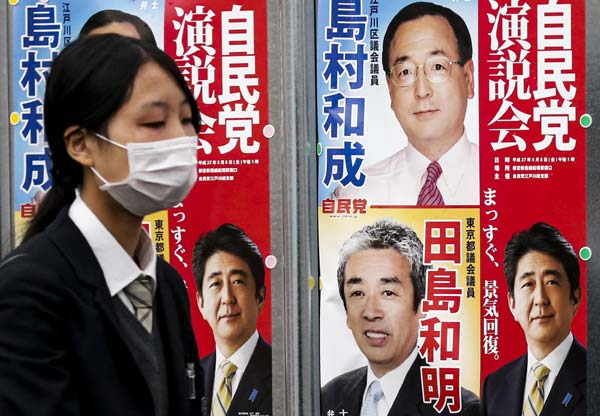
A woman walks past election posters for Japan's upcoming snap election in Tokyo, December 11, 2014. Pictured bottom left and bottom right is Japan's Prime Minister and leader of the ruling Liberal Democratic Party (LDP) Shinzo Abe. [Photo/Agencies] |
In the three weeks since he delayed a sales tax increase and called the election, Abe has shifted the debate from curbing the government's runaway debt to finding ways to stimulate the economy and put more money in voters' hands.
For example, policymakers say they are considering shopping vouchers for lower-income earners that would cover a portion of the cost of goods and services.
Such handouts would resemble vouchers and tax breaks used during the global financial crisis that boosted sales of energy-efficient cars, appliances and housing, officials said. Those measures had a multiplier effect on spending, but were followed by a pullback when the giveaways expired.
Maintaining government spending and massive yen-printing by the Bank of Japan while putting off thorny economic reforms could mean Japan is left with an ever-growing debt pile and little improvement in the economy's long-term growth potential.
Some investors are betting that a seemingly endless postponement of reform could be calamitous, with a collapse in the yen and uncontrolled inflation.
Abe's coalition is on course to keep or even expand its two-thirds majority in the lower house of parliament, opinion polls show. And while many investors hope he will use his mandate to press ahead with reforms ranging from easing labor market restrictions to cutting agricultural protection, the government is instead looking at ways to get people to spend.
This suggests Abe may concentrate on the first two "arrows" in his policy quiver, stimulus spending and printing more money, with little enthusiasm for the third arrow of deregulation and reform.
A resounding election victory and the prospect of a long term in office would eventually make vested interests more prone to compromise on reform, said Eurasia Group analysts Scott Seaman and Ross Schaap.
"That said, we still do not expect Abe to force rapid, near-term progress on structural reform," they said in a report.
On the campaign trail, Abe says he remains committed to all three arrows. But while the summary of his party's platform emphasizes economic recovery, promises fiscal reform and even prominently cites tourism promotion, there is no mention of structural reforms.
Bleak data
To be sure, the Finance Ministry strongly opposes easing its grip on spending. A promised supplementary budget is shaping up to be small at 2 to 3 trillion yen ($17-$25 billion), an amount the ministry can scrape together with unspent funds and money sitting in various budget accounts.
And Abe insists he remains committed to balancing the budget, excluding debt service and income from debt sales, by the fiscal year to March 2021. His party promises to outline by next summer how it will hit that goal, which economists said was ambitious even before the tax-hike delay.
Japan's public debt is about $8 trillion, the worst in the industrial world at well over twice GDP.
But with the economic news unrelentingly bleak even after two quarters of unexpectedly deep contraction, and with regional and upper house elections looming in the next two years, pressure may build for a return to hefty fiscal stimulus.
In November, Abe postponed by 18 months until April 2017 a rise in sales tax to 10 percent after his April hike to 8 percent from 5 percent knocked Japan into its worst contraction since the global financial crisis in the second quarter. There was another drop in the subsequent three months.
The data since then have remained weak: falling machinery orders and inflation expectations, depressed sentiment in a government "economy watchers" survey and feeble capital-spending plans.
Monday's Bank of Japan Tankan survey, a key economic indicator, will show business confidence remains fragile, a Reuters poll of corporate managers suggests.
After Abe delayed the tax hike, Moody's Investors Service downgraded Japan's debt by a notch and Fitch Ratings warned it may cut the sovereign rating, lowering the outlook to negative from neutral.

Copyright 1995 - . All rights reserved. The content (including but not limited to text, photo, multimedia information, etc) published in this site belongs to China Daily Information Co (CDIC). Without written authorization from CDIC, such content shall not be republished or used in any form. Note: Browsers with 1024*768 or higher resolution are suggested for this site.
License for publishing multimedia online 0108263 Registration Number: 130349