Shoemaker left its sole in Lagos
Updated: 2014-02-28 10:24
By Yu Ran (China Daily Africa)
Comments Print Mail Large Medium Small
|
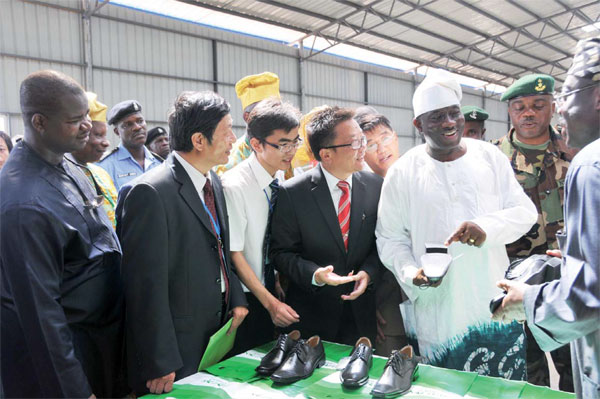
Wang Jianping (center, with red tie), chairman of Hazan Shoe Co, with Nigerian president Goodluck Jonathan (in white) and other officials, visits the company's shoe factory in Lagos in 2010. Provided to China Daily |
Since Wang Jianping decided to go into the world, things have never looked better
It may turn out to be one of the most inspired decisions Wang Jianping has ever made. Going to Nigeria 10 years ago has helped him turn what was once a modestly-sized shoemaker in Wenzhou, Zhejiang province, into a manufacturing phenomenon that has left its footprint all over Africa.
Soon after Wang's Hazan Shoe Co Ltd was founded in 1991 it employed about a dozen people in its small factory, and they made 300 pairs of shoes a day. These days, in addition to its factory and offices in Wenzhou that cover 116,000 square meters, it has four production lines in Lagos employing 1,000 people, and they make 11,000 shoes a day. It also has a research center in Italy, set up after Hazan bought the Italian shoemaker Wilson in 2004.
But it was going to Africa that radically changed Hazan, which is exactly what Wang had in mind when he planned the move.
"For the first three years we were an original equipment manufacturer for international brands, and as a first step of getting Hazan out of China I decided to take it to Africa," he says.
"Materials and labor are a lot cheaper in Africa than in China, which is why I switched the main factory from Wenzhou to Nigeria, where there is also more demand."
Hazan has now become one of the most popular shoes for males in West Africa. Its sales across the continent brought in revenue of $36 million last year, it says. However, it is not as though the company's African odyssey has been a cakewalk.
In January 2004, Hazan was dealt a severe blow when the Nigerian government decided to ban imports of more than 30 products, including shoes. Instead of meekly accepting it as fate, Wang drummed up support among 20 shoe companies in the country to make common cause to get the shoes ban lifted.
"We solved the crisis after long talks with the government, and I realized the only way of staying in Africa was to localize," Wang says.
Within nine months he had set up Hazan Asia Pacific Industrial Co Ltd in Nigeria to make shoes tailored to the local market.
Unlike other Chinese manufacturers who have opened factories overseas and kept their main factories in China, Wang moved Hazan's focus of operations to Nigeria because of the lower costs and a more promising market, spending more than $6 million to launch a second production line at the factory in 2005.
A year after the factory opened, Hazan advertised 300 vacancies for people who would be given professional training, and it brought more advanced plant and machinery from China to Africa.
"Life was incredibly tough when I first went to Nigeria," says Jia Yifeng, operations director of Hazan Asia Pacific Industrial Co Ltd in Nigeria, Africa.
"Staff lived in an old apartment block not far from the factory and there was nowhere where you could spend your free time."
Jia says that after he had lived in Lagos for three years, he had many close connections there, and it had become a second hometown for him.
Wang says: "After talks with Nigerian companies we also increased our level of local content from 3 percent to 20 percent."
That content goes into shoes targeted at different social classes, a brand called Blue for the lower paid and one called Cherry for the better off.
"That may be one of the advantages we have over other Chinese companies," Wang says.
One of the other Chinese shoemakers in Africa is Huajian Group of Dongguan, Guangdong province, which has operations in the Oromia region of Ethiopia.
Like many other Chinese shoe companies including Hazan which have been extremely fleet of foot in looking for expansion opportunities, Huajian went to Africa in 2012 mainly because of the cheaper labor.
In 2012, trade between China and Africa was worth more than $20 billion, 20 times what it was in 2000, but manufacturing in Africa still needs to be improved, and Chinese companies can help with that endeavor, Wang says.
Africa offers the companies huge potential to expand their markets over the coming decade, he says.
The tough financial environment in the United States and Europe and rising labor costs in China have made the need to harness that potential all the more pressing, he says.
"For shoe companies, going out of the country with their own brands is the only way to survive the US and European slump."
As such companies look for the right path to follow, they could do a lot worse than using as a role model Hazan, which has spent 20 years transforming itself from a local manufacturer to a global company.
"I've noticed that more shoe trading companies and factories that have focused on manufacturing products for other brands have collapsed under financial pressure, which bodes ill for the whole industry," Wang says
Of course, small and medium-sized companies that create brands and take them overseas run risks, but success will deliver them greater opportunities for higher profits, he says.
Having become a localized brand, Hazan has encouraged other businesses from China to work with it in Africa.
In October 2009, several years after a Nigerian government initiative almost killed Hazan's dreams, the company signed an agreement with it that holds the promise of even more prosperous times.
The Zhejiang-Hazan economic zone signals another transformation of Hazan, this time from a shoemaker to a business operating in many different industries. The first and second phases of the project, occupying 116 hectares, are now being built, and they will be open to businesses from Zhejiang wanting to carry out tax-free trading with Nigerian and other African businesses.
Hazan hopes its revenue from the zone will be 15 billion yuan ($2.45 billion) before the end of next year.
"The decision to move Hazan from China to Africa was a wise one," Wang says. "I still believe Africa offers more opportunities for labor-intensive enterprises to have more skilled employees trained and make more high-quality products."
yuran@chinadaily.com.cn