Institute fosters exchanges and dialogue between the two countries
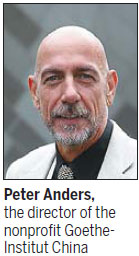
Comments Print Mail Large Medium SmallPeter Anders, the director of the nonprofit Goethe-Institut China, said the cultural difference between China and Germany lies in how they perceive the concept "more".
"Chinese people are driven by a strong will to make the world better through a concept of 'more of ...' while we (German people) are skeptical about an ongoing progress," wrote Anders in an e-mail to China Daily during a business trip in Europe.
"Innovation for Germans means a better life that is not just 'more of ...' but includes health, common sense and tolerance."
Anders, who joined the German cultural institute in 1990, added: "There is an ongoing interest in searching for alternative solutions for the problems that concern German people the most: climate protection, demographic change and urban transformation."
The events and activities organized over the past several years by Goethe-Institut China reflect these concerns.
Last year, for example, the institute funded the translation of a German book about climate change in China. Last August, when the Chinese version of the book was published, the institute gathered a group of Chinese and German experts in Beijing to discuss climate change and social reality.
In an event about the transformation of social space, also organized by the institute in Beijing in March, a group of architects, philosophers and social critics were invited to discuss the transformation of social space in Beijing and its impact on people.
"These are cultural phenomena that must be discussed in a visionary way to get solved," Anders said.
Founded in Beijing in 1988, Goethe-Institut China is part of Germany's global cultural organization Goethe-Institut. It offers language classes, training for teachers, library resources and information services about Germany, and cultural programs in China.
German language training courses, one of the institute's primary programs, received almost 2,500 students in 2013.
Apart from language training and events that are closely tied to society, Goethe-Institut China also offers a wide range of cultural events and programs that showcase German and Chinese elements to the public, such as plays, literature, music, dance and film.
In 2013, the institute held 155 cultural events on the Chinese mainland that had almost 200,000 participants.
The co-production of a play called Totally Happy, which premiered in Munich recently, is one prime example of cultural cooperation between China and Germany, he said.
The play, created by Chinese and German performers under the guidance of Chinese director Tian Gebing, was "an amazing example of cultural exchange", Anders said.
Anders said that they are now preparing for a German film festival in November. The success of these encounters will deepen cultural exchanges and help improve understanding, he said.
Looking ahead, Anders said the institute wants to make people curious about each other's views.
"We will facilitate innovative projects that are dedicated to bringing more global knowledge into our world," he said.
zhaoxinying@chinadaily.com.cn
Background