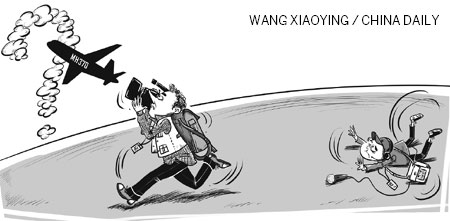
A message board on a Chinese website reads: "To our domestic media: can you do anything other than lighting candles?" Such complaints are all over Chinese websites because the Western media have been providing most of the key information on the missing Flight MH370, with the Chinese media playing second fiddle.
The complaints are not groundless. The case of the Malaysia Airlines Flight 370, missing since the early hours of March 8, is just one example of how deficient the Chinese media are. Chinese media outlets seem to lag behind their Western counterparts, especially when it comes to timely coverage of big global events.
There are obvious reasons for the huge gap between the Chinese and top global media outlets. The New York Times website proudly says "founded in 1851". In contrast, the majority of China's mainstream media outlets were born in the 1980s.
It is hard to imagine Chinese media outlets, which are still in their 30s, challenging their US counterparts that have accumulated resources and know-how. Media outlets today need to mobilize enormous resources-communications and security networks, and business connections-to get the latest information on incidents like the disappearance of MH370. American media outlets can get information from US satellites, companies like Boeing, and even US overseas military bases, something that Chinese media outlets cannot.
But being relatively young is not the only reason why the Chinese media are lagging behind their Western counterparts. History tells us that the founding of almost every Western media giant was accompanied by a transformation in the world of communications-The NYT was founded in 1851, The Washington Post in 1877 and The Wall Street Journal in 1889, the so-called golden age of newspapers. And CNN was founded in 1980 when TV emerged as the new mass media.
These newspapers and news channels were founded at the "right time", and, after decades of fierce competition, have established a virtuous circle. Thanks to their high quality reports, they have become highly influential, increased their market shares and raised their profit margins, establishing the standard mode of survival as well as excellence.
In comparison, the Chinese media encountered the information age during their growth period, facing traditional competition as well as the challenge posed by the emerging new media.
The pressure of new media on traditional media cannot be ignored. On Aug 5, 2013, The Washington Post, along with some other assets, was sold for $250 million. Before that its circulation had dropped to 470,000, about half of the peak in 1993, and its revenue had fallen by 44 percent in six years. That was after The New York Times group sold its influential newspaper The Boston Globe. When even such media giants cannot sustain the shock of new and social media and the changing times, it is understandable why the Chinese media are finding it difficult to cope with the challenges.
Besides, the successful business mode followed by media giants has several prerequisites. Turning excellent journalism into wider readership and thus larger circulation and more profit is not easy in China, because society does not follow journalistic and business ethics. For example, when Gu Junshan, a senior military official, was found to have been involved in corruption in January, caixin.com published a news feature titled, "The mansion of General Gu Junshan", which narrated an excellent story about how he became corrupt. The report won widespread praise but hardly increased the hits on the website. The reason: it was almost immediately reprinted or relinked by several other media outlets, some of them didn't credit either caixin.com or the reporter for the excellent piece of journalism.
After condemning the media outlets but without being able to do anything, caixin.com complained on its official micro blog: "... society needs high-quality reports but gets it almost for free ... the traditional business mode is failing." The reporter, Wang Heyan, even said, "piracy is a sustainable business while creation is not".
The habit of "paying for what you read" is not yet part of the Chinese psyche. According to the ninth reading habits survey of Chinese nationals, released in March last year, only 41.8 percent of the people reading digital contents said they would pay for them. The figure is not only lower than that in most Western countries, but also lower than that in China in 2010. The average acceptable price for a book for them is only 3.5 yuan ($0.56), not enough to buy even a 1.5 liter bottle of water.
That's why Chinese media outlets face a dilemma: if they insist on providing only quality reports, they cannot possibly survive. There is no dearth of good journalists in China, as was seen in Gu's case. The problem is in making good journalism a rewarding experience.
There is hope, though. With the likely improvement in overall business rules, including strengthening of IPR protection, this year, the Chinese media will find more support and returns for their efforts. Perhaps that will help them gain global influence.
The author is a writer with China Daily. zhangzhouxiang@chinadaily.com.cn.
(China Daily 03/20/2014 page9)

Copyright 1995 - . All rights reserved. The content (including but not limited to text, photo, multimedia information, etc) published in this site belongs to China Daily Information Co (CDIC). Without written authorization from CDIC, such content shall not be republished or used in any form. Note: Browsers with 1024*768 or higher resolution are suggested for this site.
License for publishing multimedia online 0108263 Registration Number: 130349