|
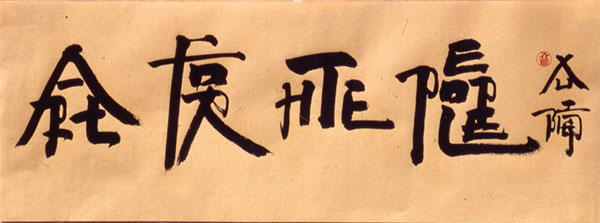
Read between the lines, Xu Bing's Square Word Calligraphy uses English letters (spelling out "Art for the people") to construct Chinese-looking characters. Courtesy of the Frost Museum. |
Confucius once said: "Writing cannot express all words, words cannot encompass all ideas." 
A new exhibit of works by renowned Chinese artist Xu Bing pushes the envelope of that adage - and turns it on its head.
Opening next weekend at the Frost Art Museum at Florida International University (FIU) in Miami, a show called Writing between Heaven and Earth encompasses 5,000-square-feet worth of the artist's iconic installations, as well as newer works created just for the show.
Xu is known internationally for his large-scale installations about language and text that playfully recreate the written word and invite viewers to take another look at their cultural identity and their language.
At the heart of his work is the preservation of Chinese culture and tradition. "My aim," Xu has been quoted as saying, "is to make an art that truly serves the people."
The focal point of the exhibit is the complete Book from the Sky, a massive piece that features more than 4,000 illegible, meaningless Chinese-looking characters invented by the artist, meticulously hand-carved (the work was four years in the making) and more than 160 hand-made, woodblock printed volumes, huge scrolls hanging from the ceiling and wall panels resembling propaganda posters.
The work was created between 1987 and 1991 and there are only a few museums in the world with enough space to display it.
Xu's relationship with his motherland has been something of a rollercoaster ride. Born in Chongqing in 1955, he moved to Beijing with his parents at the age of two. Relocated to the mountainous regions of northern China to perform farm labor in the mid-'70s, he began sketching and organizing arts groups.
In 1977 he enrolled in the Central Academy of Fine Arts in Beijing and studied printmaking, eventually teaching there. His first big solo show came in 1988 at the China National Museum of Fine Arts and drew international attention, but its subject matter - how the written word can be turned into propaganda and rendered meaningless - was deemed too controversial and Xu moved to the US in 1990.
His works continued to be shown and commissioned worldwide and in 1999 he was awarded a MacArthur genius award, and numerous other honors followed. In 2007 he returned to China in his current capacity as vice-president of Beijing's prestigious Central Academy of Fine Arts. He divides his time between New York and Beijing.
On Jan 21, Xu Bing was one of seven international artists awarded the US Department of State-Medal of Art by Secretary of State John Kerry during a ceremony at the State Department in Washington.
"My viewpoint is that wherever you live, you will face that place's problems," Xu wrote in a letter to a young artist in 2006. "If you have problems then you have art. Your plight and your problems are actually the source of your artistic creation."
The show opening at the Frost Museum on Feb 21 is curated by Lidu Yi, a professor and Chinese art historian at FIU and a long-time friend of the artist.
"Xu Bing is a genius," said Yi. "He looks very eccentric. He constantly thinks about art. That's all he thinks about."
Xu Bing has created his own visual language, she explained. "Nobody can read his Book from the Sky because he invented the 4,000 characters, which look very much like classic Chinese characters and yet they're not," she said. The symbols intentionally have no meaning, not even to the artist himself.
"The book pushes you to rethink your cultural identity, it forces you to participate, to be involved in the artwork," she said. "The book does not communicate with you because you do not understand any single word of it and yet it forces you to communicate with it by not communicating with you."
The work is meaningful, she said, because it makes everyone in the world equal before it, because no one understands the words, "so we are the same in many ways, just as we are the same in front of this artwork".
One of the smaller pieces is called Square Word Calligraphy and is part of a classroom setting with desks and chairs that invites the audience to take up a brush and follow calligraphy instructions on the wall and a video of the artist teaching how to draw characters that he has, again, invented using Western letters in traditional Chinese formations. It spells out: "Art for the people."
"It looks like Chinese but it's English," she said, adding that like Book from the Sky, it challenges the audience to rethink their preconceptions about cultural identity.
Yi, who is a Buddhist, said all of the pieces she picked have a Zen quality to them. "It gives you a good sense of tranquility, serenity," she said.
Contact the writer at chrisdavis@chinadailyusa.com.
Copyright 1995 - . All rights reserved. The content (including but not limited to text, photo, multimedia information, etc) published in this site belongs to China Daily Information Co (CDIC). Without written authorization from CDIC, such content shall not be republished or used in any form. Note: Browsers with 1024*768 or higher resolution are suggested for this site.
License for publishing multimedia online 0108263 Registration Number: 130349