 |
|
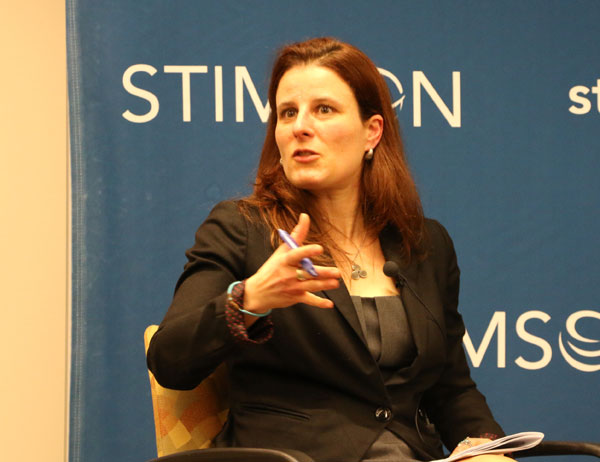
Aude Fleurant, director of the new Arms and Military Expenditure program of the Stockholm International Peace Research Institute (SIPRI), talks about the global arms trade in the Stimson Center in Washington on Monday, the day SIPRI released its latest annual report on global arms trade. Chen Weihua/China Daily. |
The volume of US exports of major weapons jumped by 23 percent between 2005-2009 and 2010-2014, to account for 31 percent of global exports.
Russia's exports of major weapons grew by 37 percent during the period to make up 27 percent of total exports.
China, which saw its exports skyrocket 143 percent during the period, narrowly surpassed Germany to be the world's third-largest major weapons exporter.
But China's share of 5 percent of global major weapons exports is far lower than that of the US and Russia.
"The US has long seen arms exports as a major foreign policy and security tool, but in recent years, exports are increasingly needed to help the US arms industry maintain production levels at a time of decreasing US military expenditure," said Aude Fleurant, director of the SIPRI Arms and Military Expenditure Program.
Some of the US major arms exported to Iraq were believed to have fallen into the hands of ISIS.
A document distributed on Monday at the SIPRI data announcement talk in the Stimson Center in Washington quoted William Hartung, director of the Arms and Security Project at the Center for International Policy, as saying that the need for closer monitoring and control of US arms transfers to the Middle East and North Africa is underscored by recent cases such as the use of US-supplied weaponry to put down the democracy movement in Bahrain and the surrender of large quantities of US-supplied weaponry to ISIS by US-trained Iraqi security forces.
The SIPRI data, which reflects the volume of the deliveries of major weapons rather than the financial value, will include more detailed analysis this summer, according to Fleurant.
The data released on Monday showed that five of the top 10 importers of major weapons during 2010-2014 are in Asia, in the order of India (15 percent of global arms imports), China (5 percent), Pakistan (4 percent), South Korea (3 percent) and Singapore (3 percent).
While India imported three times as much as China, China has seen its arms imports decline by 42 percent between 2005-2009 and 2010-2014. China, a top arms importer during 2005-2009, has dropped to third place, behind India and Saudi Arabia.
"Following rapid advances in its arms industry, China has become less dependent on arms imports," according to Pieter Wezeman and Siemon Wezeman, senior researchers with the SIPRI Arms and Military Expenditure Program and co-authors of Monday's report on trends in international arms transfers.
"Enabled by continued economic growth and driven by high threat perceptions, Asian countries continue to expand their military capabilities with an emphasis on maritime assets," said Siemon Wezeman.
"Asian countries generally still depend on imports of major weapons, which have strongly increased and will remain high in the near future," he said.
Rachel Stohl, senior associate with Stimson Center's Managing Across Boundaries Initiative, said on Monday that the US wanted to strengthen its allies in the region and also to share the burden and responsibility. She believes that both economic and foreign policy reasons are behind the exports.
Jeff Abramson of the Forum on the Arms Trade, a network of civil society experts, said that he was not sure if this should be seen as part of the US rebalance strategy to counter the rise of China.
While US exports of major weapons went to more than 94 countries and regions in 2010-2014, with Asia and Oceania as the largest recipient, China's exports mainly went to Pakistan, Bangladesh and Myanmar, which together absorbed 69 percent of Chinese exports.
Because the US imposes an arms embargo on China and has been pressuring its European Union allies to follow it, Russia supplied 61 percent of Chinese arms imports, followed by France with 16 percent and Ukraine with 13 percent.
Fleurant indicated that when she worked in France years ago, France's internal view was to open the market to China; many of the exports to China are now in the dual-use category.
She said that predicting what's going to happen in the market is risky because major deals, for example, could immediately raise the ranking for the United Kingdom.
chenweihua@chinadailyusa.com
Copyright 1995 - . All rights reserved. The content (including but not limited to text, photo, multimedia information, etc) published in this site belongs to China Daily Information Co (CDIC). Without written authorization from CDIC, such content shall not be republished or used in any form. Note: Browsers with 1024*768 or higher resolution are suggested for this site.
License for publishing multimedia online 0108263 Registration Number: 130349